TLDR
- Poisonous animals hurt you when you touch or eat them. Venomous animals inject toxin with a bite or sting. Most “poisonous animal” lists mix the two up.
- The deadliest to people on this list: the golden poison frog (touch), the king cobra, bushmaster and Gaboon viper (bites), and the Brazilian wandering spider (bites).
- The ones you’re most likely to meet in a temperate forest, the adder, copperhead, timber rattlesnake, fire salamander and rough-skinned newt, almost never kill a healthy adult.
- Nearly every bite or poisoning happens because someone grabbed, stepped on, or cornered the animal.
Contents
- Poisonous vs venomous: the difference
- Rainforest animals
- Temperate forest animals
- Tropical Asian and island forest animals
- Comparison table
- Staying safe on the trail
Poisonous vs venomous: the difference
Poisonous animals are toxic to touch or eat. The toxin sits in the skin or tissue, and you only get hurt if you handle the animal or swallow part of it. The same split applies outside the vertebrates, from jellyfish to cone snails; see the field guide to poisonous invertebrates for more. Venomous animals have a delivery system: fangs, stingers, or spurs that inject toxin on purpose.
The rule of thumb: if it bites you and you get sick, it’s venomous. If you bite it and you get sick, it’s poisonous. A few animals break the rule. The slow loris on this list does both, and the hooded pitohui is poisonous in a way that makes it hard to classify as anything else.
Most poisonous forest animals show off. Bright colors usually mean “don’t.” Most venomous snakes do the opposite and rely on camouflage, which is why they get stepped on.
Rainforest animals
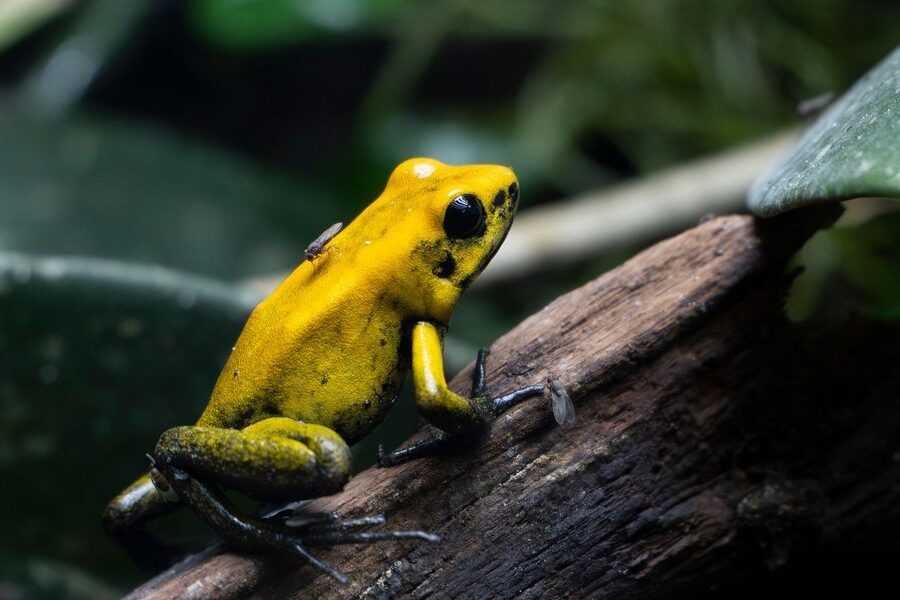
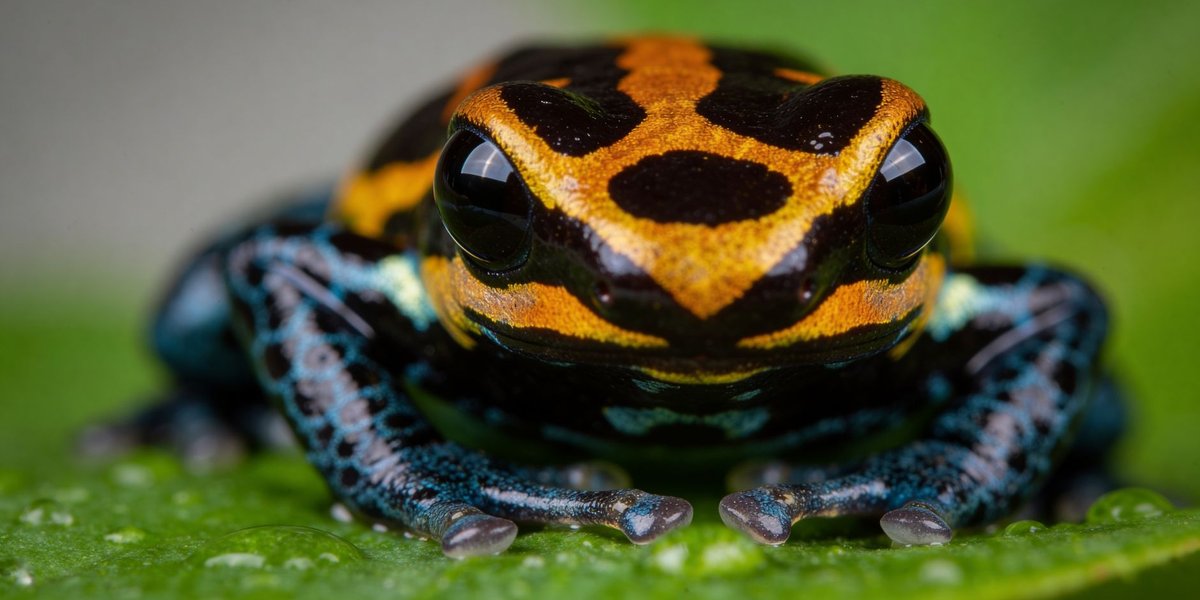
1. Golden poison frog (Phyllobates terribilis)
The most toxic of the poison dart frogs lives in a tiny strip of Pacific coastal rainforest in Colombia. It’s about the size of a paperclip, and its skin carries enough batrachotoxin to kill several adults. National Geographic notes that wild frogs get their toxins from the insects they eat, which is why captive-bred frogs are nearly harmless.
- Type: poisonous (skin)
- Danger to humans: high if handled or if the toxin reaches a cut. Batrachotoxin locks sodium channels open in nerves and muscles, including the heart. Indigenous Emberá hunters have long rubbed darts on these frogs.
2. Bushmaster (Lachesis muta)
The longest viper in the Americas can pass 2.5 meters and lives on the floor of Central and South American rainforest. It’s rarely seen because it’s nocturnal and spends days still in leaf litter, which is exactly why a bite usually happens at close range.
- Type: venomous (long fangs, large venom yield)
- Danger to humans: very high. Bites cause severe tissue damage, bleeding problems and shock. Encounters are rare, but untreated bites are often fatal.
3. Gaboon viper (Bitis gabonica)
Gaboon vipers have the longest fangs of any snake, up to about 5 cm, and a head as wide as a man’s palm. They sit in the leaf litter of African rainforests and woodlands, perfectly disguised as a pile of dead leaves.
They’re famously calm. They rarely bite unless stepped on or grabbed, but when they do, the venom yield is huge.
- Type: venomous
- Danger to humans: high. Bites cause swelling, bleeding and shock. Medical care is the difference between recovery and death.
4. Brazilian wandering spider (Phoneutria spp.)
These large spiders don’t build webs. They roam the forest floor at night and hide in banana bunches, boots and woodpiles by day, which is how they end up in houses. Guinness World Records lists them as the most venomous spider. That’s about venom potency, not how often they kill: modern antivenom means deaths are rare.
- Type: venomous
- Danger to humans: moderate to high. Bites cause intense pain, sweating and, in some men, prolonged painful erection. Children and the elderly are most at risk.
Temperate forest animals
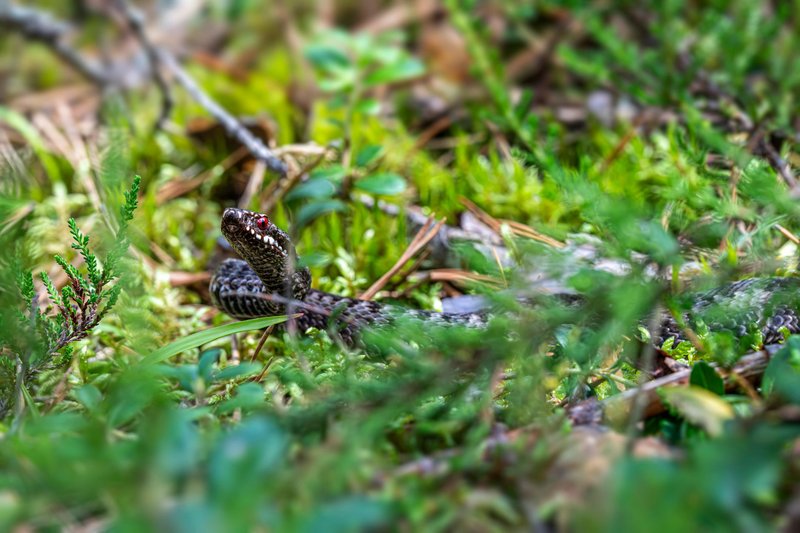
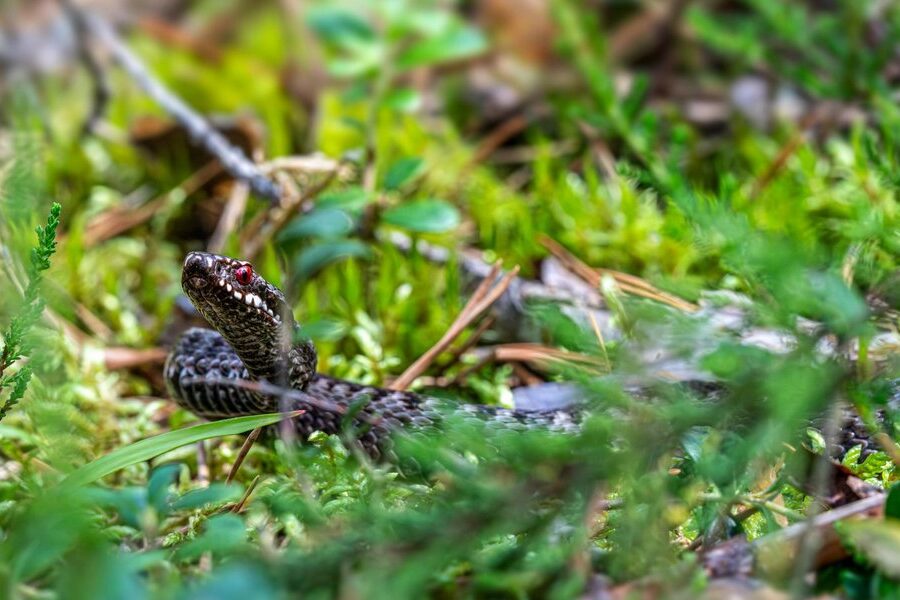
5. Adder (Vipera berus)
The adder ranges across Europe and into northern Asia, and it’s the only venomous snake native to Britain. You’ll find it in woodland edges, heaths and clearings, basking on warm mornings. It has a dark zigzag along its back and bites only when it can’t leave.
- Type: venomous
- Danger to humans: low to moderate. Bites hurt and swell badly, but deaths are very rare. Dogs are bitten far more often than people.
6. Copperhead (Agkistrodon contortrix)
Copperheads live in the deciduous forests of the eastern United States, and their coppery, hourglass-banded pattern vanishes on fallen leaves. They account for more bites in the US than any other venomous snake, mostly because they sit still instead of fleeing.
- Type: venomous (hemotoxic)
- Danger to humans: low. Bites are painful and need treatment, but fatalities are extremely rare.
7. Timber rattlesnake (Crotalus horridus)
The timber rattlesnake is a larger, heavier snake of the eastern US hardwood forests and rocky ridges. It gives a warning with its rattle, but not always, and it’s shy and slow to strike unless cornered.
- Type: venomous
- Danger to humans: moderate to high. Bites need urgent hospital care, but deaths are rare with treatment.
8. Fire salamander (Salamandra salamandra)
Black with yellow patches, this salamander lives in damp beech and oak forests across Europe and comes out after rain. Glands behind its head and along its back ooze samandarin, a neurotoxin, and it can squirt it a short distance when threatened.
- Type: poisonous
- Danger to humans: low. The secretion irritates eyes and mucous membranes and can burn if it gets in a cut. It is much more dangerous to small pets that mouth it.
9. Rough-skinned newt (Taricha granulosa)
This dull brown newt lives in the Pacific Northwest, from Alaska down to California. It carries tetrodotoxin, the same toxin found in pufferfish, in its skin. When threatened, it arches its tail and shows its bright orange belly.
- Type: poisonous
- Danger to humans: low if you just touch one and wash your hands. Swallowing one can be fatal, and a few deaths have been recorded in people who swallowed one on a dare.
Tropical Asian and island forest animals
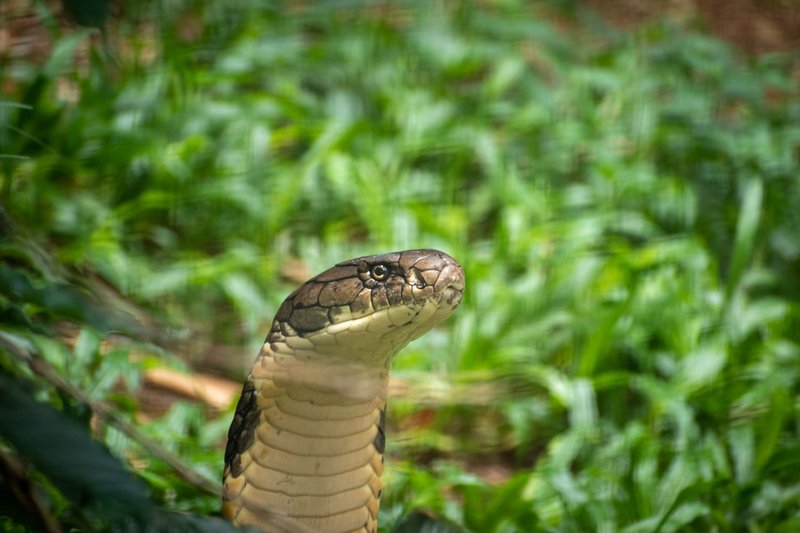
10. King cobra (Ophiophagus hannah)
The world’s longest venomous snake can reach 5.5 meters. It lives in the forests of India and Southeast Asia, eats mostly other snakes, and builds a nest for its eggs, which is unusual for any snake. It rears up, spreads a hood and hisses loud enough to hear from several meters away.
- Type: venomous (neurotoxic)
- Danger to humans: very high. A bite can cause paralysis and respiratory failure, but king cobras are shy and prefer retreating. The World Health Organization estimates that snakebite kills tens of thousands of people every year, mostly in rural parts of Asia and Africa, and most of those bites are from other species.
11. Hooded pitohui (Pitohui dichrous)
A songbird from the rainforests of New Guinea, orange and black, and one of the first known poisonous birds. Its skin and feathers contain homobatrachotoxin, the same family of toxin as in poison dart frogs, and it gets it by eating Choresine beetles. Local hunters call it the “rubbish bird” because it tastes awful and numbs the mouth and skin. For more poisonous animals from around the world, see The 12 Most Poisonous Animals on Earth.
- Type: poisonous (skin, feathers)
- Danger to humans: low. Handling one causes tingling and numbness, not death.
12. Slow loris (Nycticebus spp.)
The slow loris is the only venomous primate that scientists have studied, and the venom comes from a gland on its elbow. It licks the gland, mixes the secretion with saliva, and delivers it through a toothcomb bite. Several species live in the forests of Southeast Asia and are threatened by the illegal pet trade.
- Type: venomous (also considered toxic on the fur after grooming)
- Danger to humans: low to moderate. Bites are painful and can cause swelling or, rarely, anaphylactic shock. You’d have to try quite hard to get bitten by one in the wild.
Comparison table
| Animal | Toxin delivery | Region | Danger to humans |
|---|---|---|---|
| Golden poison frog | Poisonous (skin) | Colombia | High (if handled) |
| Bushmaster | Venomous (bite) | Central and South America | Very high |
| Gaboon viper | Venomous (bite) | Central and West Africa | High |
| Brazilian wandering spider | Venomous (bite) | South America | Moderate to high |
| Adder | Venomous (bite) | Europe, northern Asia | Low to moderate |
| Copperhead | Venomous (bite) | Eastern US | Low |
| Timber rattlesnake | Venomous (bite) | Eastern US | Moderate to high |
| Fire salamander | Poisonous (skin) | Europe | Low |
| Rough-skinned newt | Poisonous (skin) | Pacific Northwest | Low (high if swallowed) |
| King cobra | Venomous (bite) | India, Southeast Asia | Very high |
| Hooded pitohui | Poisonous (skin, feathers) | New Guinea | Low |
| Slow loris | Venomous (bite) | Southeast Asia | Low to moderate |
Staying safe on the trail
Most encounters follow the same pattern: someone steps without looking, reaches into a log, or picks up something small and colorful.
- Watch your hands and feet. Don’t reach under logs or rocks without looking, and wear closed boots and long trousers in snake country.
- Don’t touch amphibians. Bright frogs, newts and salamanders are best left alone. If you do handle one, wash your hands before eating or touching your face.
- Keep your distance. A snake that can see you usually leaves. Give it room and a path out, and never try to move it.
- Keep dogs close. Pets are bitten and poisoned more often than people, by snakes and by salamanders and newts they mouth.
- Know what to do after a bite. Call emergency services, keep the person calm and still, and keep the bitten limb at about heart level. Remove rings and tight clothing before swelling starts. The CDC’s NIOSH guidance also says not to cut the wound, suck out venom, apply ice, or use a tourniquet.
- Know the local species. Antivenom is specific to a region, so tell the doctor where it happened and what the animal looked like.
If a poisonous frog or newt gets into your eyes or mouth, rinse with plenty of clean water and call a poison center or a doctor.