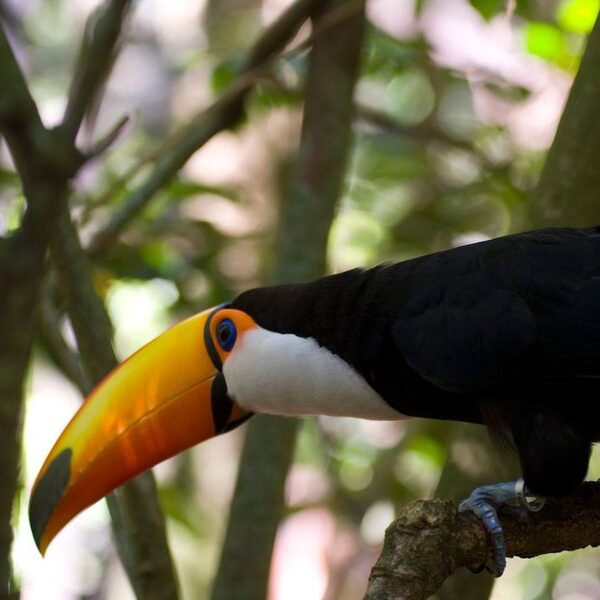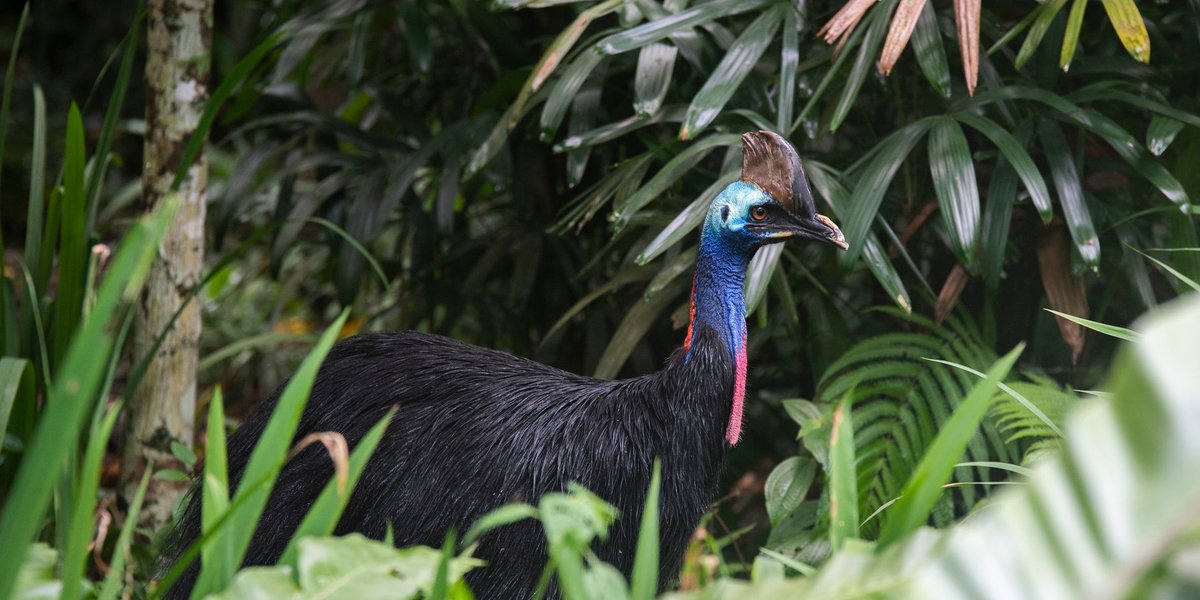
The Congo Basin holds more than 1,000 bird species, and the Democratic Republic of the Congo (DRC) has the most diverse bird assemblage of any country in Africa. Most of those birds never leave the forest, and a handful exist nowhere else. The Congo peafowl, for one, is found only in the DRC’s forests. This guide picks 12 of the Congo rainforest birds worth knowing and sorts them by where they live: canopy, mid-story, forest floor and riverbank.
Lists of “African rainforest birds” tend to blur the Congo Basin together with West Africa and the Albertine Rift. This one stays in the basin, with a short detour to its eastern mountain edge.
Table of contents
- Quick-ID table
- Why the Congo Basin holds so many birds
- Canopy birds
- Mid-story birds
- Forest-floor birds
- River and swamp birds
- Threats to Congo rainforest birds
- Where to see them
Quick-ID table
| Bird | Field mark | IUCN status |
|---|---|---|
| Great blue turaco | Blue-grey body, tall crest, yellow bill | Least Concern |
| African grey parrot | Grey body, scarlet tail | Endangered |
| African crowned eagle | Double crest, heavily barred legs | Near Threatened |
| Congo serpent eagle | Barred tail, spotted underparts, big dark eyes | Least Concern |
| African emerald cuckoo | Male glossy green above, yellow belly | Least Concern |
| Black bee-eater | All-black body, scarlet throat | Least Concern |
| Grauer’s broadbill | Tiny, bright green | Vulnerable |
| Congo peafowl | Male blue-green with a red throat | Endangered |
| Crested guineafowl | Spotted body, curly black crest | Least Concern |
| Pel’s fishing owl | Large, ginger, no ear tufts | Least Concern |
| African finfoot | Red bill, orange-red legs, swims half-submerged | Least Concern |
| Congo martin | Small brown swallow over big rivers | Least Concern |
Why the Congo Basin holds so many birds
The basin is the second-largest tropical rainforest on Earth, behind the Amazon, and WWF describes it as one of the most biodiverse regions on the continent. Birds sort themselves into layers, much as rainforest animals generally do. Fruit eaters live up in the canopy, insect hunters work the mid-story, ground foragers walk the leaf litter, and a separate set of specialists lives along the rivers. Nothing on this list is random: each bird fits a layer and a food source.
Canopy birds
1. Great blue turaco
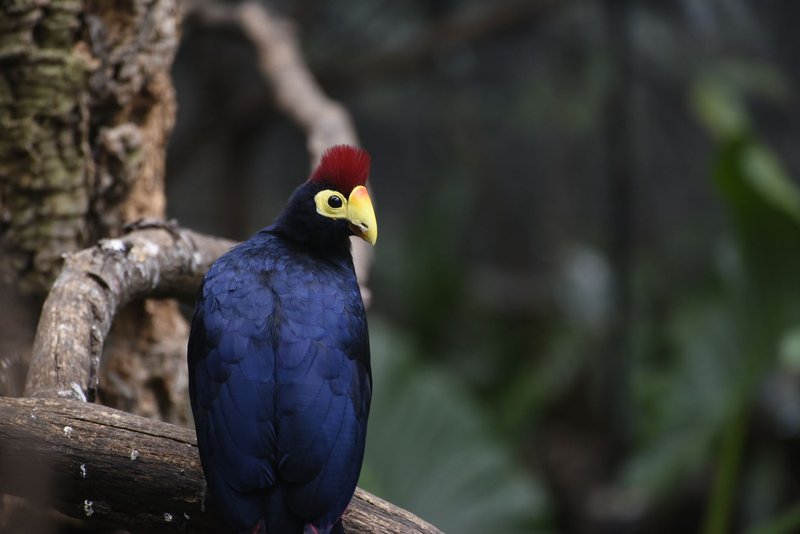
The great blue turaco is the largest of the turacos, about 70 cm long, with a blue-grey body, a rust-colored belly, a tall crest of stiff feathers and a yellow bill tipped in red. It lives in groups in the upper canopy and eats mostly figs and other fruit, plus some leaves and flowers.
You will hear it before you see it. The call is a loud, honking “kok-kok-kok” that carries a long way through the forest. It scrambles through branches more than it flies, and when it does fly, the flight is heavy and short.
Status: Least Concern. Fun fact: turacos get their red and green feather color from copper-based pigments, which are rare among birds.
2. African grey parrot
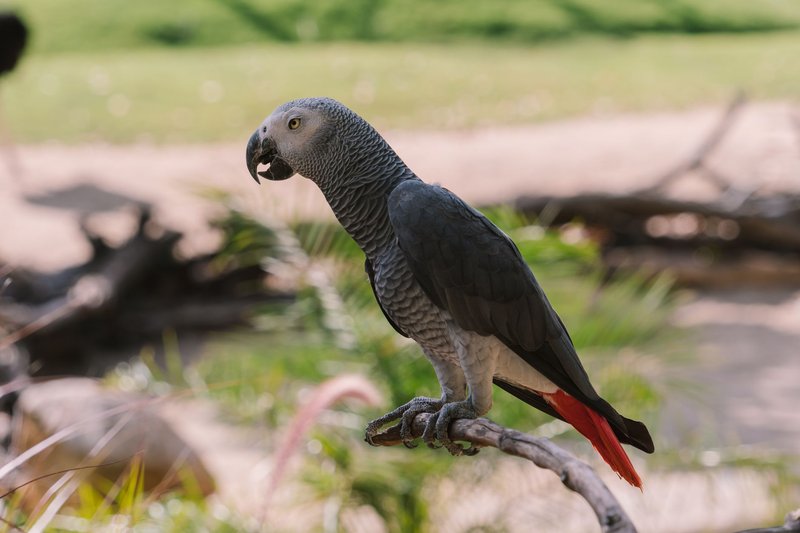
The African grey parrot is the Congo bird most people already know, mostly from living rooms. In the wild it is a pale grey parrot with a white face patch and a scarlet tail, traveling in noisy flocks that commute from roost trees to fruiting trees at dawn and dusk. It eats fruit, seeds and palm nuts, and visits mineral-rich clay patches in forest clearings.
Wild numbers have fallen hard. The species was uplisted to Endangered on the IUCN Red List after decades of trapping for the pet trade, and in 2016 member countries of CITES moved it to Appendix I, which bans international commercial trade in wild birds.
Status: Endangered. Fun fact: its mimicry is not a captivity quirk. Wild greys copy the calls of other forest birds.
3. African crowned eagle
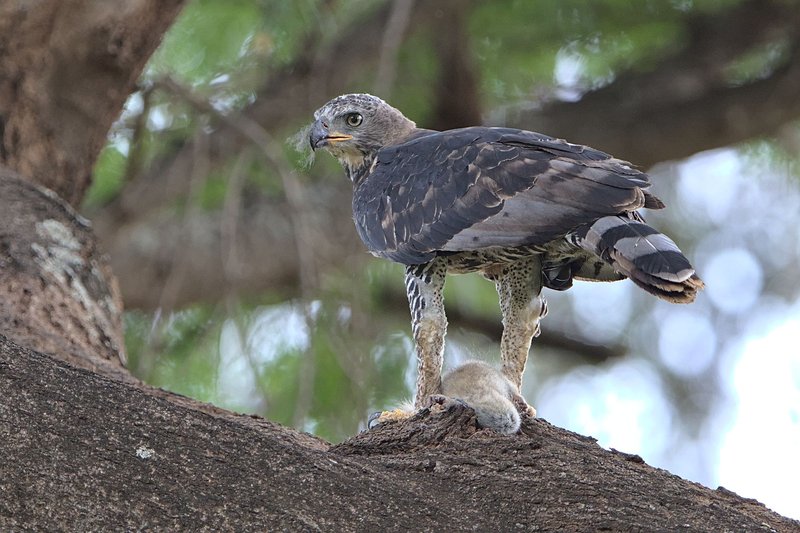
This is the forest’s top avian predator. The African crowned eagle is a stocky, broad-winged raptor with a double crest and heavily barred legs and feet. Its short, rounded wings let it weave between trunks at speed. It takes monkeys and small antelope such as duikers, ambushing them from a perch below the canopy or swooping down from above.
Pairs build enormous stick nests in the fork of a big tree and often reuse them for years. During display flights, the male calls with a ringing, whistled “kewee-kewee” while undulating above the trees.
Status: Near Threatened. Fun fact: the species is built for power rather than speed, and its talons are among the heaviest of any African eagle.
Mid-story birds
4. Congo serpent eagle
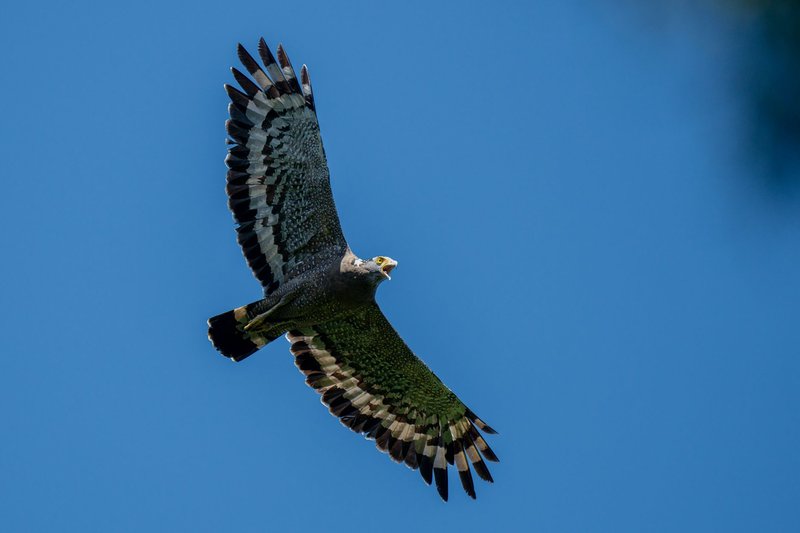
The Congo serpent eagle is a forest-interior raptor of the Guinea-Congo forest block, with the Congo Basin as its stronghold. It is a medium-sized eagle with a barred tail, spotted underparts and large dark eyes. It spends hours sitting motionless on a mid-level branch, then drops onto a chameleon, a snake, a frog or a large insect.
It is easy to miss. The bird rarely soars over the canopy the way open-country eagles do, so most sightings are of a still silhouette in the shade, or a call at dawn.
Status: Least Concern. Fun fact: it is a patient ambush hunter and a poor candidate for a photo, since it can sit for long stretches without moving.
5. African emerald cuckoo
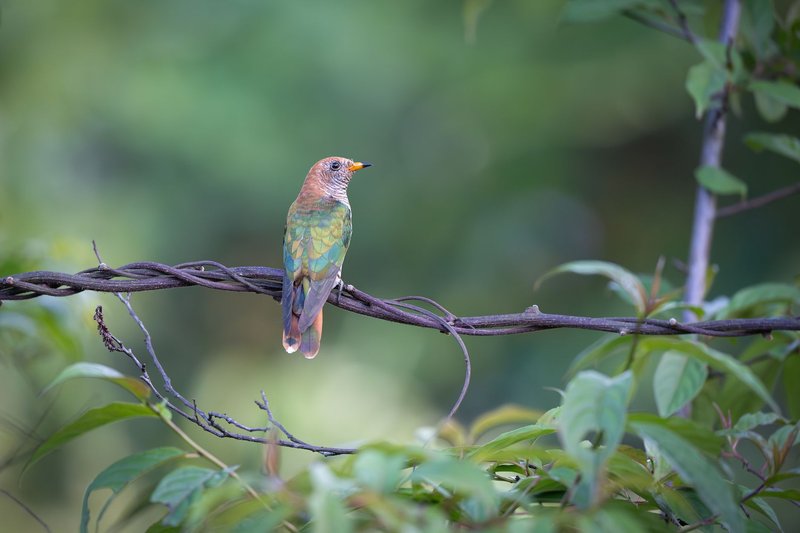
The male African emerald cuckoo looks like a green jewel in the right light: glossy emerald above, bright yellow below. The female is barred brown and green. The call is the easy way to find one, a clear whistled phrase often rendered as “hello, Georgie” that repeats from a high perch.
It eats caterpillars and other insects, including hairy ones many birds avoid. Like many cuckoos, it lays its eggs in other birds’ nests and leaves the hosts to raise the chick.
Status: Least Concern. Fun fact: the “hello, Georgie” call is one of the most recognizable sounds in African forests, even for people who have never seen the bird.
6. Black bee-eater
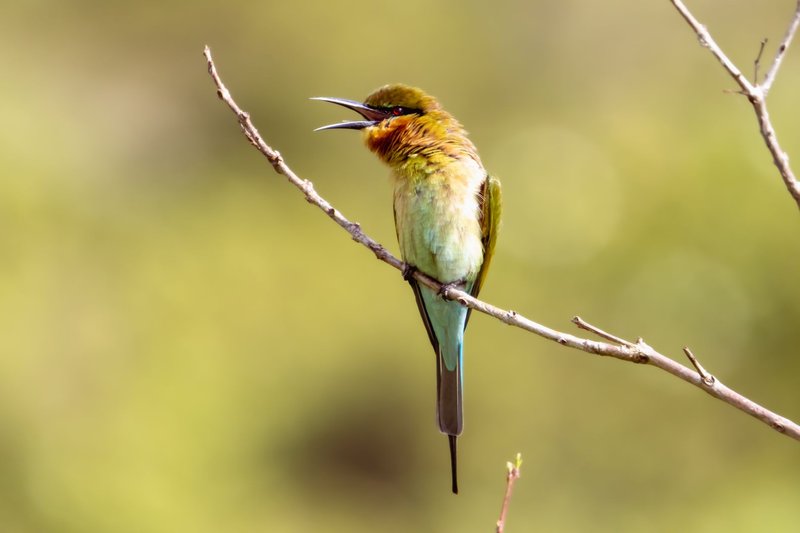
Most bee-eaters are bright green and open-country birds. The black bee-eater breaks that rule. Its plumage is nearly all black, set off by a scarlet throat and flashes of blue, and it perches on exposed branches at forest edges, clearings and river corridors. From there it sallies out to snatch bees, wasps and other flying insects in the air.
It is a good example of a Congo rainforest bird that favors the gaps in the forest, not the dark interior. Look near fallen trees, roads and riverbanks.
Status: Least Concern. Fun fact: like other bee-eaters, it rubs the stinger off its catch against a branch before swallowing.
7. Grauer’s broadbill
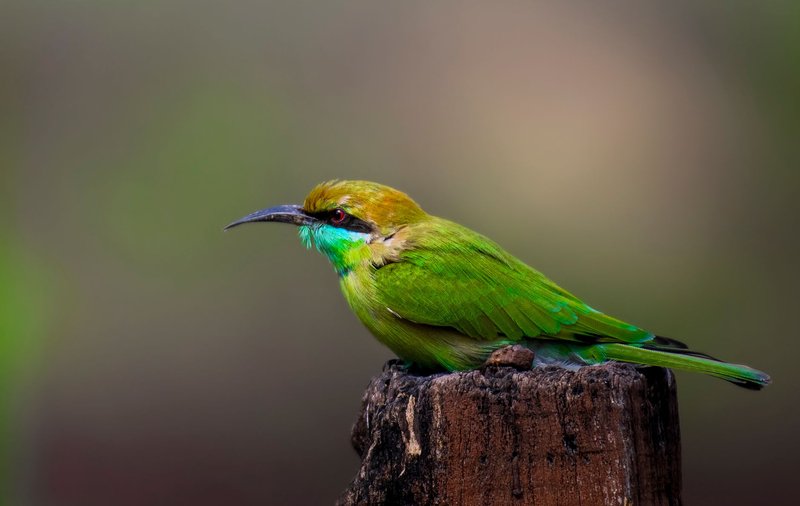
Grauer’s broadbill is the one bird on this list that lives on the basin’s mountainous eastern edge, not in the lowland forest. It is a small, bright green bird found in the montane forests of eastern DRC, part of the Albertine Rift. It is also called the African green broadbill. It eats fruit and insects and is hard to spot because its green plumage blends with the foliage.
It is range-restricted, which makes it a priority for conservation. Its high-altitude forest habitat is shrinking under pressure from farming, logging and settlement.
Status: Vulnerable. Fun fact: it is one of only a few broadbills in all of Africa; the family is mainly Asian.
Forest-floor birds
8. Congo peafowl
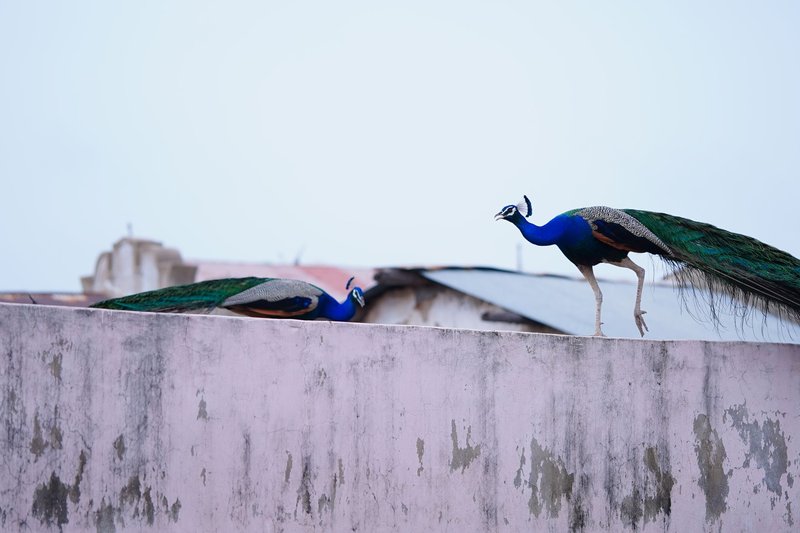
The Congo peafowl is the bird most readers searching for “Congo rainforest birds” are hoping to find. It is the only peafowl native to Africa, and it lives only in the DRC. Males are dark, glossy blue-green with a red throat patch and a bristly crest. Females are chestnut-brown with a green back. Neither sex fans a train like the Asian peacock.
Western science did not know the bird existed until 1936. The American ornithologist James Chapin had seen odd feathers in the headdresses of Congolese men in 1913, and later recognized two stuffed birds in a Belgian museum as mislabeled specimens of the same unknown species. It lives in primary forest, eats fruit, seeds and insects, and calls in duets that carry through the understory. Pairs and small groups are shy and mostly stay out of sight.
Populations survive in protected areas such as Salonga National Park and the Maiko and Lomami regions. Hunting with snares and forest loss are the main threats.
Status: Endangered. Fun fact: it was one of the last big bird species discovered, and it got its genus name, Afropavo, from “African peafowl”.
9. Crested guineafowl
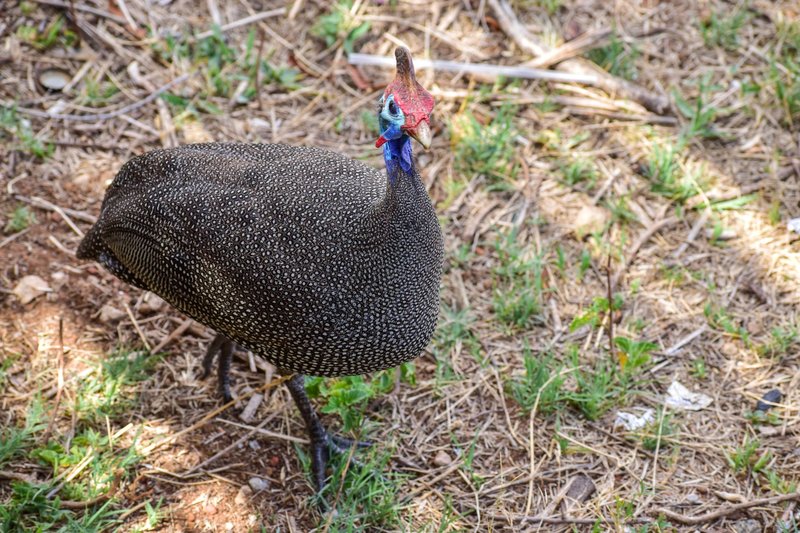
The crested guineafowl is a dark, white-spotted bird with a curly black crest and a bare face. It travels in flocks of ten or twenty and moves single file along forest trails, scratching through leaf litter for seeds, fruit and insects, then flying up into trees to roost at night.
When disturbed, the flock bursts into a clatter of wingbeats and harsh, rattling calls. Of all the Congo birds here, this is the one a visitor is most likely to meet on a short walk along a forest path.
Status: Least Concern. Fun fact: guineafowl are tough, fast ground runners, and a flock can disappear into the undergrowth within seconds.
River and swamp birds
10. Pel’s fishing owl
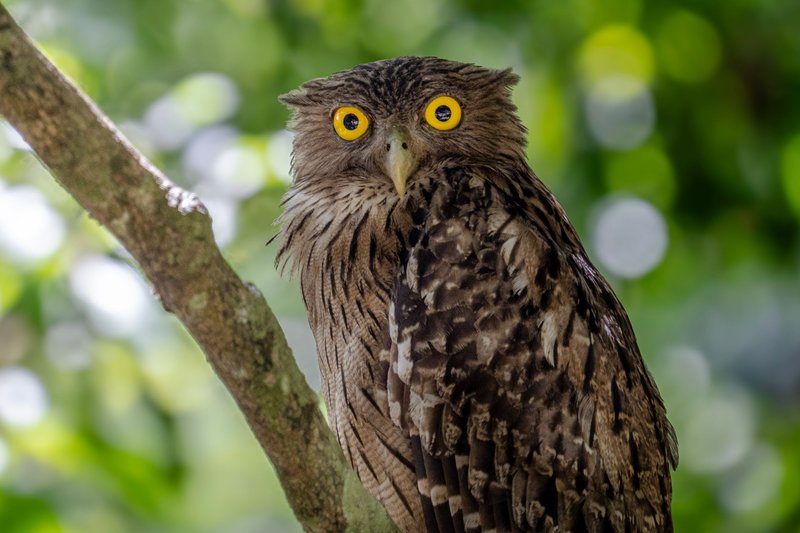
Pel’s fishing owl is the largest of the fishing owls and one of the biggest owls in Africa. It is rich ginger-brown, with dark spots on the underparts and no ear tufts. It roosts in the shade of overhanging riverside trees during the day and hunts at night, grabbing fish near the surface from a low perch. It also takes frogs and crabs.
Its call is a deep, resonant hoot, usually the first and only clue it is nearby.
Status: Least Concern. Fun fact: its feet have rough, spiny soles that grip slippery fish.
11. African finfoot
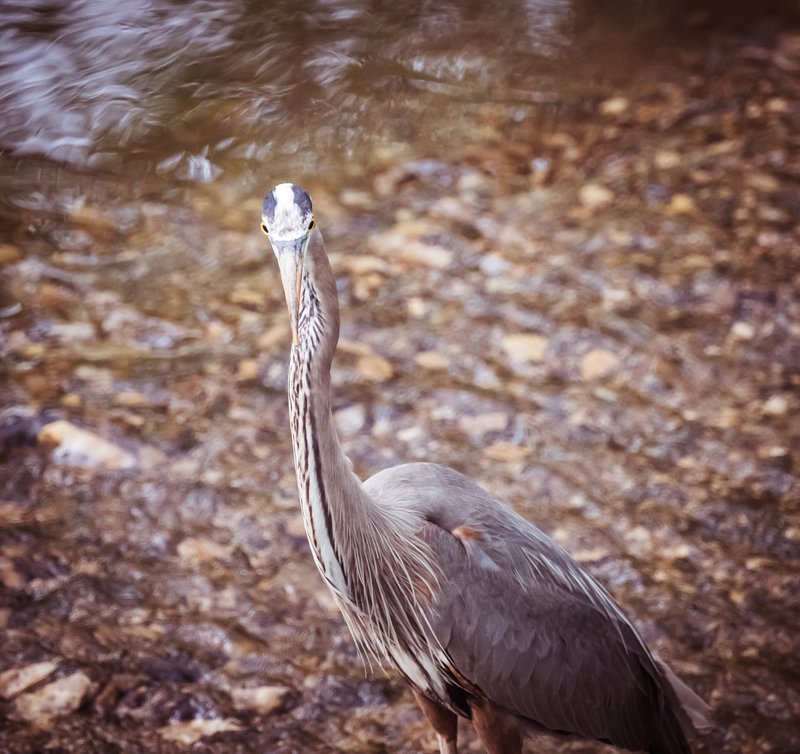
The African finfoot is a secretive waterbird that looks like a cross between a grebe and a duck. It has a red bill and orange-red legs with lobed toes, and it swims low in the water with just its head and neck showing. When alarmed, it slips under overhanging vegetation and vanishes.
It lives along quiet, shaded forest rivers and streams and feeds on aquatic insects, small fish and crustaceans. If you see one, you will usually see it from a canoe.
Status: Least Concern. Fun fact: the bird’s name comes from the lobed, fin-like toes that make it a strong swimmer.
12. Congo martin
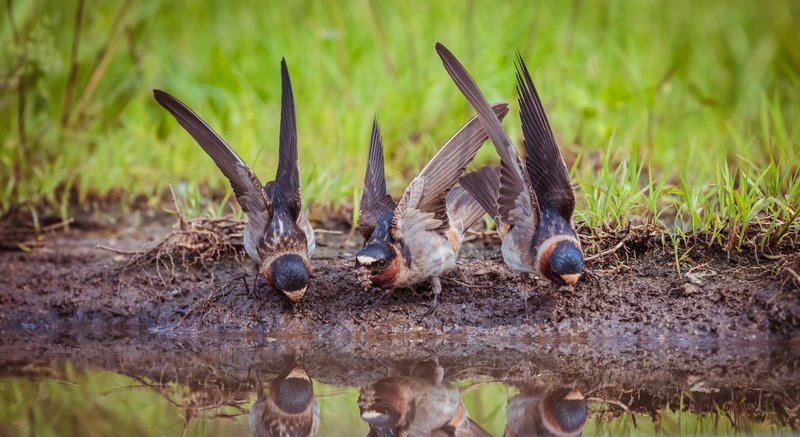
The Congo martin is the “Congo” bird that few visitors ever tick off. It is a small, brown swallow tied to the Congo and Ubangi rivers, and it nests in colonies in burrows dug into sandbanks. It hunts insects in the air over open water and sandbars, which means you look for it on the river itself, not in the forest.
Its range is narrow and sits along some of Africa’s busiest river traffic routes, so it is easy to overlook. It is also an example of why rivers matter to Congo rainforest birds: the Congo River is as much a habitat as the trees beside it.
Status: Least Concern. Fun fact: its narrow range makes it a prized find for birders on the Congo River.
Threats to Congo rainforest birds
The pressure comes from several directions at once. Industrial plantations (palm oil, rubber and sugar) clear forest in the western basin. Logging opens roads that bring hunters and farmers into intact forest. Snaring for bushmeat catches peafowl, guineafowl and other ground birds. And the pet trade has taken a heavy toll on African grey parrots, which is why the species now sits on both the Endangered list and CITES Appendix I. The same forces hit other African rainforest species too; see endangered African rainforest animals for the wider picture.
Birds with small ranges, like the Congo peafowl and Grauer’s broadbill, have the least room to absorb that damage. Birds with huge ranges, like the great blue turaco, can lose habitat for a long time before the numbers show it.
What helps: buying certified wood and palm oil products, never buying a wild-caught parrot, and supporting groups that protect basin forests such as WWF. If you travel, use operators that employ and pay local guides, since a living forest has to be worth more standing than cleared.
Where to see them
Salonga National Park in the DRC is Africa’s largest tropical rainforest park and a UNESCO World Heritage Site. It holds Congo peafowl, but access is difficult and slow. Eastern DRC’s Kahuzi-Biega and Itombwe forests are the places to look for Albertine Rift species like Grauer’s broadbill, and security conditions there change often, so check current travel advice first.
Across the river in the Republic of Congo, Odzala-Kokoua National Park is the more practical base for forest birding. It has clearings where parrots, pigeons and other forest birds gather, plus rivers for finfoot and fishing owls. Hire a local guide wherever you go; in dense rainforest, most birds are heard first, and a good guide turns a wall of calls into a species list.
The 12 Congo rainforest birds above cover each layer of the forest, from a canopy parrot to a riverbank owl. Seeing even a few puts you in the company of one of the richest bird assemblages in Africa.