Short answer: feed a baby duck an unmedicated duck or waterfowl starter with about 20% protein and added niacin, free choice, with water always right beside it. Ducklings need that water to swallow their food and rinse their nostrils. Switch to a grower feed of about 16% protein at 2 weeks. Never feed bread, medicated chick starter or layer feed. Treats such as peas and chopped greens can start at about 2 weeks and stay under 10% of the diet.
The chart below sorts common foods into safe staples, small amounts only and never feed. Search any food to see where it falls. Under the chart are the feed choices, how to set up feed and water, a schedule by age and a printable cheat sheet. This guide covers domestic ducklings from a hatchery or feed store. A sick duckling needs a vet who treats poultry. If you found a wild duckling, start with the box.
Found a wild duckling?
Can a baby duck eat it?
Safe staples (7)
- Safe to feed. Unmedicated crumbles or mini pellets with about 20% protein and added niacin. Free choice, always with water beside it.Ages 0–2 weeks#
- Safe to feed. Drop to about 16% protein after week 2. More protein speeds growth and is linked to wing and leg problems.From 2 weeks#
- Safe to feed. A fallback only. Chick feed is short on niacin for ducklings: add about 100 to 125 mg niacin per gallon of drinking water.Ages 0–2 weeks#
- Safe to feed. Always next to the feed. Ducklings need water to swallow and to rinse eyes and nostrils, so it must be deep enough to dunk the bill.All ages#
- Safe to feed. Finely chopped romaine, kale, chard, dandelion, clover or grass, floated in water. Skip spinach, which can block calcium.All ages#
- Safe to feed. A natural, protein-rich duck food. In trials, fresh duckweed replaced soybean in duck diets without slowing growth.From 2 weeks#
- Safe to feed. Needed once it eats greens, seeds or treats, to grind them. Not needed on feed alone. Never use oyster shell as grit for ducklings.From 2 weeks#
Small amounts only (14)
- Small amounts only. Thawed frozen or fresh peas are a favorite. Float a few in the water dish; mash or halve them for small ducklings.From 2 weeks#
- Small amounts only. Thawed kernels or cracked corn as a treat. Merck warns diets of bread, lettuce and corn alone cause protein and vitamin deficiencies.From 2 weeks#
- Small amounts only. Cooked or rolled oats, plain, as a small treat. No sugar, salt or flavored instant packets.From 2 weeks#
- Small amounts only. Plain cooked rice is a fine treat. Uncooked rice does not swell up and burst a bird's stomach; that is a myth.From 2 weeks#
- Small amounts only. Mostly water with little nutrition. A little shredded is fine, but romaine, kale or dandelion do far more.From 2 weeks#
- Small amounts only. Cut into quarters or bite-sized pieces so a duckling can't choke on a whole grape. An occasional treat.From 2 weeks#
- Small amounts only. Small mashed or bite-sized pieces now and then. Fruit is sugary, so it stays a small share of the treats.From 2 weeks#
- Small amounts only. Chopped into bite-sized pieces as an occasional treat.From 2 weeks#
- Small amounts only. Halve them for young ducklings. A few at a time as a treat.From 2 weeks#
- Small amounts only. Bite-sized pieces or a slice to peck at on a hot day. Mostly water, so it is a treat, not food.From 2 weeks#
- Small amounts only. Ducks love them, but they are high in protein. A few, not every day, so growth stays steady.From 2 weeks#
- Small amounts only. Plain hard-boiled or scrambled egg, chopped fine, as an occasional protein treat. Never raw.From 2 weeks#
- Small amounts only. Very ripe red flesh only, a little at a time. Green tomatoes, leaves, stems and vines carry solanine and are toxic.From 2 weeks#
- Small amounts only. Fills a duck with seed instead of balanced feed. A small handful counts as treats and needs grit to grind it.From 2 weeks#
Never feed (11)
- Never feed. Fills ducks up with no protein or vitamins. Bread-heavy diets are linked to angel wing, a mostly permanent wing deformity.
- Never feed. Salty, fatty junk food makes ducklings gain weight too fast for their legs. Too much salt causes dehydration and kidney damage.
- Never feed. Usually salted or buttered, and it has no place in a duckling's diet. Offer peas or chopped greens instead.
- Never feed. Flesh, skin and pit contain persin, which damages the heart in birds and can cause sudden death.
- Never feed. Thiosulfates in onion and garlic destroy red blood cells and can cause anemia.
- Never feed. Oranges, lemons, limes and grapefruit can interfere with calcium absorption, which growing bones need.
- Never feed. Theobromine and caffeine can cause seizures, heart and lung problems and death in poultry.
- Never feed. Ducks are lactose intolerant. Milk, cheese and yogurt can cause painful digestive upset.
- Never feed. Ducklings don't need it, and its amprolium is not approved for ducks. Use an unmedicated duck starter instead.
- Never feed. Layer feed has four to five times the calcium a growing duck needs. Wait for the first egg, around 18 to 26 weeks.
- Never feed. Green or sprouting potatoes, peels and plants contain solanine, which affects the nervous system, gut and heart.
Sources
- Feeding Ducks (Peter R. Ferket) — NC State Extension, Prestage Department of Poultry Science
- Feeding Ducks Intended for Consumption (Jacquie Jacob) — University of Kentucky, Poultry Extension (extension.org)
- Nutrient Requirements of Pekin Ducks — Merck Veterinary Manual
- Nutrition in Waterfowl — Merck Veterinary Manual
- Care of Ducks (David R. Laatsch) — University of Wisconsin-Madison Extension
- Rearing Instructions — Metzer Farms (hatchery)
- Determining How to Supplement Your Ducks' Diet with Niacin — Metzer Farms (hatchery)
- Are My Ducklings' Leg Problems Due to a Niacin Deficiency? — Metzer Farms (hatchery)
- Treats Your Ducks Will Love — Metzer Farms (hatchery)
- Foods Ducks Should Never Eat — Metzer Farms (hatchery)
- What Do Ducklings Eat? — Murray McMurray Hatchery
- Raising Backyard Ducks: A Reference Guide — Purina Animal Nutrition (feed maker)
- What Do Ducks Eat? Tips and Best Practices for Feeding Backyard Ducks — Purina Animal Nutrition (feed maker)
- How Do I Care for Ducklings and Goslings? — My Pet Chicken (retailer)
- Guidelines for Feeding Baby Ducklings (Lisa Steele) — Fresh Eggs Daily
- What To Feed Ducks (Instead of Bread) (Sandra C. Mitchell DVM) — PetMD
- 10 Foods You Should Never Feed Chickens — UF/IFAS Extension Holmes County
- Avocado (Persea spp) Toxicosis in Animals — Merck Veterinary Manual
- Chocolate Toxicosis in Animals — Merck Veterinary Manual
- Urban Wildlife in Central Park: The Hazards of Feeding Wild Animals — Central Park Conservancy
- 4 myths about backyard birds, debunked — Popular Science
- I found a baby duck or goose — Toronto Wildlife Centre
- Temporary care for baby ducks and geese — Toronto Wildlife Centre
- Ducks and Geese: Coexisting with Wildlife — San Diego Humane Society
- Ducks and Geese in Distress — Connecticut Department of Energy and Environmental Protection
- Sick, injured or orphaned wildlife — Minnesota Department of Natural Resources
- 50 CFR 10.13 List of Migratory Birds — Cornell Legal Information Institute
- Can Chickens Eat Tomatoes? (Lisa Steele) — Fresh Eggs Daily
- Use of duckweed (Lemna spp) as replacement for soya bean meal in a basal diet of broken rice for fattening ducks (Men, Ogle and Preston) — Livestock Research for Rural Development 7(3), 1995
Setting up a feeding routine for ducklings
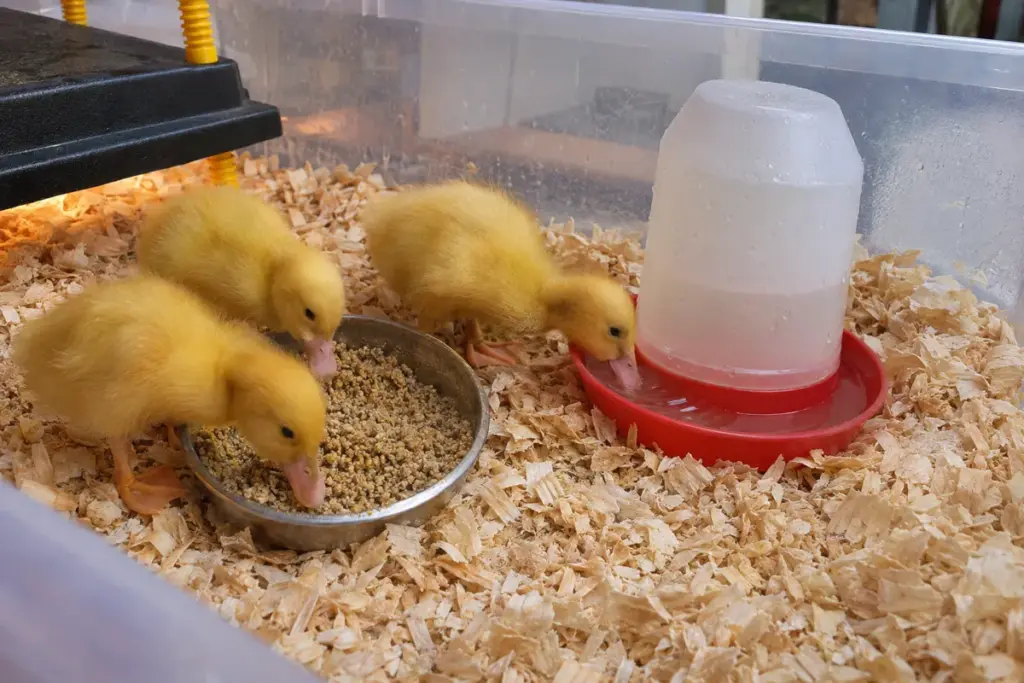
Ducklings eat and drink from the day they hatch, and they do it together: a duckling fills its bill with feed, then dips it in water to wash the food down. Get the brooder right before they arrive and feeding mostly runs itself.
1. Put feed and water side by side
Purina’s duck guide says water helps ducklings get food down, cleans their bills and keeps their nasal passages moist. So the waterer goes next to the feeder, never across the brooder. Both stay full at all times. NC State Extension says growing ducks should have free access to feed and water around the clock.
2. Use a waterer they can dunk in but not climb into
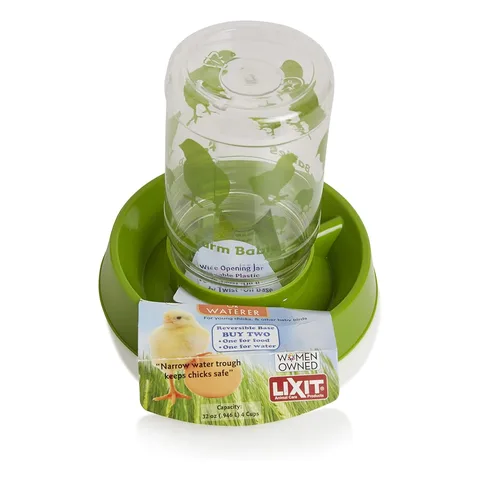
Murray McMurray Hatchery says the water must be deep enough for a duckling to dunk its whole head. A dish ducklings can climb into is the problem: they get soaked and chilled. Use a narrow poultry waterer, and set it on a wire platform over a tray, as Metzer Farms suggests, so the bedding stays dry. A duckling drinks about half a gallon a week in its first weeks, roughly three times what a chick drinks.
3. Keep the brooder warm
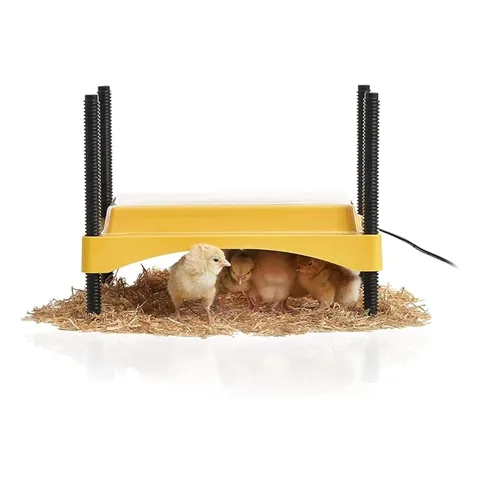
A cold duckling eats less. Start at about 90 °F at floor level under the heat, then lower it about 5 °F a week. Ducklings piled under the heat are cold. Ducklings pressed against the walls are too hot.
4. Hold off on treats for 2 weeks
For the first 2 weeks, starter and water are the whole diet, with finely chopped greens floated in the water if you like. Treats come later and in small amounts.
What to feed a baby duck: starter feed
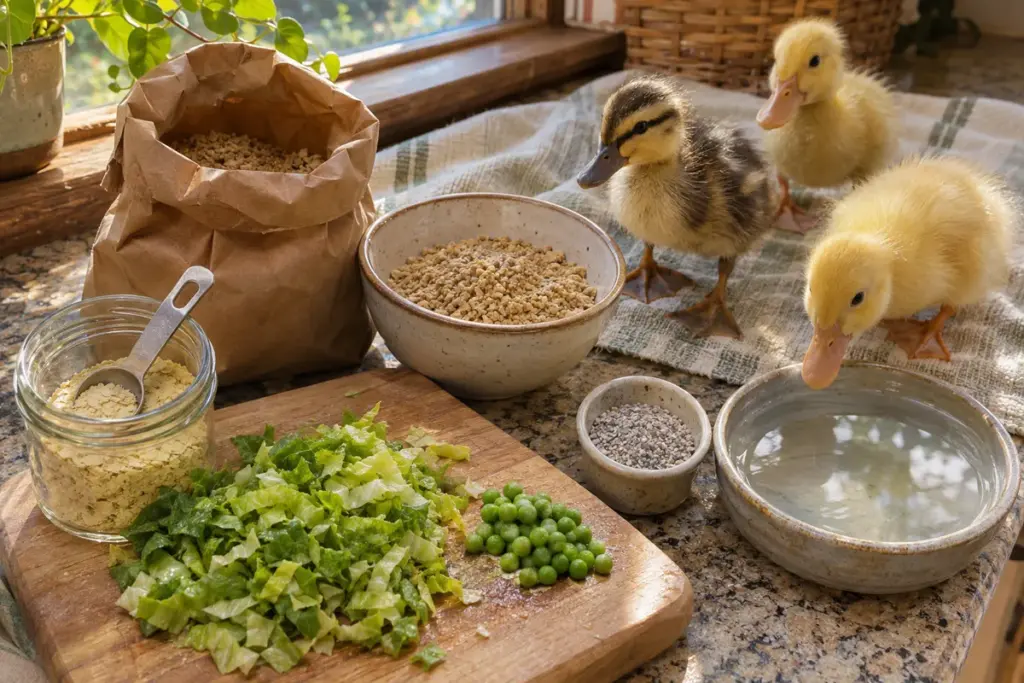
The best food for a duckling is a commercial duck or waterfowl starter. PetMD calls commercial duck feed “by far the best choice.” Look for three things on the label:
- About 20% protein for the first 2 weeks. NC State, Kentucky and Wisconsin extension all use 20%.
- Added niacin. Ducklings need far more niacin (vitamin B3) than chicks. Purina’s Duck Feed and Flock Raiser each carry at least 60 ppm, above the 55 ppm the Merck Veterinary Manual lists for Pekin ducks.
- Unmedicated. Purina says ducklings should not get a medicated starter. Its amprolium is not approved for ducks, and Wisconsin Extension says ducklings don’t need it.
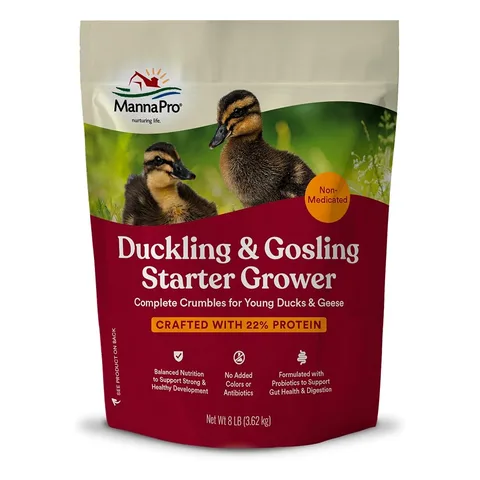
Feed crumbles or mini pellets. My Pet Chicken warns that powdered feed can make ducklings choke. Purina Duck Feed, Purina Flock Raiser, Mazuri Waterfowl Starter and Manna Pro Duckling and Gosling Starter Grower are the feeds most often named. Check the bag for protein, niacin and “non-medicated” before you buy.
If you only have chick starter
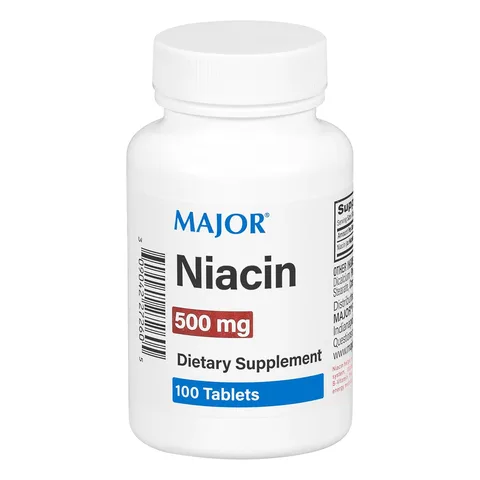
Unmedicated chick starter works as a fallback if you add niacin. The University of Kentucky says chick feeds are made for egg-type chicks and fall short on niacin for ducklings. Add about 100 to 125 mg of niacin per gallon of drinking water. One 500 mg niacin tablet dissolved in 4 gallons gives 125 mg per gallon, the figure Metzer Farms uses when about half the water gets spilled.
Brewer’s yeast is the usual home fix, but it is a weak niacin source. Metzer’s numbers put human-grade brewer’s yeast at about 5 mg of niacin per tablespoon, so a growing duck would need nearly 2 tablespoons a day. A niacin-fortified duck feed or niacin in the water is more reliable.
Foods that harm ducklings
- Bread, crackers and chips. The Merck Veterinary Manual says bread has no nutritional value for waterfowl. The Central Park Conservancy links bread-heavy diets to angel wing, a wing deformity that is mostly permanent. Salty snacks add dehydration and kidney damage.
- Medicated chick starter. Not approved for ducks and not needed.
- Layer feed and oyster shell. Layer feed has four to five times the calcium a growing duck needs. Save it for laying ducks.
- Milk and dairy. Ducks are lactose intolerant, so milk, cheese and yogurt upset their digestion.
- Avocado. Merck lists persin in avocado as a cause of heart damage and sudden death in birds.
- Onion, garlic, chocolate and caffeine. Onion and garlic damage red blood cells. Theobromine and caffeine cause seizures and death in poultry.
- Raw potato peels and green tomatoes. Both carry solanine, as do tomato leaves and vines.
- Citrus. Metzer Farms says it interferes with calcium absorption, which growing bones need.
How much and how often to feed ducklings
Ducklings are not portion-fed. They eat free choice, and the job is keeping feed and water in front of them.
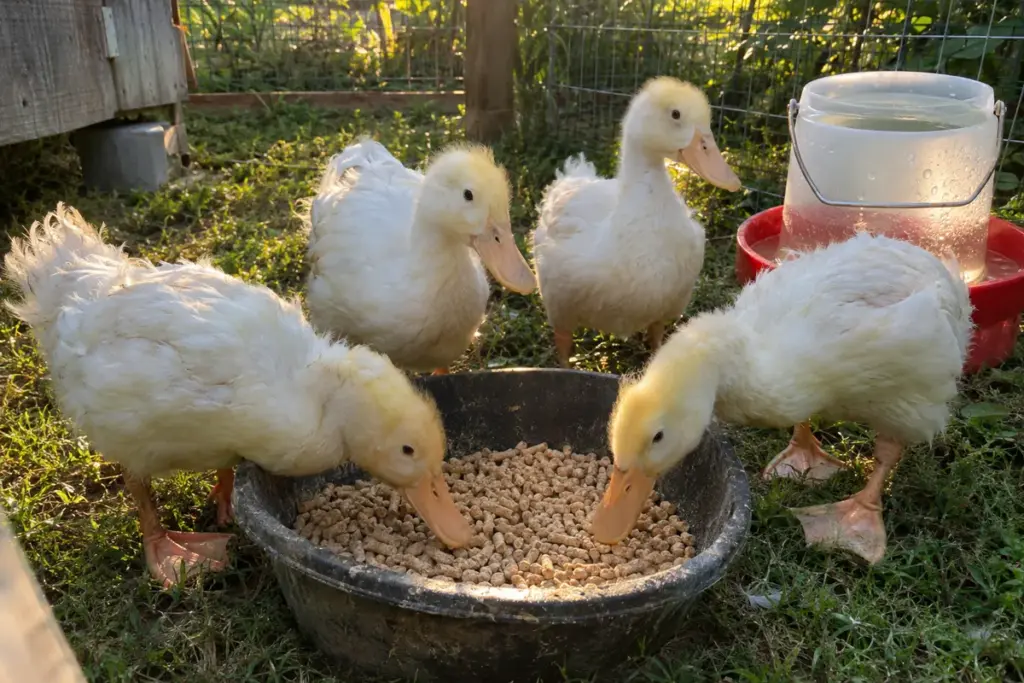
- Fill the feeder so it never runs empty. Purina’s guide says not to let feeders run dry. Use a weighted bowl or a gravity feeder they can’t tip.
- Refill the water at least twice a day. Ducklings fill it with feed and bedding fast. McMurray refills twice daily.
- Feed starter before any treat. Purina’s rule is 90% complete feed, 10% treats at most: up to 2 tablespoons of treats per half cup of feed.
- Chop everything small. Greens, grapes and berries go in bite-sized pieces, and grapes are quartered so a duckling can’t choke on one.
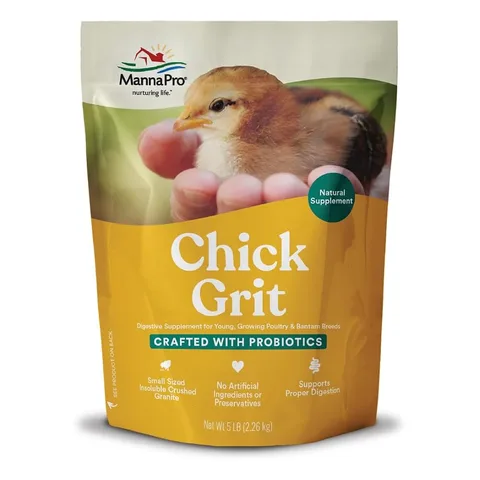
- Add grit when treats start. Grit (chick grit or coarse sand) grinds greens and seeds. A duckling on starter alone doesn’t need it. Never use oyster shell as grit.
- Watch the legs. A duckling that limps, won’t walk or has swollen hocks may be short on niacin. Metzer Farms says ducklings usually recover within a few days if niacin starts within 24 hours of the first sign.
Baby duck feeding schedule by age
The schedule follows fast-growing breeds such as Pekins. Sources split on when to drop protein, from 2 to 3 weeks. The table switches at 2 weeks to a feed of about 16% protein, the figure Kentucky extension and the Merck Pekin table use, because extra protein after that point adds nothing and is linked to wing problems. A starter-grower feed labeled for ducks from hatch is fine if you follow the bag.
| Age | What it looks like | Food | Amount | How often | Notes |
|---|---|---|---|---|---|
| 0–1 week | Fluffy yellow, brown or black down; wobbly; dunks its bill after every bite | Duck or waterfowl starter, about 20% protein, unmedicated, plus water | Free choice; each duckling drinks about half a gallon of water a week | Feed and water in reach at all times. Never feed without water | Brooder about 90 °F under the heat. No swimming yet. Chopped greens in water only. |
| 1–2 weeks | Growing fast, still all down, messy around the waterer | Starter crumbles or mini pellets, water, chopped greens | Free choice; don't let the feeder run empty | Feed and water at all times | Lower the heat about 5 °F a week. Using chick starter? Add niacin to the water. |
| 2–4 weeks | Bigger and louder; first feathers start near the end of week 4 | Grower feed, about 16% protein; small treats begin, with grit | Free choice feed; treats under 10% of the diet | Feed and water at all times | Short, supervised swims in warm water from about 3 weeks, then dry and warm it. |
| 4–8 weeks | Feathers growing in; makes its own waterproofing oil from about 4 weeks | Grower feed, greens, duckweed, a few treats | Up to 2 tablespoons of treats per half cup of feed | Feed and water at all times | Outdoors by day above 65 °F from about 4 weeks; outside full time by 6 weeks. |
| 8–16 weeks | Near adult size by 8–12 weeks; hens quack loudly, drakes hiss from about 10 weeks | Grower or maintenance pellets, greens, grit | Complete feed at least 90% of the diet | Feed and deep water at all times | Still no layer feed. Its calcium is for laying ducks only. |
| 16 weeks and up | Adult plumage; first eggs at about 18–26 weeks, by breed | Maintenance feed; layer feed or oyster shell once the first egg appears | Complete feed at least 90% of the diet | Feed and deep water at all times | Drakes and non-laying ducks stay on maintenance feed. |
Fast growth is normal: most breeds reach adult size by 8 to 12 weeks, according to Purina. The weeks of fastest growth, about 2 to 7, are when Metzer Farms sees niacin shortages most, so watch legs and gait closely then. A duckling that falls behind its brood-mates needs a closer look.
Treats and diet changes as ducklings grow
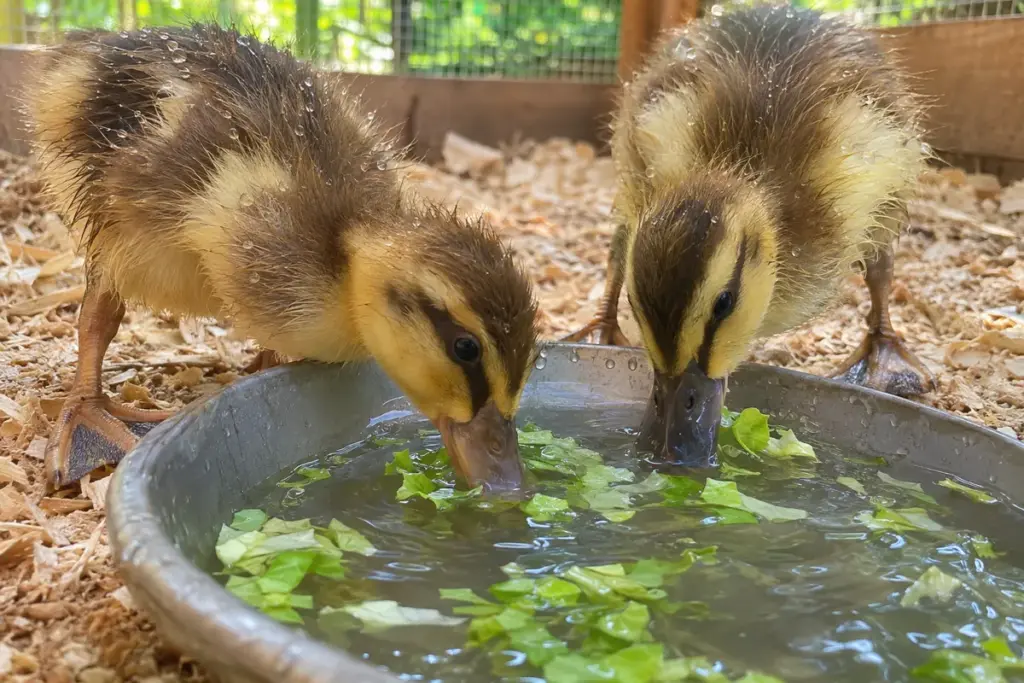
- Greens from the start. Toronto Wildlife Centre and Fresh Eggs Daily float finely chopped dandelion, clover, grass or romaine in water. Skip spinach, which Metzer says can block calcium.
- Other treats from about 2 weeks. Peas, chopped fruit, mealworms and cooked egg, a little at a time. Purina’s own line is stricter (no treats until adult size), so go light.
- Duckweed. A natural duck food. In a feeding trial published in Livestock Research for Rural Development, fresh duckweed replaced soybean meal in duck diets without slowing growth.
- Grower feed from 2 weeks, then maintenance pellets once they reach adult size at 8 to 12 weeks.
- Layer feed only at the first egg, usually between 18 and 26 weeks depending on breed. Drakes and non-laying ducks stay on maintenance feed.
- Swimming from about 3 weeks, short and supervised in warm, shallow water, then dry and warm the duckling. Ducklings make no waterproofing oil until about 4 weeks. A pond is not required: Wisconsin Extension calls swimming good exercise but not essential.
Can baby ducks eat bread, rice or fruit?
Bread, no. It fills a duckling with calories and almost no protein or vitamins, and bread-heavy diets are linked to angel wing. Rice is fine as a plain cooked treat after 2 weeks. The story that raw rice swells and bursts a bird’s stomach is a myth. Fruit such as banana, strawberries, blueberries and quartered grapes is a small treat from about 2 weeks. Citrus is the exception and stays off the menu.
Signs something is wrong
- Limping, bowed legs, swollen hocks or a duckling that won’t walk: a common sign of niacin deficiency, most likely between 2 and 7 weeks. Add niacin to the water now and call a vet if it does not improve in a few days.
- Wing tips that twist outward as the feathers come in: angel wing, linked to too much protein and to bread. Cut protein to a grower feed and stop all bread.
- Choking or gasping at the feeder: it has no water nearby or the feed is powdered. Put water right beside the feed and switch to crumbles.
- Huddling, shivering or crusted eyes: too cold or no water deep enough to rinse its eyes. Check the brooder temperature and the waterer depth.
- A duckling that stops eating, sits apart or can’t stand: see a vet who treats poultry. Purina notes that a duckling that can’t stand may be short on nutrients, but illness looks the same.
Printable baby duck feeding chart
The cheat sheet fits on one page. It has the safe, small amounts only and never food lists, the schedule by age and the wild duckling steps. Print it in color or black and white and tape it near the brooder.
Supplies for feeding ducklings
These are the items hatchery and extension guides name. Before the ducklings arrive you need a duck starter, a waterer and feeder, a heat source and a thermometer. Grit can wait until treats start at 2 weeks.

More about ducks and waterfowl
See what makes a duck a duck in the characteristics of waterfowl, where the mallard fits among the most important wetland birds and what it eats in the wild in wetland omnivores. Wood duck ducklings jump from tree cavities on their first day, one of the stories in our wetland birds guide. For other young animals, see what to feed a baby pigeon and what to feed a baby squirrel. All our bird articles are in the birds section.
Frequently asked questions
What do baby ducks eat?
Domestic ducklings eat an unmedicated duck or waterfowl starter with about 20% protein and added niacin, free choice, with water always beside it. At 2 weeks they move to a grower feed of about 16% protein, with chopped greens and small treats. Wild ducklings eat insects, seeds and water plants their mother leads them to.
Can baby ducks eat chick starter?
Only unmedicated chick starter, and only with extra niacin. Chick feed is made for chicks and is short on the niacin ducklings need for strong legs. Add about 100 to 125 mg of niacin per gallon of drinking water, or use a duck starter that already has it.
Is medicated chick starter bad for ducklings?
Skip it. Purina says ducklings should not get a medicated starter, because its amprolium is not approved for ducks, and Wisconsin Extension says ducklings don't need it. Some keepers report no problems, but no extension or veterinary source recommends it.
How much niacin do ducklings need?
Duck feeds should carry about 55 ppm niacin, the requirement in the Merck Veterinary Manual. If you feed chick starter, add about 100 to 125 mg of niacin per gallon of drinking water. One 500 mg tablet in 4 gallons gives 125 mg per gallon.
Can baby ducks eat bread?
No. Bread has almost no protein or vitamins for a growing duck, and bread-heavy diets are linked to angel wing, a wing deformity that is mostly permanent. Thawed peas or chopped greens make a better treat for ducklings and park ducks alike.
Do ducklings need water when they eat?
Yes, always. Ducklings fill their bills with feed and dip them in water to swallow it, and they use the water to rinse their eyes and nostrils. Put the waterer right beside the feeder and make it deep enough to dunk the bill but too narrow to climb into.
When can ducklings have treats?
Finely chopped greens floated in water are fine from the start. Other treats such as peas, chopped fruit, mealworms and cooked egg can begin at about 2 weeks. Keep all treats under 10% of the diet, about 2 tablespoons per half cup of feed, and add grit once they start.
Can baby ducks eat grapes, bananas or strawberries?
Yes, as small treats from about 2 weeks. Quarter grapes so a duckling can't choke on one, and cut banana and strawberries into bite-sized pieces. Citrus fruit is the exception; Metzer Farms says it interferes with calcium absorption.
Can ducklings eat rice?
Plain cooked rice is a fine small treat from about 2 weeks. The story that uncooked rice swells and bursts a bird's stomach is a myth. Rice still counts toward the 10% treat share, because it has little protein.
When do ducklings switch from starter to grower feed?
At about 2 weeks, to a grower feed of about 16% protein. Extra protein after that point adds nothing to growth and is linked to wing and leg problems. Some feeds are labeled starter-grower for ducks from hatch; follow the bag if you use one.
When can ducklings eat layer feed?
Only once the first egg appears, usually between 18 and 26 weeks depending on breed. Layer feed carries four to five times the calcium a growing duck needs. Drakes and ducks that aren't laying stay on maintenance feed.
What should I do if I find a wild duckling?
Look for the hen and brood first and help the duckling rejoin them if they are close. If there is no family, box it with a soft towel and gentle heat, keep it dry and out of water, and call a licensed wildlife rehabilitator. Mallards and most native ducks are protected by the Migratory Bird Treaty Act, so keeping one needs a permit.
Sources
- Feeding Ducks, NC State Extension
- Feeding Ducks Intended for Consumption, University of Kentucky Poultry Extension
- Care of Ducks, University of Wisconsin-Madison Extension
- Nutrient Requirements of Pekin Ducks and Nutrition in Waterfowl, Merck Veterinary Manual
- Raising Backyard Ducks, Purina Animal Nutrition
- Supplementing Your Ducks’ Diet with Niacin and Foods Ducks Should Never Eat, Metzer Farms
- What Do Ducklings Eat?, Murray McMurray Hatchery
- What To Feed Ducks (Instead of Bread), PetMD
- The Hazards of Feeding Wild Animals, Central Park Conservancy
- I found a baby duck or goose, Toronto Wildlife Centre