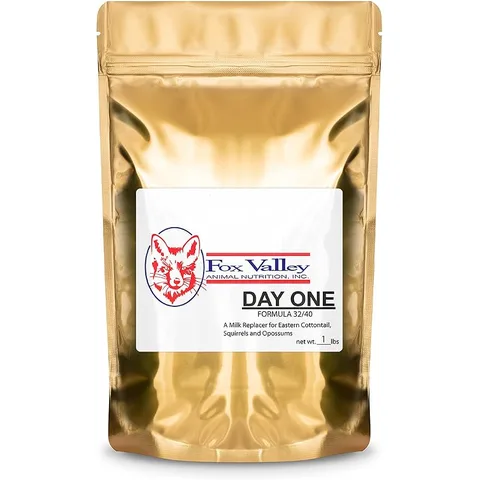
Short answer: a baby squirrel drinks squirrel milk replacer such as Fox Valley 32/40, mixed 1 part powder to 2 parts warm water and given from a 1 ml syringe. Never give it cow’s milk. Before any formula the baby has to be warm and rehydrated with unflavored Pedialyte. Solid food starts at about 6 to 7 weeks with a rodent block, then vegetables. Nuts and fruit wait until about 16 weeks.
The chart below sorts common foods into safe, small amounts only and never. Search any food to see where it falls. Under the chart are the feeding method, a schedule by age and a printable cheat sheet for your fridge.
Before you feed anything
Can a baby squirrel eat it?
Safe staples (7)
- Safe to feed. Squirrel milk replacer used by rehabbers. Mix 1 part powder to 2 parts warm water, as the label says.Ages 0–5 weeks#
- Safe to feed. Higher-fat formula Henry's recommends from about 4 weeks until weaning ends.Ages 3–16 weeks#
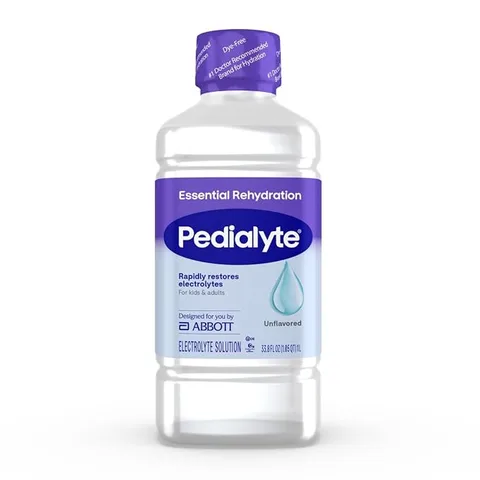
- Safe to feed. For rehydrating only, before formula. Unflavored. Henry's dilutes it half and half with water.Ages 0–5 weeks#
- Safe to feed. Offer in a hanging bottle or shallow dish once eating solids. Don't syringe plain water into a weak baby.Ages 5–16 weeks#
- Safe to feed. Should be the first solid food. Supplies the calcium and vitamins that prevent bone disease.Ages 5–16 weeks#
- Safe to feed. A good first vegetable once blocks are eaten well. Add one new vegetable at a time.Ages 7–16 weeks#
- Safe to feed. Henry's lists these as vegetables to feed freely. Wash well and chop small.Ages 7–16 weeks#
Small amounts only (12)
- Small amounts only. Some rehabbers raise squirrels on Esbilac powder; Henry's now advises squirrel formula instead. Mix 1:2 per label.Ages 0–7 weeks#
- Small amounts only. Only in Henry's stopgap recipe with cream, yogurt and egg yolk, for 2 weeks at most. Not plain goat milk.Ages 0–5 weeks#
- Small amounts only. Rehabbers use it as an early vegetable, but it is starchy, so keep portions small.Ages 7–16 weeks#
- Small amounts only. Fine in small pieces. Henry's puts carrots in its limited-vegetable group.Ages 7–16 weeks#
- Small amounts only. High in calcium, but Henry's limits it. Mix it with other greens rather than feeding it alone.Ages 7–16 weeks#
- Small amounts only. Sugary. Henry's says no fruit before about 4 months, then 2 small pieces of fruit a day at most.From about 16 weeks#
- Small amounts only. Small wedges only, seeds removed. Too much fruit causes diarrhea.From about 16 weeks#
- Small amounts only. Seedless, cut small, as an occasional treat. Henry's and rehab guides list grapes as safe fruit.From about 16 weeks#
- Small amounts only. Safe fruit, but count it in the limit of 2 small fruit pieces a day.From about 16 weeks#
- Small amounts only. Safe fruit in small amounts after weaning starts. Too much fruit causes diarrhea.From about 16 weeks#
- Small amounts only. Treat only, 2 a day at most, not before about 16 weeks. Nuts as a staple lead to bone disease.From about 16 weeks#
- Small amounts only. Unsalted, as a treat after about 16 weeks. Count it in the limit of 2 nuts a day.From about 16 weeks#
Never feed (13)
- Never feed. Causes severe stomach upset and diarrhea. Babies need squirrel formula.
- Never feed. Henry's lists KMR and kitten formulas as unsuitable, and rehabbers link KMR to bone disease in squirrels.
- Never feed. Wrong nutrient balance for squirrels. Henry's lists it among formulas never to use.
- Never feed. Not a safe rehydration fluid for babies. Use unflavored electrolyte solution instead.
- Never feed. Starchy filler with little nutrition. It crowds out the calcium a growing squirrel needs.
- Never feed. Raw peanuts can carry aflatoxin mold and salted ones are worse. No nuts of any kind for a baby.
- Never feed. Henry's lists acorns as toxic because they can hold aflatoxin you can't see. Juveniles learn them after release.
- Never feed. Fatty and low in calcium. Seeds are removed entirely when treating bone disease.
- Never feed. Low in calcium and a known aflatoxin risk when dried. Henry's removes all corn in bone disease cases.
- Never feed. Salt and processed snacks can cause dehydration and other health problems.
- Never feed. Contains theobromine and caffeine, which poison many animal species. Henry's lists sweets as avoid.
- Never feed. Dairy is hard for squirrels to digest and can upset a young gut.
- Never feed. Very fatty, and the skin and pit are toxic. Not a food for a baby or weanling.
Sources
- Baby Squirrel Care Guide — Henry's Healthy Pets
- Infant Feeding — Squirrel Wildlife Rehabilitation (squirrel-rehab.org)
- Eyes Open: Weaning — Squirrel Wildlife Rehabilitation (squirrel-rehab.org)
- Squirrel Care: The Basics of Squirrel Rehab (K. Verduin) — Florida Wildlife Rehabilitators Association
- Weaning a Baby Squirrel — Henry's Healthy Pets
- Healthy Diet for Pet Squirrels (printable) — Henry's Healthy Pet Foods
- Emergency Treatment for MBD — Henry's Healthy Pets
- Fox Valley Day One Formula 32/40 — Henry's Healthy Pets (product listing)
- Esbilac Puppy Milk Replacer Powder — PetAg
- Raising Orphan Baby Fox Squirrels (Ron Hines DVM PhD) — 2nd Chance (vetspace.2ndchance.info)
- Baby animals need specialized formula, not cow's milk — Cornell Wildlife Health Lab
- How to help orphaned or injured baby wild animals — Humane World for Animals
- What to do if you found a sick or injured baby squirrel — Tufts Wildlife Clinic, Cummings School of Veterinary Medicine
- Found a Squirrel? — Houston Humane Society
- Feeding Your Pet Squirrel — Avian and Animal Hospital (Largo, FL)
- Unsafe Foods for Squirrels — Exotic Nutrition
- Chocolate Toxicosis in Animals — Merck Veterinary Manual
- Aflatoxins in Corn (G4155) — University of Missouri Extension
- About wildlife rehabilitation in Washington — Washington Department of Fish and Wildlife
- Animal Help Now: find wildlife help near you — Animal Help Now
The first 24 hours: warm, hydrate, then call a rehabber
Most orphaned squirrels that die in human care die from being fed too early. Do these steps in this order.
1. Check whether it needs you at all
A baby that fell from a nest today and is not hurt still has a mother looking for it. Put it in a shallow open box at the base of the nest tree, with a rice sock or a bottle of warm water wrapped in cloth beside it. Leave the box uncovered, keep pets and people away and watch from indoors. Houston Humane Society gives the mother about 4 hours. If she has not come by dusk, or sooner if the weather turns cold, bring the box inside. Touching the baby does not stop the mother from taking it back.
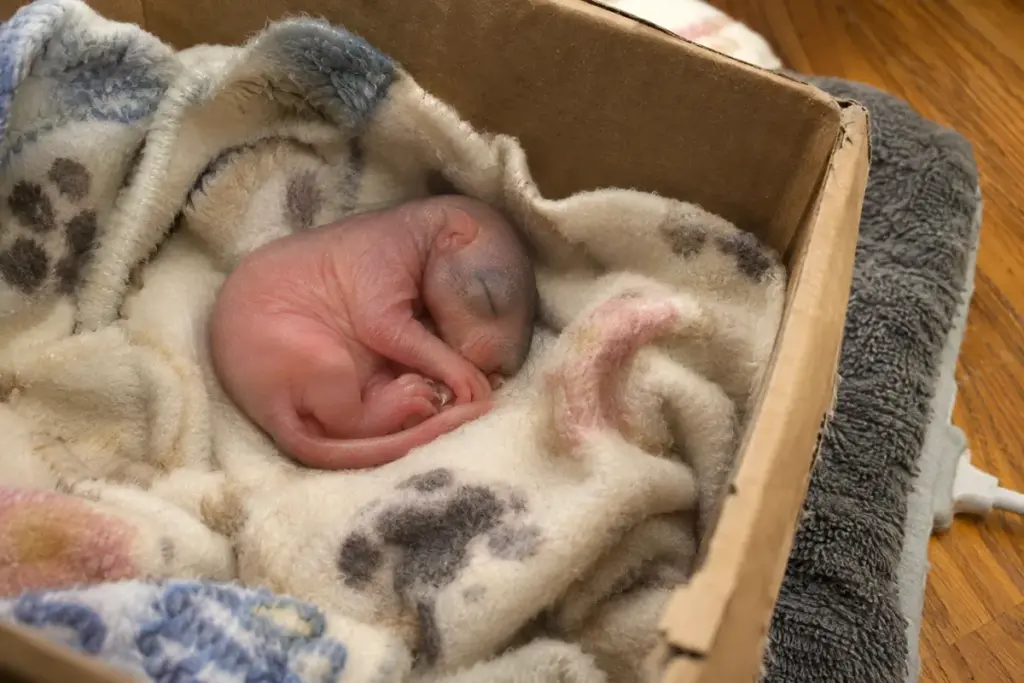
Skip the reunion attempt and go straight to care if the baby is injured, was carried by a cat or dog, has flies or eggs on it, or is cold and limp. A squirrel that is nearly full size, with a bushy tail and that runs and climbs well, is independent and does not need rescue.
2. Warm it before anything else
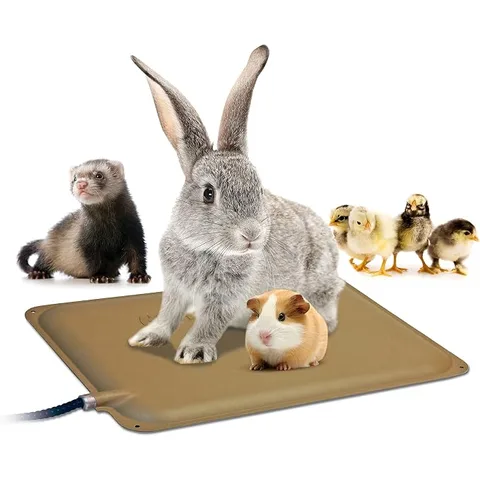
A chilled baby cannot digest. Set a heating pad on low under half of a small box, put a layer of soft fleece or an old T-shirt on top and let the baby choose how close to sit to the heat. Use a pad without an auto shut-off. Skip terry towels, because the tiny claws catch in the loops. Keep the box in a dark, quiet room away from pets and children.
3. Rehydrate with electrolyte fluid, not milk
Treat every found baby as dehydrated. Pinch the skin between the shoulders: if it stays tented or falls back slowly, the baby is dry. Give warmed, unflavored Pedialyte one drop at a time from a 1 ml syringe. Squirrel-rehab.org gives it every 15 minutes for about 2 hours. Henry’s Healthy Pets dilutes it half and half with water because of the sodium. A badly dehydrated baby can need fluids for up to 24 hours.
Move to formula in steps: a mix of 25% formula and 75% fluid for the first couple of feeds, then half and half, then 75% formula, then full strength. Do not use Gatorade or sports drinks.
4. Call a licensed wildlife rehabilitator
Find one near you through Animal Help Now, your state wildlife agency or a local vet. Most US states make it illegal to keep a wild squirrel without a permit, and a rehabber has the formula, the experience and the outdoor release cages a squirrel needs. Many rehabbers are volunteers, so plan to drive the baby to them. The rest of this guide is for the hours or days before that handoff, and for anyone a rehabber has asked to help.
What formula to feed a baby squirrel
Rehabbers in the US raise gray, fox and red squirrels on Fox Valley Day One 32/40, a milk replacer made for squirrels, opossums and cottontails. Mix 1 part powder to 2 parts warm distilled water by volume. Henry’s Healthy Pets moves babies to Fox Valley 20/50, which has more fat, at about 4 weeks old. Wombaroo Squirrel Milk Replacer is the other option rehab sources name, and Henry’s prefers it for babies under 2 weeks.
Esbilac puppy milk replacer powder is the fallback. Squirrel-rehab.org has raised squirrels on it for years, mixed 1:2 per the PetAg label. Henry’s now advises against it. If Esbilac is all the pet store has tonight, it is far better than any milk from the fridge, and you can switch when Fox Valley arrives.
Mix one day’s supply at a time and keep it refrigerated. Warm one feed at a time to about body temperature and test a drop on your wrist. Throw away what is left in the syringe.
Formulas and milks that harm baby squirrels
- Cow’s milk, including evaporated and condensed milk. Cornell’s Wildlife Health Lab warns it causes severe stomach upset. Diarrhea in a baby this small turns into dehydration within hours.
- Kitten formula (KMR). Rehabbers link it to metabolic bone disease in squirrels.
- Human infant formula and breast milk.
- Soy, almond, oat, cashew or coconut milk.
Homemade recipes all over the internet have no rehab source behind them. The one exception is Henry’s emergency goat milk formula (3 tablespoons goat milk, 2 tablespoons heavy cream, 3 tablespoons plain yogurt and half an egg yolk), which Henry’s limits to 2 weeks at most.
How to feed a baby squirrel
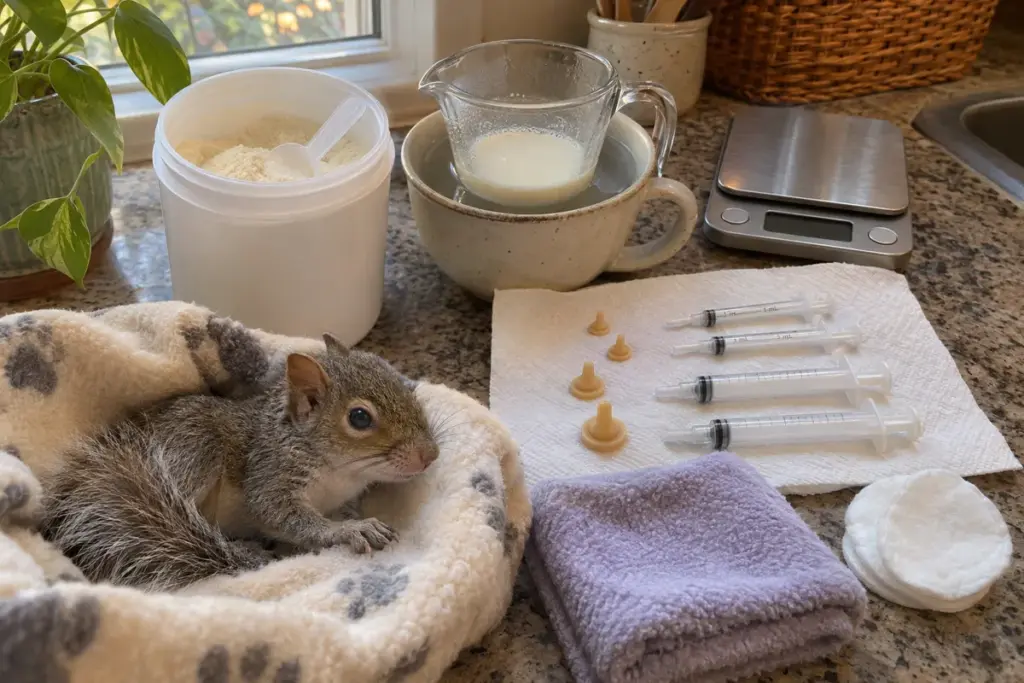
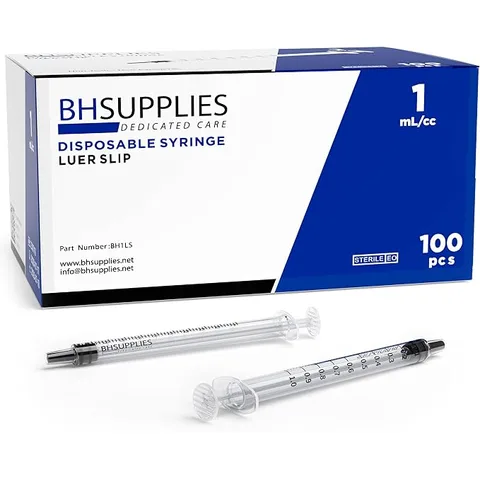
Use a 1 ml oral syringe with a small rubber nipple on the end, such as a Miracle Nipple. The Florida Wildlife Rehabilitators Association moves babies to a 3 ml syringe at about 4 and a half weeks and never goes bigger. A pet nursing bottle lets milk run too fast and the baby inhales it.
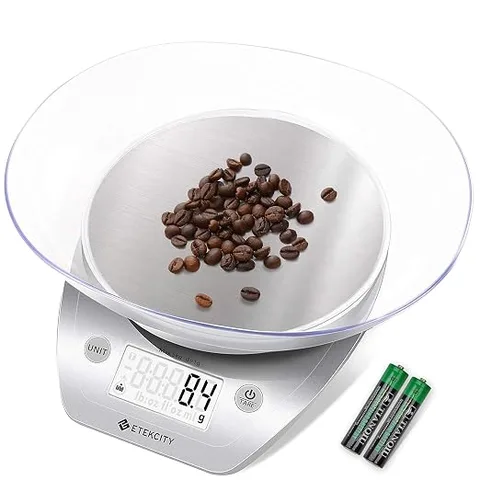
- Weigh the baby on a digital gram scale before the first feed of the day. Kitchen scales that read in ounces are not precise enough.
- Work out the amount. Feed about 5% of its body weight in milliliters. A 50 g baby gets 2.5 ml. Start smaller with a weak or thin baby and work up to 5%, then 7% once it feeds well.
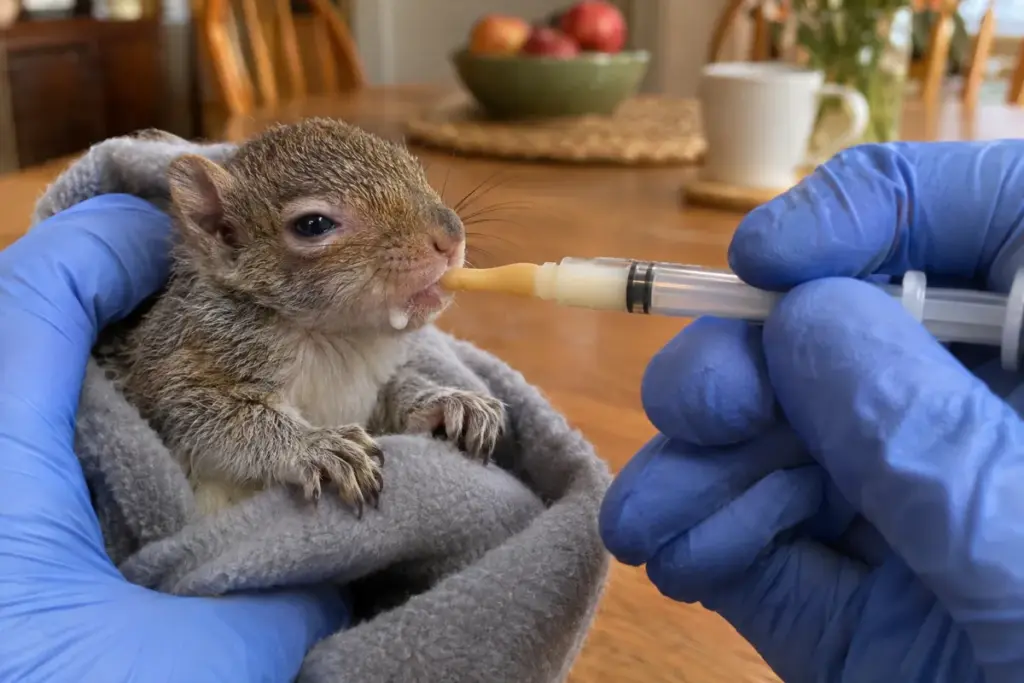
- Hold it belly down or upright, wrapped in fleece, the way it would lie against its mother. Never feed a squirrel on its back.
- Go slowly. Newborns get single drops. Older babies get about one second of gentle pressure, then a pause to swallow. Let the baby let go of the nipple on its own.
- Watch the nose. Milk or bubbles from the nose mean formula went into the lungs. Stop, tip the head down and wipe the nose and mouth. Wait before trying again.
- Stimulate it to pee and poop after every feed. Rub the genitals and anus gently with a warm, damp cotton ball for up to a minute until it goes. Keep doing this until about 5 weeks, when the eyes open and it starts going on its own.
- Clean every syringe and nipple after each use.
A feed takes about 5 to 7 minutes. If the baby starts gulping and stretching its arms out in a feeding trance, pull the syringe away for a moment.
Baby squirrel feeding schedule by age
The schedule follows eastern gray squirrels, the species most people find in the US. Fox squirrels develop more slowly and red squirrels are smaller, so dose by body weight rather than by age for those. If you don’t know the age, the “what it looks like” column is a reliable guide.
| Age | What it looks like | Food | Amount | How often | Notes |
|---|---|---|---|---|---|
| 0–1 week | Pink, hairless, eyes and ears sealed | Rehydrate first, then formula only | A few drops, building to 5% of body weight in ml | Every 2 hours, day and night | Stimulate to pee and poop after every feed. Needs a rehabber urgently. |
| 1–3 weeks | Dark skin on head and back, eye slits, then short fur except belly | Formula only | 5% of body weight in ml per feed | Every 2–3 hours, including night | Stimulate after every feed. Weigh in grams daily. |
| 3–5 weeks | Thicker fur, lower front teeth, eyes open around 4–5 weeks | Formula; switch to Fox Valley 20/50 near 4 weeks | 5–7% of body weight in ml per feed | Every 3–4 hours, night feeds still needed | Keep stimulating until about 5 weeks or eyes open. |
| 5–7 weeks | Fully furred incl. belly, eyes open, upper teeth showing | Formula, plus rodent block left in the box | 5–7% of body weight in ml per feed | Every 4 hours, night feeds only if needed | Add a water bottle when blocks go in. |
| 7–10 weeks | Tail starts to fluff, climbs and explores | Formula, rodent block, one new vegetable at a time | Formula 5–7% of body weight; blocks free choice | Formula 3–4 times a day | Stop a new food for a while if diarrhea starts. |
| 10–16 weeks | Near adult look, full bushy tail | Formula as it wants, blocks, vegetables; nuts and fruit as treats near 16 weeks | Up to 2 fruit pieces and 2 nuts a day | Formula 2–3 times a day until it weans itself | Rehabbers move them to an outdoor cage before release. |
Weigh at the same time every day and write it down. Weight should go up on most days. A baby that loses weight two days in a row needs a rehabber.
Weaning: what solid food to give a young squirrel
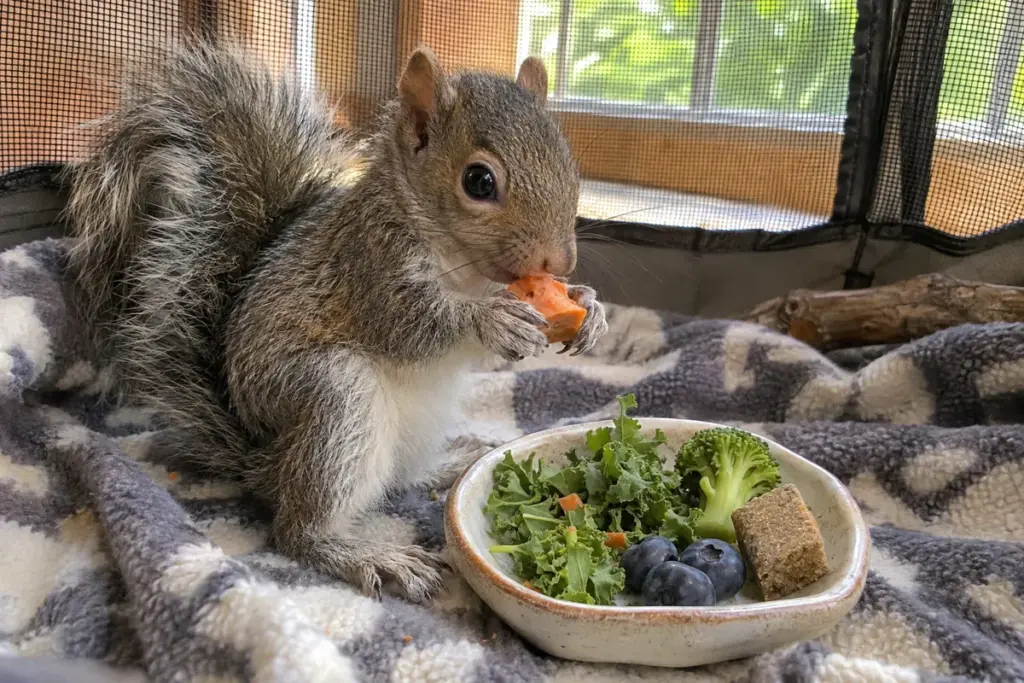
At around 5 to 6 weeks, leave a piece of rodent block in the box so the baby learns the smell. Solids start in earnest at 6 to 7 weeks.
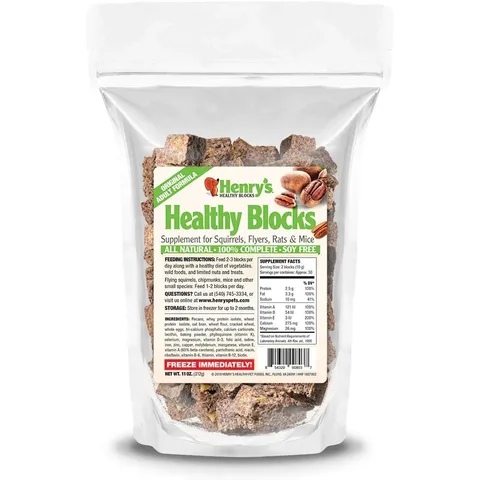
- Rodent block first. Henry’s Healthy Blocks, Rodent Bloc and similar lab blocks supply the calcium and vitamin D that formula used to provide. Squirrels raised on nuts and seeds instead develop metabolic bone disease: weak legs, fractures and seizures.
- Vegetables next, one at a time. Broccoli, cauliflower, romaine and bok choy are good first choices. Wait 24 hours after each new food. If diarrhea starts, drop that food and try it again later.
- Starchy vegetables in small amounts. Sweet potato and carrots are fine as small pieces, not the bulk of the diet.
- Water in a hanging bottle from the day blocks go in.
- Keep offering formula until at least 16 weeks. Weaning off formula too early is one of the most common mistakes, according to Henry’s.
When can a baby squirrel eat nuts and fruit?
Not before about 16 weeks. After that, Henry’s caps treats at 2 nuts and 2 small pieces of fruit a day. Walnuts, pecans and unsalted almonds are fine as treats. Peanuts, sunflower seeds and dried corn stay off the menu: they are low in calcium and can carry aflatoxin mold, and they fill a growing squirrel up without the minerals its bones need. Acorns can also carry aflatoxin. Wild squirrels learn to find them after release.
Signs something is wrong
- Milk or bubbles from the nose: formula went into the lungs (aspiration). Stop feeding and tilt the head down.
- Clicking sound when it breathes, labored breathing or lethargy: likely aspiration pneumonia. It needs antibiotics from a vet or rehabber the same day.
- Tight, swollen belly: bloat, usually from overfeeding or feeding too fast. Skip a feed, give less next time and stimulate.
- Diarrhea: overfeeding, the wrong formula, cow’s milk or too much fruit. Diarrhea dehydrates a baby fast.
- Dark or thick, honey-colored urine: dehydration, or the baby is not being stimulated often enough.
- Weak or splayed legs, trouble climbing or limping: metabolic bone disease from a low-calcium diet. Get it to a rehabber.
Printable baby squirrel feeding chart
The cheat sheet fits on one page. It has the safe, small amounts only and never food lists, the schedule by age, the emergency steps and a log for weight and feeds. Print it in color or in black and white and tape it next to the formula.
Supplies for feeding a baby squirrel
These are the items rehab guides name. You need the formula, a syringe with a nipple and a gram scale on the first day. The rest can wait until weaning.
More about squirrels
Adult squirrels eat a very different diet from babies. See what wild Douglas squirrels eat through the seasons, how Columbian ground squirrels fatten up before hibernation and the characteristics of flying squirrels. For their striped cousins, read what Siberian chipmunks eat. All our squirrel articles are in the squirrels section. Found a baby bird instead? See what to feed a baby pigeon. For a baby bunny, see what to feed a baby rabbit. Found a fawn? See what to feed a baby deer.
Frequently asked questions
What can I feed a baby squirrel in an emergency?
Warmth and unflavored Pedialyte come first, given one drop at a time from a 1 ml syringe. If you have to feed before you can get squirrel formula, Esbilac puppy milk replacer powder from a pet store is the usual stopgap, mixed 1 part powder to 2 parts warm water. Never use cow's milk. Call a wildlife rehabilitator the same day.
Can baby squirrels drink cow's milk?
No. Cow's milk causes severe stomach upset and diarrhea in baby squirrels, and diarrhea dehydrates a baby that small within hours. The same goes for evaporated milk, condensed milk, plant milks, kitten formula and human baby formula.
What do baby squirrels drink?
In the wild they drink only their mother's milk until about 6 weeks and keep nursing for weeks after they start solids. In care they drink squirrel milk replacer such as Fox Valley 32/40, plus unflavored Pedialyte for rehydration at the start. Once they eat rodent block they drink water from a hanging bottle.
How much formula do you feed a baby squirrel?
About 5% of its body weight in milliliters per feeding. A 50 g baby gets 2.5 ml and a 100 g baby gets 5 ml. Start with less for a weak baby and work up to 7% once it feeds well. Weigh it in grams every day.
How often do you feed a baby squirrel?
Every 2 hours in the first week, every 2 to 3 hours until 3 weeks and every 3 to 4 hours from 3 to 5 weeks, including through the night. From 5 to 7 weeks it eats every 4 hours, then 3 to 4 formula feeds a day during weaning.
How do I know how old a baby squirrel is?
A pink, hairless baby with sealed eyes is under a week old. Short fur except on the belly means about 3 weeks. Lower front teeth appear around 4 weeks, and a fully furred baby with open eyes is about 5 weeks old. A squirrel that is nearly full size with a bushy tail and runs well is independent.
When can baby squirrels eat solid food?
At about 6 to 7 weeks, starting with a rodent block. Add vegetables such as broccoli and romaine one at a time after that. Keep offering formula until at least 16 weeks.
Can baby squirrels eat nuts?
Not before about 16 weeks. Nuts are low in calcium, and young squirrels fed mostly nuts or seeds develop metabolic bone disease. After 16 weeks, 2 walnuts, pecans or unsalted almonds a day is the limit Henry's Healthy Pets recommends. Skip peanuts, sunflower seeds and dried corn.
Can baby squirrels eat fruit like bananas, apples or grapes?
Only after about 16 weeks, as treats. Banana, apple without seeds, seedless grapes, strawberries and blueberries are all fine in small pieces, up to 2 pieces of fruit a day. Too much fruit causes diarrhea.
Do I need to stimulate a baby squirrel to pee?
Yes, until it is about 5 weeks old and its eyes are open. After every feed, rub its genitals and anus gently with a warm, damp cotton ball for up to a minute until it pees and poops. Light yellow urine is normal. Dark urine means it needs stimulating more often.
Is it legal to keep a baby squirrel?
In most US states it is illegal to keep a wild squirrel without a wildlife rehabilitation permit. You can give short-term care while you find a licensed rehabilitator through Animal Help Now, your state wildlife agency or a vet.
What should I do if formula comes out of the baby squirrel's nose?
Stop feeding at once, tip its head down and wipe the nose and mouth. Formula from the nose means some went into the lungs. If you later hear a clicking sound when it breathes, or it turns lethargic, it needs antibiotics from a vet or rehabber that day.
Sources
- Baby Squirrel Care Guide, Henry’s Healthy Pets
- Infant Feeding and Eyes Open: Weaning, Squirrel Wildlife Rehabilitation
- Squirrel Care: The Basics of Squirrel Rehab, Florida Wildlife Rehabilitators Association
- What to do if you found a sick or injured baby squirrel, Tufts Wildlife Clinic
- How to help orphaned or injured baby wild animals, Humane World for Animals
- Found a Squirrel?, Houston Humane Society
- Baby animals need specialized formula, not cow’s milk, Cornell Wildlife Health Lab
- Raising Orphan Baby Fox Squirrels, Ron Hines DVM PhD
- Esbilac Puppy Milk Replacer Powder, PetAg