Table of Contents
- What Makes a Bird “Wetland-Adapted”
- The Long-Legged Waders
- The Cranes
- Hunters on the Wing and Water
- Why These Birds Need Wetlands to Survive
Stand at the edge of any marsh at dawn and you’ll hear it before you see it — the rusty-gate creak of a heron taking off, the rattle of a kingfisher, something unseen booming like a slammed car door in the reeds. Wetland birds are some of the strangest, most specialized animals in North America, and most people can only name two or three of them.
That’s a shame, because these birds are built like tools. A spoonbill’s bill is a sieve. A bittern’s plumage is camouflage so precise it points its beak skyward to disappear into the reeds. This guide covers 10 wetland birds you’re likely to actually encounter, grouped by how they make a living, with the field marks and the one detail about each that’s worth remembering.
What Makes a Bird “Wetland-Adapted”
Three body parts do most of the work. Legs, first: waders like herons and egrets have stilt-like legs that let them walk through water without swimming, wading out past shorter-legged competitors to hunt in deeper zones. Second, the bill. Spear-shaped bills (herons) stab; spatulate bills (spoonbills) sweep and filter; decurved bills (ibises) probe blind into soft mud where sight is useless. Third, the feet — webbed for swimmers like ducks, splayed and long-toed for birds that need to stand on floating vegetation without sinking.
Diet follows form. A bird that wades stabs fish and frogs one at a time. A bird that dabbles or dives eats in bulk — seeds, aquatic plants, invertebrates filtered from mud. Once you know which category a bird falls into, identifying it gets a lot easier, even before you check plumage.
The Long-Legged Waders
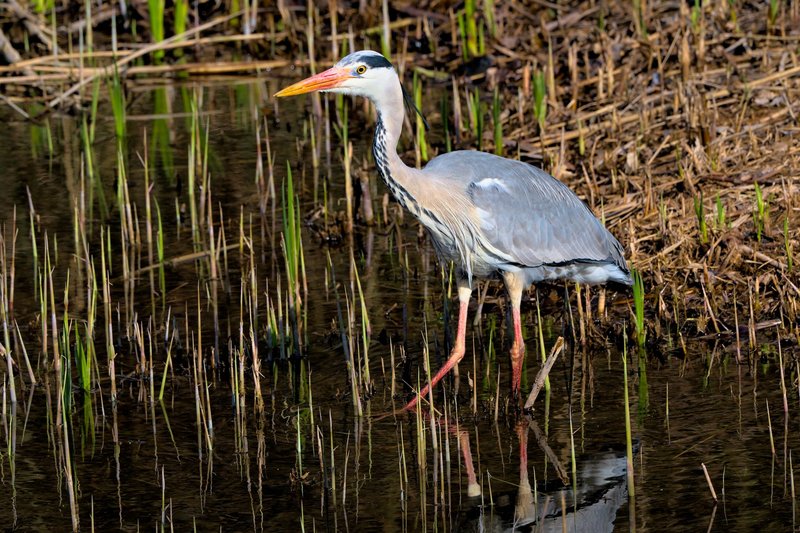
These are the birds most people picture when they hear “wetland bird” — tall, patient, built to stand motionless in shallow water until something swims within range.
1. Great Blue Heron
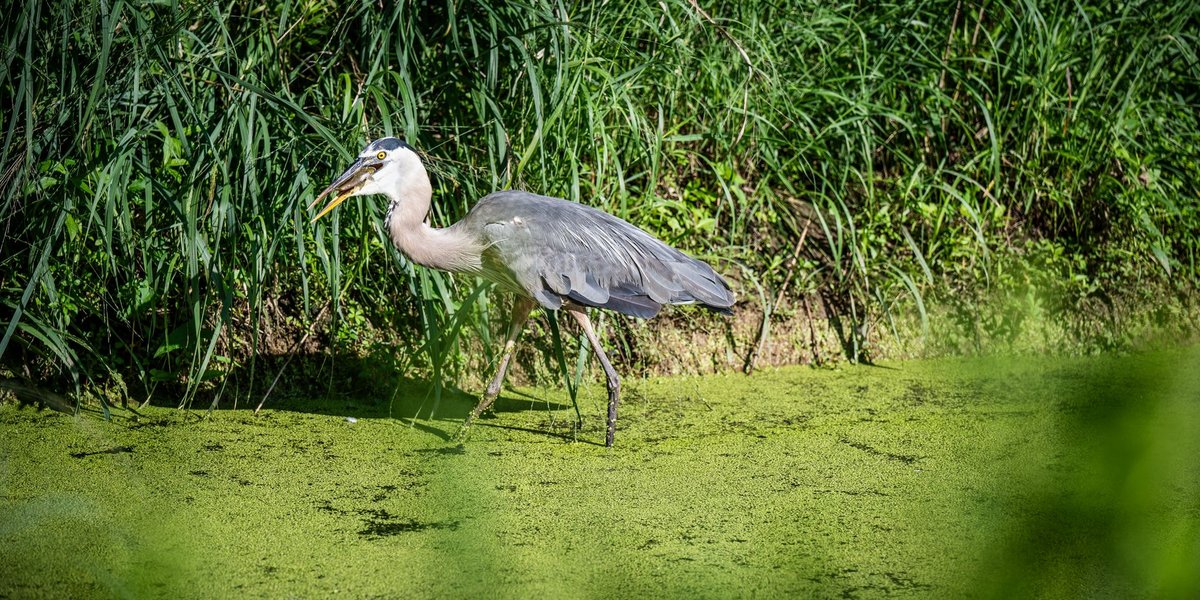
North America’s largest heron stands close to four feet tall, with a shaggy gray-blue body, a black eyebrow stripe, and an S-curved neck it keeps folded in flight — the giveaway that separates it from a crane at a distance. It hunts by standing dead still, then striking with a dagger bill fast enough to spear fish clean through. It’s also more opportunistic than its elegant posture suggests: Great Blue Herons have been documented eating gophers, ducklings, and small snakes when the water’s not delivering. Unlike a lot of wetland species, its population is stable to increasing, and it’s rated Least Concern.
2. Great Egret
Pure white, yellow-billed, black-legged, and the reason plume hunting is illegal today. In the late 1800s, egret feathers sold for more than gold by weight to supply the hat trade, and the Great Egret was hunted to the edge of extirpation across much of its range. Its recovery became the founding cause of the Audubon movement — the bird is literally the organization’s logo. Watch one hunt and you’ll see it stalk in slow motion, one leg lifted for whole seconds, before an explosive strike.
3. Snowy Egret
Smaller than the Great Egret, with a black bill, black legs, and bright yellow feet that look like it stepped in paint — birders call them “golden slippers.” Those feet aren’t just decoration: the Snowy Egret shuffles them in shallow water to stir up small fish and crustaceans, then stabs whatever bolts. It’s one of the more active hunters on this list, moving and flushing prey rather than waiting it out.
4. Roseate Spoonbill
The pink one. That color comes from carotenoid pigments in the crustaceans it eats — the same pigment pathway that turns flamingos pink. Its bill is flattened and rounded at the tip like a spoon, and it feeds by swinging its head side to side through shallow water with the bill partly open, snapping shut the instant it touches something edible. It’s often mistaken for a flamingo by first-time visitors to Gulf Coast marshes, but the spoon-shaped bill and shorter legs settle it immediately.
5. Wood Stork
The only stork that breeds in North America, and one of the more dramatic conservation stories on this list. Wood Storks nest in large colonies, timing their breeding to water levels so precisely that in years when the water doesn’t drop enough to concentrate fish into easy range, a colony may skip nesting entirely. That sensitivity to hydrology made it one of the clearest indicator species for Everglades habitat health, and decades of habitat loss pushed its southeastern population down from over 150,000 birds to roughly 10,000 by the early 1990s before conservation efforts helped it recover.
The Cranes
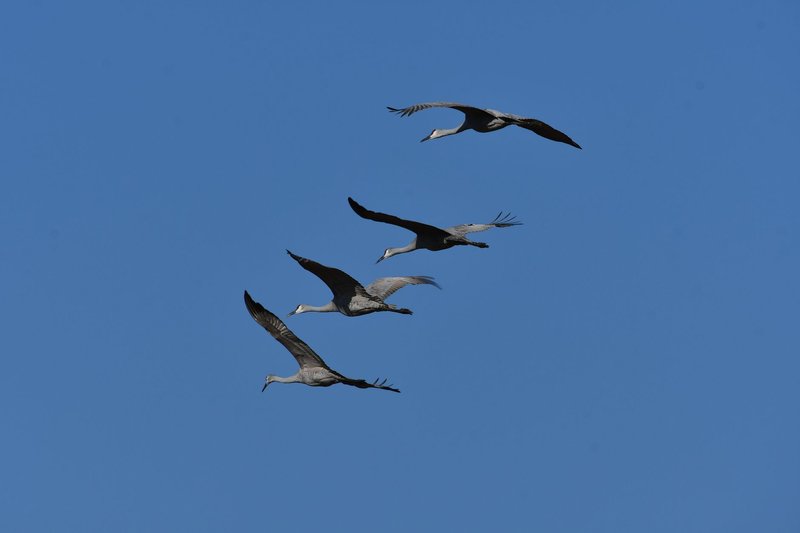
Cranes get confused with herons constantly, but the tell is in flight: cranes fly with their necks straight out, herons fold theirs into an S. Cranes are also loud in a way herons aren’t — their calls carry for miles.
6. Sandhill Crane
Gray-bodied with a bald red crown and a bugling call that sounds prehistoric because the lineage basically is — sandhill cranes are among the oldest living bird species, with fossil relatives dating back millions of years. Chicks, called colts, are mobile almost immediately: a sandhill crane colt can leave the nest and start swimming within eight hours of hatching. Adults mate for life and perform an elaborate courtship dance — leaping, bowing, wings spread to a seven-foot span — that they’ll repeat throughout the relationship, not just during initial pairing.
7. Whooping Crane
North America’s tallest bird and its rarest crane, distinguished from the sandhill by pure white plumage and black wingtips visible only in flight. The recovery story here is as dramatic as any in American conservation: the wild population dropped to just 15 birds in 1941. Decades of protection, captive breeding, and an ultralight-led migration program that taught a new flock a Wisconsin-to-Florida route have brought the wild population back to roughly 370 to 500 birds today — still critically low, but no longer in free fall. It remains listed as Endangered.
Hunters on the Wing and Water
Not every wetland bird wades. Some fly, some dive, some paddle — and their adaptations look nothing like a heron’s stilt legs.
8. Osprey
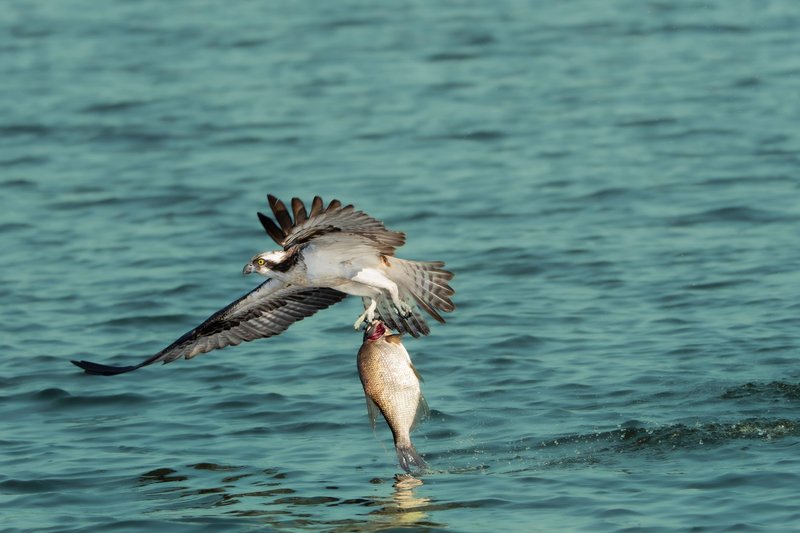
A fish hawk in the most literal sense — ospreys eat almost exclusively fish, typically four to twelve inches long, snatched feet-first from the surface after a controlled dive. Reversible outer toes and barbed foot pads let it grip a slippery fish and carry it head-first through the air to reduce drag, an adaptation no other North American raptor shares. Ospreys build enormous stick nests on dead trees, channel markers, and utility poles, often reusing and expanding the same nest for years until it’s the size of a kiddie pool.
9. Wood Duck
Arguably the most colorful waterfowl in North America — the male looks almost airbrushed, with a sweeping green-and-purple crested head, red eyes, and boldly patterned flanks. Unlike most ducks, Wood Ducks nest in tree cavities, sometimes 50 feet above the ground, which means newly hatched ducklings have to jump from the nest hole to the forest floor or water within a day of hatching, bouncing off the leaf litter largely unharmed. They’re one of the few duck species that regularly perches in trees, thanks to sharp claws most ducks lack.
10. American Bittern
The introvert of the marsh. Its plumage is a streaked brown-and-white pattern that vanishes against dead reeds, and when it feels threatened, it points its bill straight up and sways gently with the wind-blown vegetation — a posture called “bitterning” that makes an otherwise sizable bird disappear in plain sight. You’re far more likely to hear one than see one: its call is a deep, gulping “oonk-a-choonk” that sounds unsettlingly mechanical and carries across a marsh at dusk, which is why old field guides describe it as sounding like a stake being driven into mud.
Why These Birds Need Wetlands to Survive
Every bird on this list depends on a habitat type the U.S. has been steadily losing for over a century — the lower 48 states have drained more than half their original wetland acreage for agriculture and development. That loss shows up directly in these species’ fortunes: the Wood Stork’s population crash tracked almost exactly with Everglades water diversion, and the Whooping Crane’s near-extinction was as much about vanishing prairie wetlands as it was about hunting.
The flip side is that wetland birds respond fast to habitat recovery, faster than most wildlife. Restore hydrology and food shows up within a season; herons and egrets will nest in a restored marsh before the vegetation has fully matured. That responsiveness is why conservation groups treat wading bird colonies as a barometer for wetland health — when the herons come back, it’s a sign the system is working again.