Most lists of Amazon rainforest predators are really lists of things that can hurt you. Poison dart frogs, bullet ants and candiru show up constantly, and none of them hunt anything. A predator kills and eats other animals to live. That’s the filter used here.
What’s left is twelve animals that run the Amazon’s food web, split by where they hunt: the forest floor and canopy, the rivers, and the leaf litter where the invertebrates operate.
Table of Contents
- Apex predator or mesopredator?
- Forest floor and canopy predators
- Water predators
- Invertebrate predators
- Amazon rainforest predators compared
- The Amazon rainforest food chain
- Are Amazon predators dangerous to humans?
- What threatens the predators
- Summary
Apex predator or mesopredator?
An apex predator sits at the top of its food chain. Adults have no regular natural predators, and they shape what happens below them. A mesopredator sits in the middle: it kills smaller animals and gets killed by bigger ones.
The Amazon has no single apex predator of the rainforest. It has several, split by habitat. The jaguar rules the ground, the harpy eagle rules the canopy, and the black caiman and green anaconda rule the water. Ocelots, boas, piranhas and wandering spiders are mesopredators. Each one is a serious hunter that also ends up on someone else’s menu.
Each profile below uses the same four facts: size, prey, hunting method and IUCN Red List status.
Forest floor and canopy predators
Jaguar
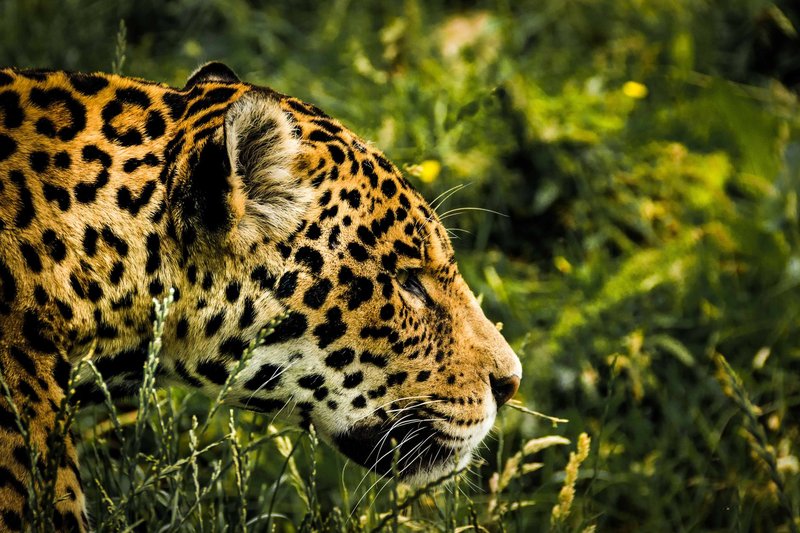
- Size: 1.1 to 1.85 m long, roughly 50 to 100 kg in the Amazon, with males larger
- Prey: capybara, peccaries, deer, tapir, caiman, turtles, fish
- Hunting method: stalk and ambush, often near water
- IUCN status: Near Threatened
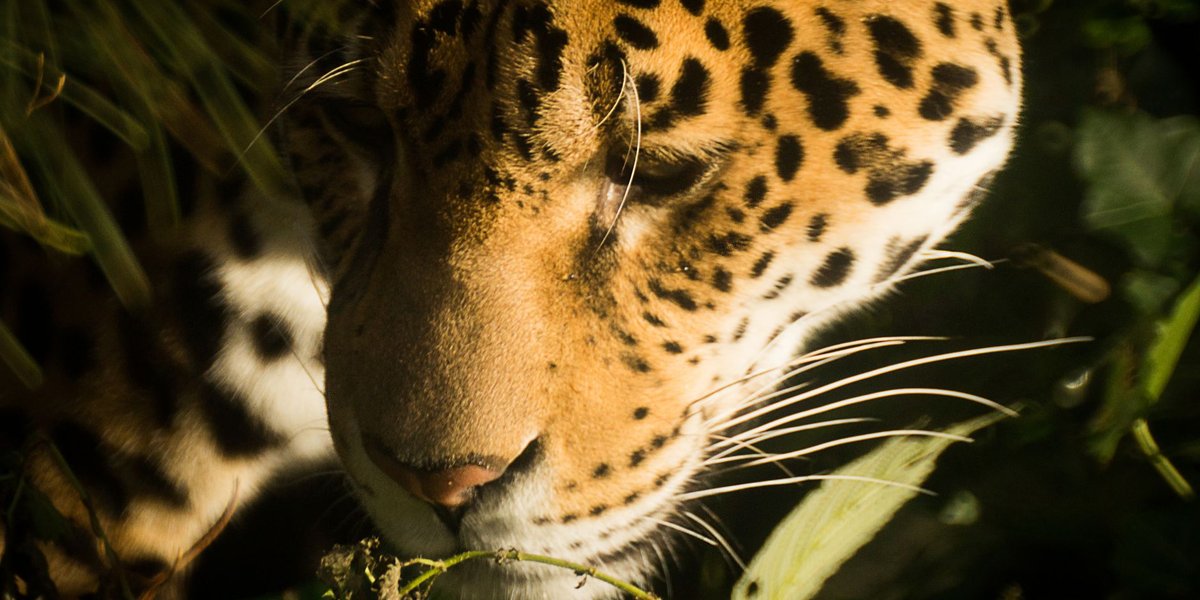
The jaguar is the biggest cat in the Americas and the Amazon’s top land predator. Its bite is the point. Pound for pound it’s one of the strongest of any big cat, and it kills by driving its canine teeth through the skull or the back of the neck instead of strangling prey, as lions and tigers do. That same bite cracks turtle shells and caiman armor.
Jaguars swim well and hunt riverbanks as often as forest. The jaguar vs black caiman question is real: jaguars do kill caimans, and the reverse happens to unlucky jaguars in the water. On land the cat wins most of these.
Puma
- Size: roughly 1 to 1.5 m long, 30 to 70 kg in tropical forest
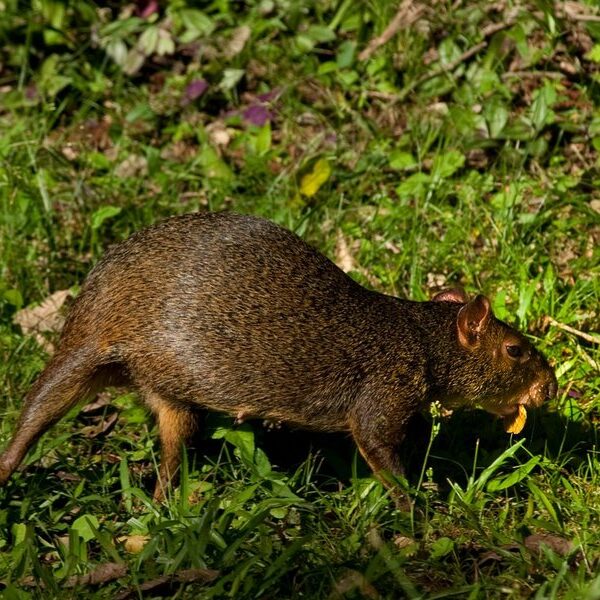
- Prey: deer, peccaries, agoutis, pacas, smaller mammals
- Hunting method: stalk and short pounce
- IUCN status: Least Concern
Pumas share the Amazon with jaguars and mostly lose the turf war. They’re smaller, take smaller prey, and lean on the margins: drier forest, edges, and hours when the jaguar isn’t around. Where jaguars disappear, pumas often expand into the vacated prey.
Ocelot
- Size: 65 to 100 cm long, 8 to 16 kg
- Prey: rodents, opossums, birds, lizards, small monkeys, fish
- Hunting method: nocturnal stalk, on the ground and low in trees
- IUCN status: Least Concern
The ocelot is the Amazon’s mesopredator cat. It’s roughly the size of a large house cat with the build of a sprinter, and it does most of its work at night. Jaguars and pumas will kill ocelots, so the smaller cat is the hunter and the hunted at once.
Harpy eagle
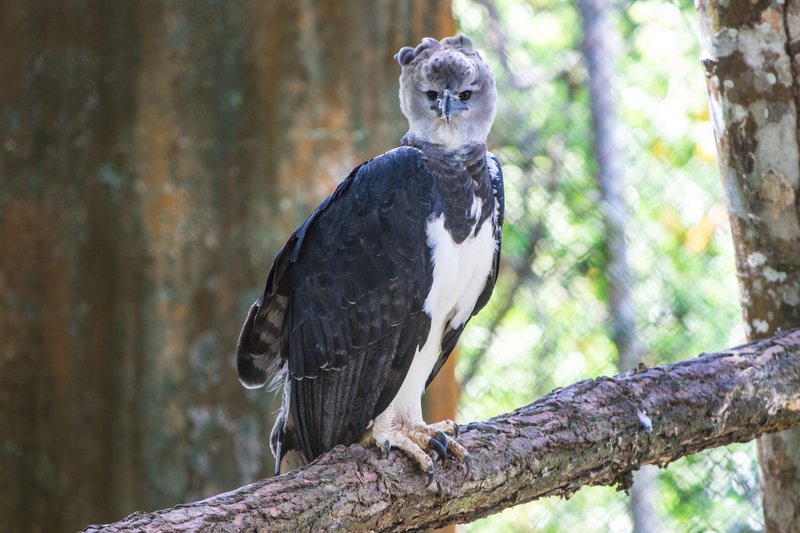
- Size: wingspan up to about 2 m, females up to about 9 kg
- Prey: sloths, monkeys, macaws, other canopy animals
- Hunting method: short, fast flights through the canopy, grabbing prey from branches
- IUCN status: Vulnerable
The harpy eagle diet is mostly sloths and monkeys, and the bird can lift prey close to its own body weight. Its wings are short and broad, built for turning between trunks instead of soaring. Its talons reach about 13 cm, which is why it’s the canopy’s apex predator. For the rest of the basin’s roughly 1,300 bird species, see Amazon rainforest birds worth knowing.
Harpies nest in the tallest emergent trees, often kapok, and raise a single chick every two to three years. That slow breeding is a large part of why the species is declining.
Boa constrictor
- Size: commonly 2 to 3 m, occasionally longer
- Prey: rodents, opossums, birds, lizards, occasionally small mammals up to the size of an ocelot
- Hunting method: ambush, then constriction
- IUCN status: Least Concern
Boas are patient. A boa picks a spot on a game trail or low branch and waits for days, then strikes, coils and squeezes until the prey’s blood flow stops. They’re mesopredators: big enough to be dangerous to most things on the forest floor, small enough to be eaten by caiman, jaguars and large eagles.
Water predators
Black caiman
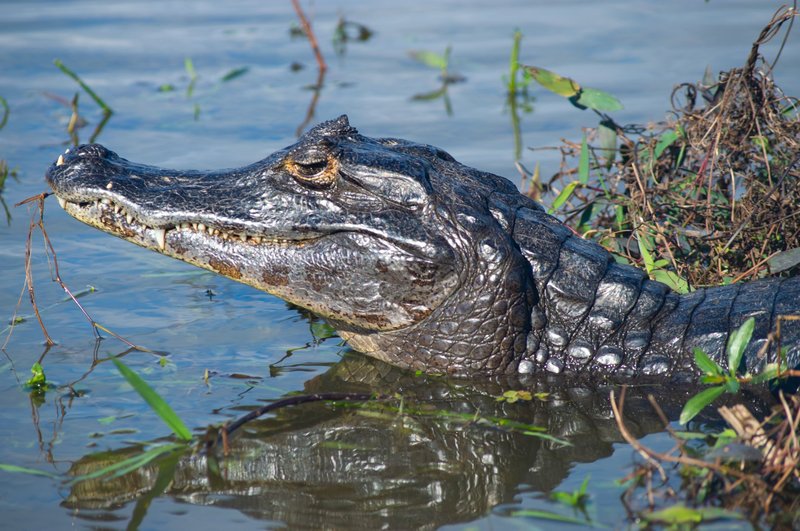
- Size: typically 3 to 4.5 m, with exceptional animals reported near 5 m or more, and weights that can pass 400 kg
- Prey: fish, capybara, birds, deer, turtles, other caiman, occasionally jaguars
- Hunting method: night ambush from the water’s edge
- IUCN status: Least Concern
The black caiman is the largest predator in the Amazon basin. Size figures conflict between sources, and the older claims of 6 m and beyond rarely come with measurements. A 4 m animal is already enormous.
Hide hunters wiped these animals out across much of their range between the 1950s and 1970s, and they recovered afterward. Mature adults have no natural enemies except, in rare cases, the biggest anacondas.
Green anaconda
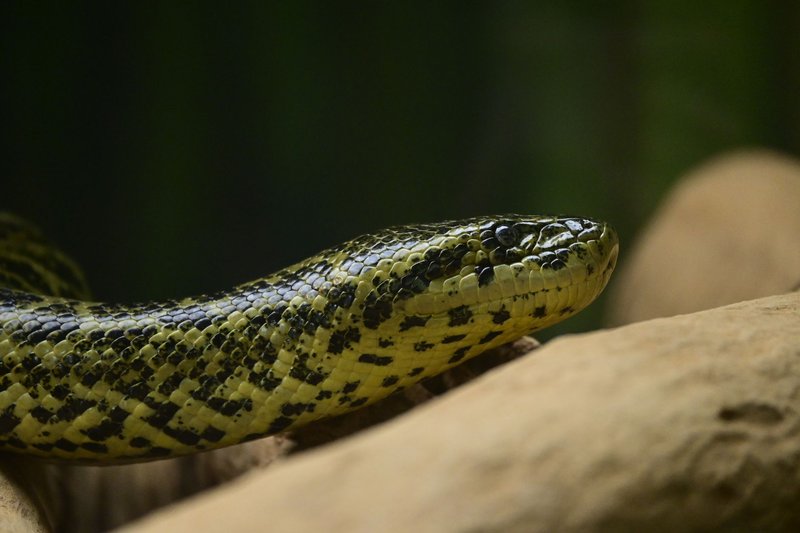
- Size: typically 3 to 5 m, with females much larger than males
- Prey: capybara, deer, caiman, waterbirds, fish, turtles
- Hunting method: ambush in shallow water, then constriction
- IUCN status: Least Concern
The green anaconda is the heaviest snake on Earth, and also the one with the most exaggerated statistics. Weights of 200 to 500 lb get repeated everywhere. Careful field measurements from the largest females put them at around 5 m and about 100 kg, and anything beyond that remains a story. It’s still a snake that eats capybaras whole.
Anacondas hunt with only the nostrils and eyes above the surface. They’re slow on land and fast in water, and that’s where nearly every kill happens.
Giant otter
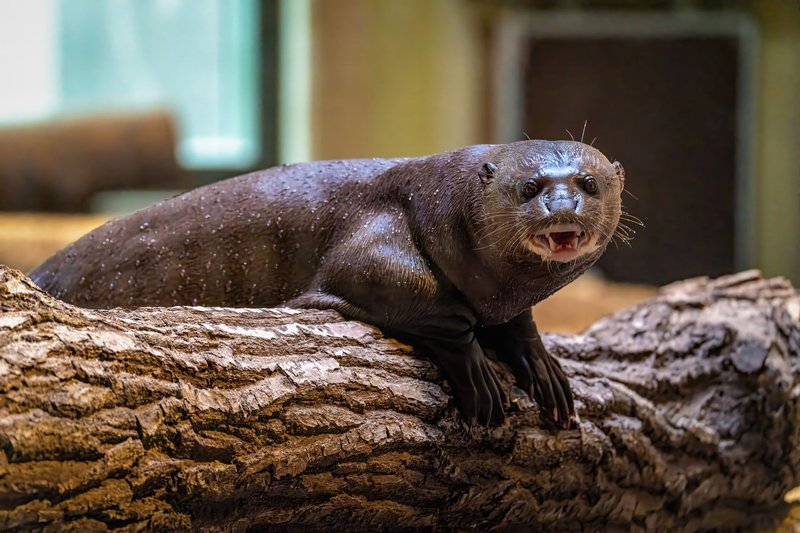
- Size: up to about 1.7 m, 26 to 32 kg
- Prey: fish, especially catfish and piranhas, plus crabs, snakes, and young caimans
- Hunting method: cooperative group hunting
- IUCN status: Endangered
Giant otters hunt in family groups of up to about eight, and the group is why they can hold their own against caimans. A single otter is food for a caiman or a jaguar. A pack that mobs a caiman is a different problem. Each adult eats around 3 to 4 kg of fish a day, which makes the otter a heavy hitter on fish populations.
Red-bellied piranha
- Size: 20 to 35 cm
- Prey: fish, insects, crustaceans, carrion, plant matter
- Hunting method: schooling, opportunistic biting
- IUCN status: Least Concern
The piranha’s reputation is bigger than the fish. Most species are scavengers and opportunistic feeders that eat fish, insects and fruit as well as meat. The school offers safety from caimans, dolphins and otters more than it works as a hunting tool. Piranhas are mesopredators and prey, and giant otters regularly eat them.
Electric eel
- Size: up to about 2.5 m
- Prey: fish, crustaceans, other small aquatic animals
- Hunting method: electric discharge to stun or force prey to twitch and reveal itself
- IUCN status: Least Concern (Electrophorus electricus); other species are less well assessed
Electric eels aren’t eels. They’re a type of knifefish. A 2019 study in Nature Communications split them into three species and measured one, Electrophorus voltai, producing up to 860 volts, the strongest bioelectric discharge known in any animal. The eel uses a high-voltage burst to paralyze prey and a low-voltage pulse to locate it in dark water.
Invertebrate predators
Brazilian wandering spider
- Size: body about 5 cm, leg span up to about 15 cm
- Prey: insects, small frogs, lizards
- Hunting method: active ground hunter, no web
- IUCN status: not evaluated
Phoneutria spiders wander the forest floor at night instead of waiting in a web, which is how they got the name. Their venom is among the most medically significant of any spider. Deaths are rare, and antivenom exists.
Army ants
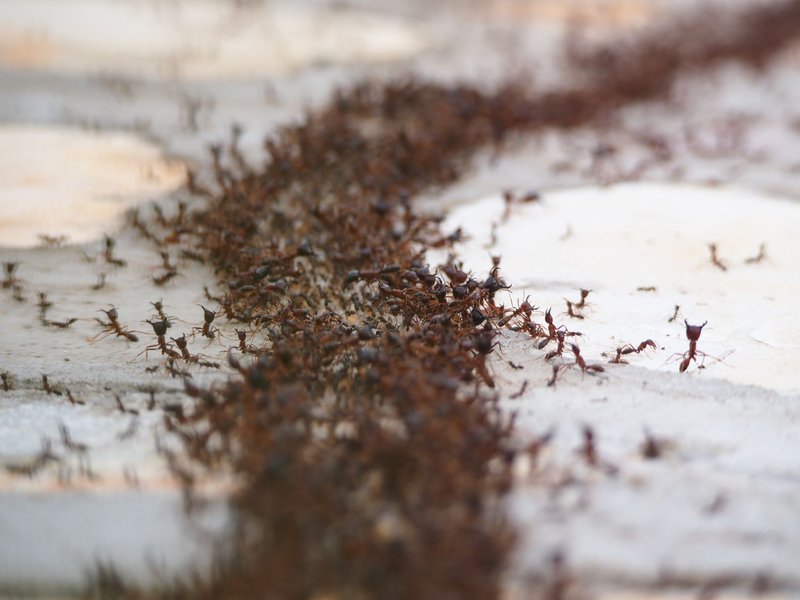
- Size: workers a few millimeters long, colonies in the hundreds of thousands
- Prey: other insects, spiders, scorpions, and small vertebrates that can’t escape
- Hunting method: nomadic swarm raids
- IUCN status: not evaluated
Army ants are the Amazon’s most efficient mass predator. A swarm raid moves across the forest floor as a broad front and flushes everything in its path. Crickets, roaches and lizards bolt ahead of it. Antbirds follow the front and eat what the ants flush out, and some depend on swarms for most of their food. Army ants are why a single colony can affect an area the size of a football field every day.
Amazon rainforest predators compared
| Animal | Size | Habitat | Main prey | Threat to people |
|---|---|---|---|---|
| Jaguar | 50 to 100 kg | Forest floor, riverbanks | Capybara, peccaries, caiman | Low (rare attacks) |
| Puma | 30 to 70 kg | Forest floor | Deer, peccaries, agoutis | Very low |
| Ocelot | 8 to 16 kg | Forest floor, low trees | Rodents, birds, lizards | None |
| Harpy eagle | Up to 9 kg, 2 m wingspan | Canopy | Sloths, monkeys | Very low |
| Boa constrictor | 2 to 3 m | Ground, low branches | Rodents, opossums, birds | Very low |
| Black caiman | 3 to 4.5 m | Rivers, oxbow lakes | Fish, capybara, deer | Moderate (documented fatal attacks) |
| Green anaconda | 3 to 5 m | Swamps, slow rivers | Capybara, caiman, deer | Low (extremely rare) |
| Giant otter | 26 to 32 kg | Rivers, lakes | Fish, young caiman | Very low |
| Red-bellied piranha | 20 to 35 cm | Rivers | Fish, insects, carrion | Low (minor bites) |
| Electric eel | Up to 2.5 m | Slow water | Fish, invertebrates | Low (painful shock) |
| Brazilian wandering spider | 15 cm leg span | Forest floor | Insects, small frogs | Moderate (venomous bite) |
| Army ants | A few mm per worker | Forest floor | Arthropods | Low (painful bites, easy to avoid) |
The Amazon rainforest food chain
The chain starts with plants. Fruit, seeds and leaves feed the primary consumers: agoutis, peccaries, capybaras, sloths, monkeys, tapirs, deer and fruit-eating fish. Those animals feed the middle tier of ocelots, boas, piranhas, wandering spiders and army ants. The top tier takes both groups.
In practice:
- Plants and fruit feed agoutis, monkeys, sloths and capybaras.
- Those herbivores feed ocelots, boas, harpy eagles and jaguars.
- Mesopredators like piranhas and ocelots feed caimans, jaguars and giant otters.
- Apex predators (jaguar, harpy eagle, black caiman, anaconda) end the chain, although they often prey on one another’s young.
The top tier does real work. Jaguars and harpy eagles keep large herbivore and primate populations in check, which affects which seeds get eaten, moved and planted. Take out the jaguar and peccaries and deer rise, and the forest changes slowly after.
Are Amazon predators dangerous to humans?
Mostly not. None of these animals hunts people, and attacks are rare. Here’s the honest ranking:
- Moderate risk: the black caiman, in rivers at night, and the wandering spider, which gets into shoes and luggage and delivers a medically serious bite. Both cause few deaths.
- Low risk: the jaguar, the anaconda, piranhas and electric eels. Jaguar attacks are very rare, anaconda attacks on people are rarer still, piranha bites are usually nips to the foot, and a large electric eel shock is painful and dangerous mostly if you’re already in the water.
- Very low risk: pumas, ocelots, boas, harpy eagles and giant otters.
The Amazon animals that kill most people are mosquitoes, through malaria and dengue. The predators aren’t close.
What threatens the predators
Deforestation is the largest threat, since it fragments territory and removes prey. Jaguars also lose animals to ranchers when they take cattle. Mercury from illegal gold mining builds up in river fish and works its way up the food chain to giant otters and caimans. Harpy eagles, with a single chick every few years, recover slowly from any loss.
Summary
Amazon rainforest predators come in layers. The jaguar and the harpy eagle control land and canopy, the black caiman and anaconda control the water, and ants and spiders cover the leaf litter. The real dividing line isn’t danger to people. It’s who eats whom, and the animals at the top of each layer decide how many herbivores the forest can carry. Lose them and the rest of the food chain follows.