The Amazon holds about 1,300 bird species, and roughly a third of them are found nowhere else or in only a few corners of the basin. That’s more than any single country in North America or Europe can claim. Most of them you’ll never see, because they live in the canopy 30 meters up or skulk on the dark forest floor.
This guide skips the checklist and profiles 15 Amazon rainforest birds that show what the place is like: the giants, the oddballs, the ones that look unreal, and the quiet ones that tell scientists how the forest is doing.
TLDR
- The Amazon has around 1,300 bird species. Fifteen are profiled below with size, diet, forest layer and IUCN status.
- Biggest and most dangerous: the harpy eagle. Strangest: the hoatzin, a leaf-eating bird that smells like manure.
- Most colorful: the macaws and the Guianan cock-of-the-rock.
- Best time to look: the drier months (roughly June to November in much of the basin), at dawn, from a boat or a riverbank.
- The most worrying trend is not among the showy species. It is the decline of small insect-eating birds on the forest floor.
Table of Contents
- Why the Amazon has so many birds
- How to find birds by forest layer
- 15 Amazon rainforest birds
- Quick-reference table
- Macaw clay licks
- When and where to see birds in the Amazon
- Conservation: what is happening to Amazon rainforest birds
Why the Amazon has so many birds
Three things stack up. The basin covers several million square kilometers, so there is simply a lot of habitat. The climate has stayed warm and wet for a very long time, which lets specialists survive in narrow niches. And the rivers cut the forest into pieces.
That last one matters more than it sounds. A bird that won’t fly over open water, like many understory species, can’t cross the Amazon, Negro or Madeira. Populations on opposite banks drift apart over thousands of generations and become separate species. Look at a range map for almost any Amazonian bird family and you’ll see boundaries that follow rivers.
How to find birds by forest layer
The forest isn’t one habitat. It’s four, stacked, and each has its own cast. A guide to the animals of every rainforest layer covers the other animals that share these levels with the birds.
- Emergent layer (40 m and up): the tops of the tallest trees. Big raptors perch and nest here.
- Canopy (20 to 40 m): the fruit and flower buffet. Macaws, toucans, umbrellabirds and most hummingbirds feed here.
- Understory (2 to 20 m): dim, humid and full of insect-eaters like flycatchers. Cock-of-the-rock males display here.
- Forest floor and waterways: antbirds, antthrushes, and the wading species along streams and oxbow lakes.
The profiles below note where each bird lives, so you know where to point your binoculars.
15 Amazon rainforest birds
1. Toco toucan
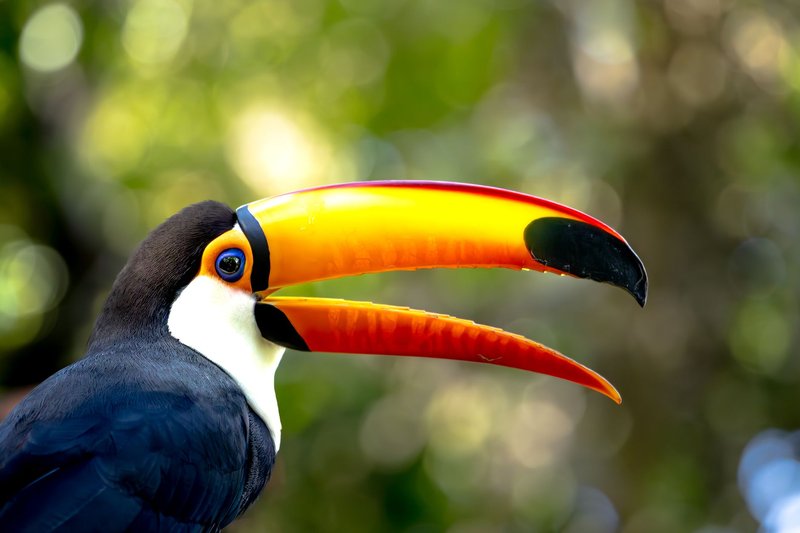
The toco toucan carries a bill of roughly 20 centimeters, about a third of its total body length, in bright orange with a black tip. It looks heavy. It isn’t: the bill is mostly hollow keratin over a light bony framework. Research published in Science showed it also works as a radiator, shedding body heat when the bird needs to cool off.
Size: 55 to 65 cm. Diet: fruit, plus insects and the occasional egg or nestling. Layer: canopy and forest edges. Status: Least Concern.
Surprising fact: the bill’s length lets it pluck fruit from branches too thin to hold the bird’s weight.
2. Scarlet macaw
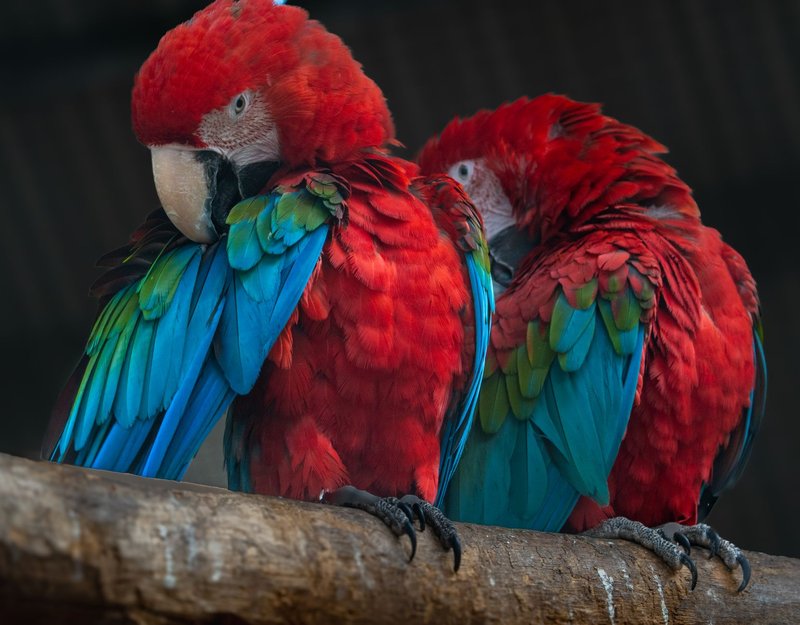
Red body, yellow-and-blue wing band, and a tail that makes up half its length. Scarlet macaws fly in noisy pairs and keep the same partner for years. A wild bird can live 40 years or more.
Size: about 85 cm including tail. Diet: seeds, nuts and fruit, often unripe seeds that other animals avoid. Layer: canopy. Status: Least Concern.
Surprising fact: they gather at riverbank clay walls in the hundreds. More on that in the clay lick section below.
3. Blue-and-yellow macaw
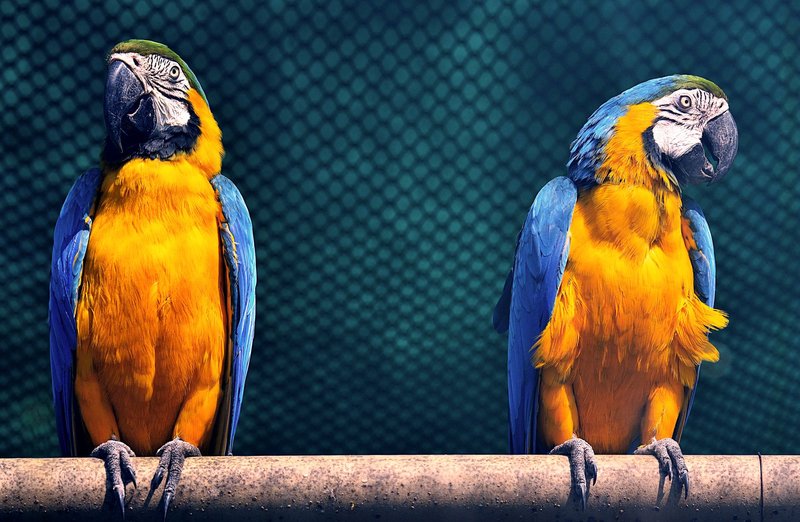
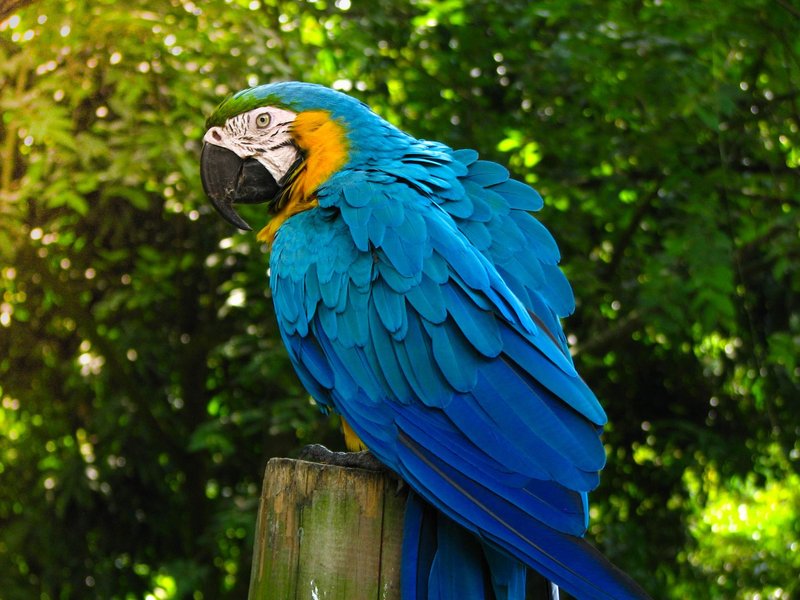
Blue back, yellow belly, green forehead, and a bare white face crossed with thin lines of black feathers. Those lines are individual: no two birds have the same pattern. The face flushes pink when the bird is excited.
Size: about 85 cm. Diet: palm fruits, seeds and nuts. Layer: canopy, especially around palm swamps and flooded forest. Status: Least Concern.
Surprising fact: they nest in dead palm trunks, so a swamp full of standing dead palms is prime macaw real estate.
4. Hyacinth macaw
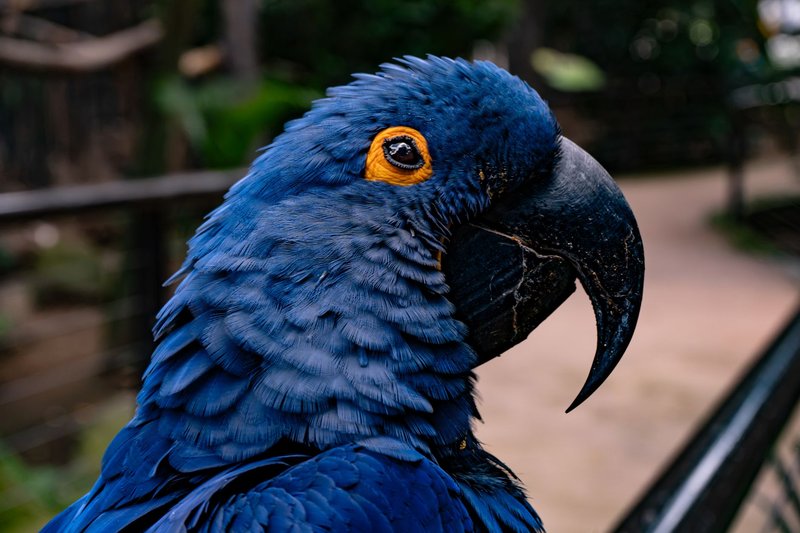
The largest flying parrot on Earth, at about a meter long with a wingspan around 1.2 meters. It is deep cobalt blue with a yellow ring around the eye and a yellow patch at the base of the lower bill. Its range covers the southern and eastern edges of the Amazon, the Pantanal and the Cerrado, not the whole basin.
Size: about 100 cm. Diet: hard palm nuts, which its massive bill cracks open. Layer: canopy and open woodland. Status: Vulnerable.
Surprising fact: it has been seen waiting beneath cattle for them to pass nuts through, then picking undigested kernels from the dung, because the softened nuts are easier to crack.
5. Harpy eagle
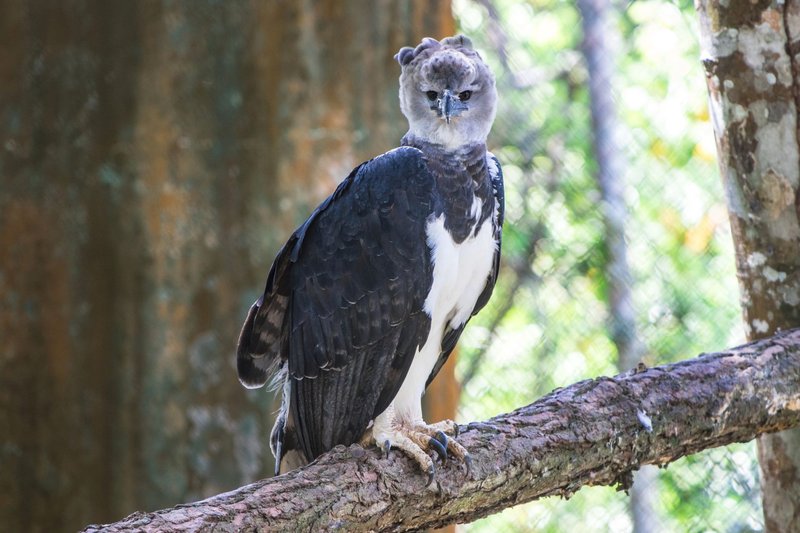
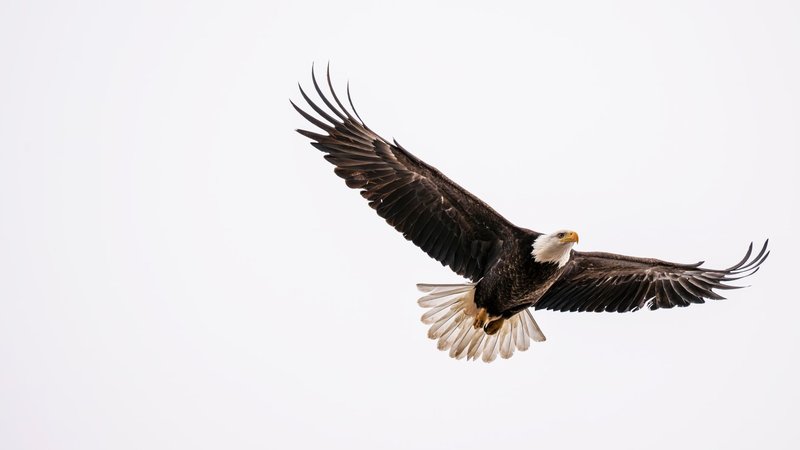
The harpy eagle is the apex aerial predator of Amazon rainforest birds. Females weigh up to 9 kilograms with a wingspan close to 2 meters, and the hind talons reach roughly 12 centimeters. It hunts sloths and monkeys, snatching them from branches in a single strike, and it flies through dense forest on short, wide wings that function like a goshawk’s.
Size: 90 to 105 cm. Diet: sloths, monkeys, large birds. Layer: emergent and upper canopy. Status: Near Threatened.
Surprising fact: a pair raises a single chick every two to three years, which is why losing even a few adults hurts a local population so badly. The nest is typically in a giant kapok or Brazil nut tree.
6. Crested eagle
Often mistaken for a small harpy eagle, the crested eagle is slimmer, grayer, and carries a long double crest it can raise like a hairdo. It hunts monkeys, sloths and other canopy mammals but is rarely seen. A birder can spend a month in the forest and never meet one.
Size: 75 to 90 cm. Diet: monkeys, sloths, snakes, large birds. Layer: canopy and emergent. Status: Near Threatened.
Surprising fact: like the harpy, it breeds very slowly, with chicks fed for a year or more after fledging.
7. Hoatzin
The hoatzin is the one bird scientists still can’t place on the family tree cleanly. It eats leaves almost exclusively and digests them by fermentation in an enlarged crop, the way a cow uses a rumen. The result is a manure-like odor that earned it the nickname “stinkbird,” and it keeps most predators away.
Size: about 65 cm. Diet: leaves, shoots, some fruit and flowers. Layer: understory beside oxbow lakes and slow rivers. Status: Least Concern.
Surprising fact: chicks have two claws on each wing, which they use to climb back up through the branches after dropping into the water to escape a predator.
8. Crimson topaz
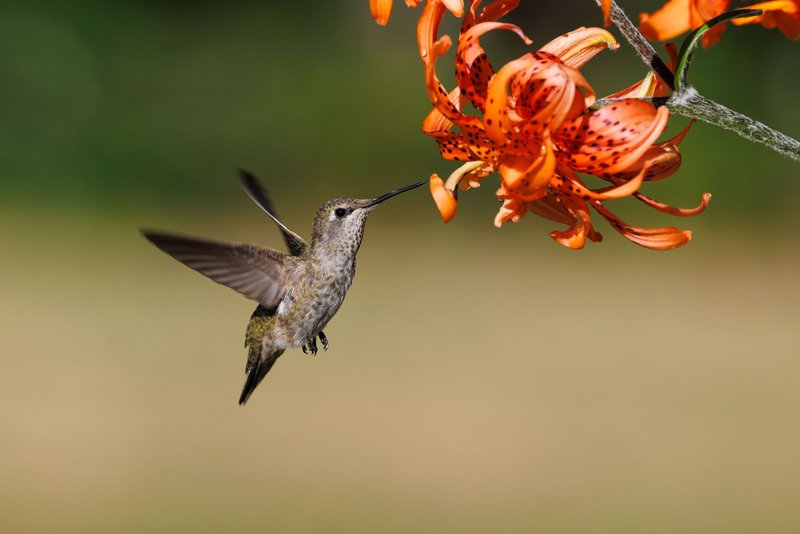
Among the Amazon’s many hummingbirds, the crimson topaz is the one people stop for. The male has a ruby-red body that shifts to orange and gold in the light, a black cap, and two long tail streamers that cross over each other. The streamers push his total length past 20 centimeters, huge for a hummingbird.
Size: up to about 23 cm for males, streamers included. Diet: nectar and small insects. Layer: canopy edge, mostly over blackwater streams. Status: Least Concern.
Surprising fact: males hold small stretches of stream and defend them aggressively from rivals, even though their tails make tight turns awkward.
9. Guianan cock-of-the-rock
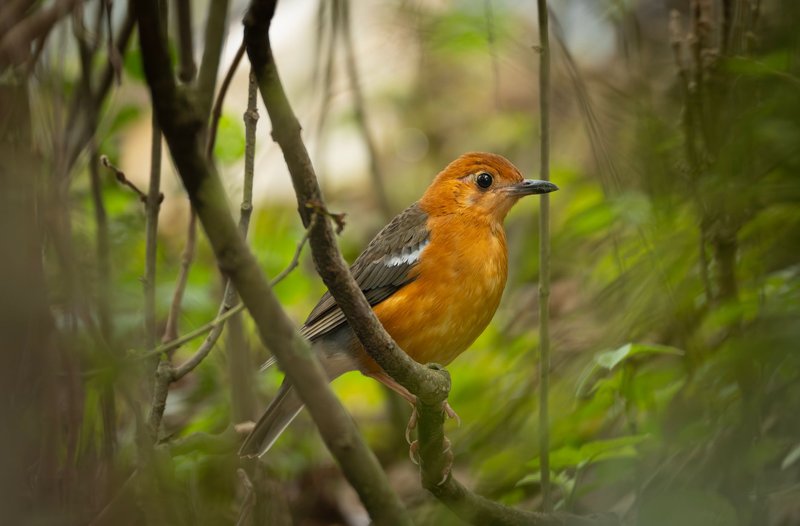
A bright orange bird with a rounded crest that hides most of the bill, like a feathered disc. Males gather in leks, communal display grounds on the forest floor, where they bow, hop and squawk to impress the plain brown females. The species lives on the Guiana Shield, north of the Amazon River, so a trip to Guyana, Suriname, French Guiana or northern Brazil is how you find it.
Size: about 30 cm. Diet: fruit, with some insects and small frogs. Layer: understory around rocky outcrops. Status: Least Concern.
Surprising fact: females glue their mud nests to rock faces, so no boulders or cliffs, no cock-of-the-rock.
10. Amazonian umbrellabird
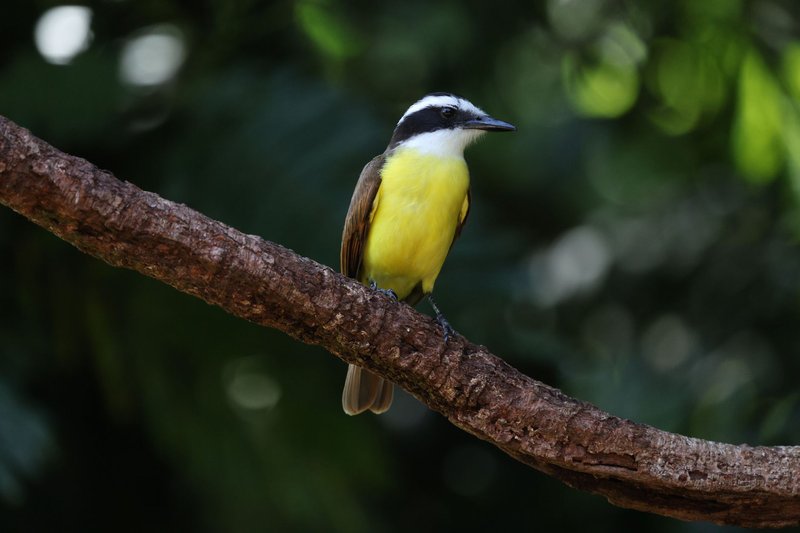
A glossy black bird with a hairlike crest that sweeps forward over its head like a collapsible umbrella, and a long feathered wattle hanging from its chest. The male puffs the wattle and sends out a low, booming call that carries a surprising distance through the trees. It’s often found on river islands and in flooded forest in the western Amazon.
Size: 40 to 50 cm. Diet: fruit and large insects. Layer: canopy and mid-canopy. Status: Least Concern.
Surprising fact: the wattle isn’t skin. It’s covered in feathers, which is why the bird looks like it’s wearing a tie.
11. Sunbittern
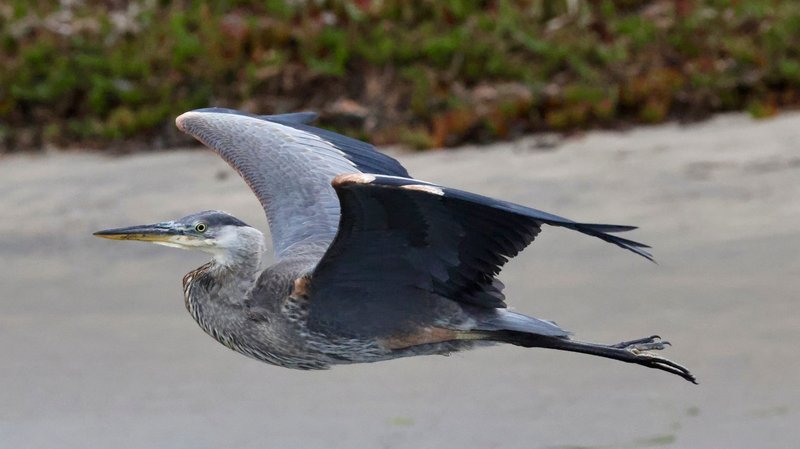
On a stream bank, the sunbittern looks like a slim gray-brown heron. Then it spreads its wings, and two huge eyespots in orange, chestnut and black appear, enough to make a predator hesitate. It walks slowly along shaded forest streams, stalking aquatic insects and small fish.
Size: 43 to 48 cm. Diet: insects, crustaceans, small fish and frogs. Layer: forest floor along streams. Status: Least Concern.
Surprising fact: the sunbittern has its own family, with only one species, and its nearest relative is the kagu of New Caledonia, on the other side of the planet.
12. Horned screamer
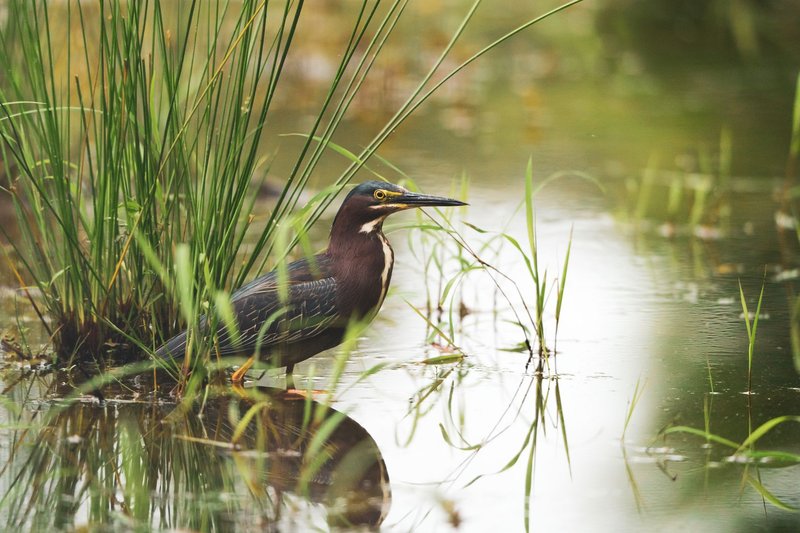
Big, chicken-shaped and gray, with a thin, straight spike about 15 centimeters long growing from its forehead. The horn is made of keratin and flexible, and its purpose is still debated. The wings carry sharp spurs, and the call, a series of loud honks and wails, carries for kilometers across floodplain marshes.
Size: 85 to 95 cm. Diet: aquatic plants, leaves and seeds. Layer: open wetlands, oxbow lakes and floodplains. Status: Least Concern.
Surprising fact: despite webbing that’s only partial, it wades and swims comfortably, and pairs stay together for life.
13. Amazonian royal flycatcher
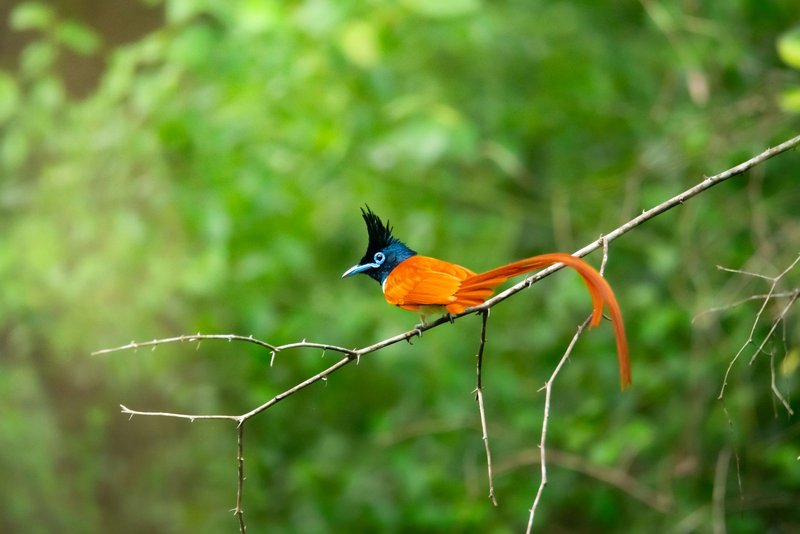
A small, plain brownish bird that conceals one of the forest’s best tricks. Its crest, a fan of feathers tipped with red or orange in males and yellow in females, lies flat most of the time. Birders may watch one for hours and never see it open. It builds a long hanging nest over water that looks like a clump of debris.
Size: about 16 cm. Diet: flying insects. Layer: understory near streams. Status: Least Concern.
Surprising fact: the crest is raised mainly during courtship and when the bird is handled, so most field photos show a plain hammerhead silhouette.
14. Black-faced antthrush
A chunky, short-tailed bird of the forest floor, with a black throat and face against a brown back, that walks instead of hopping and carries its tail cocked. It lives in the groups scientists call terrestrial insectivores, birds that pick insects off leaf litter. This is the type of species that appears in the monitoring data discussed in the conservation section below.
Size: 18 to 19 cm. Diet: insects, spiders and other invertebrates in leaf litter. Layer: forest floor. Status: Least Concern.
Surprising fact: you’ll hear it long before you see it. Its song is a low, rising series of whistles that seems to come from everywhere at once.
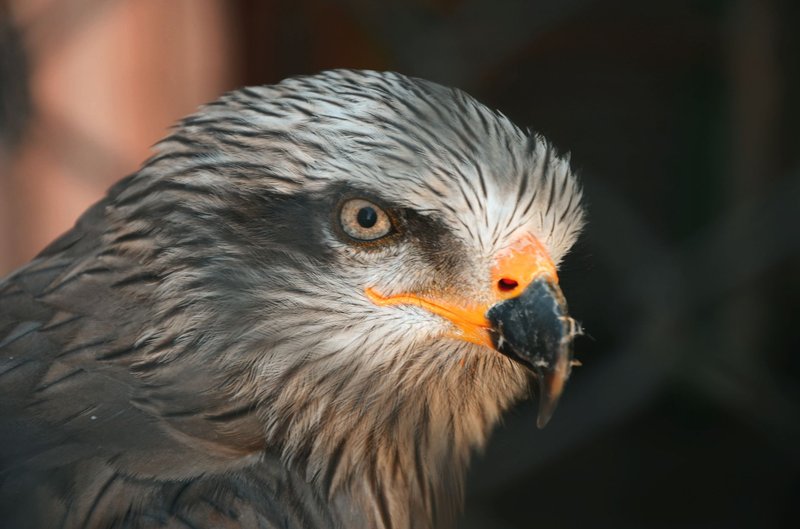
15. Black-collared hawk
A rust-colored hawk with a white head and a black collar around the neck, which hunts almost exclusively fish. The soles of its feet are covered in rough, spiny scales that help it grip slippery prey. Look for it perched low over oxbow lakes and flooded forest edges, waiting for a surface ripple.
Size: 45 to 50 cm. Diet: fish, plus occasional crabs and frogs. Layer: wetland edges and low perches over water. Status: Least Concern.
Surprising fact: it often takes its catch back to the same perch and eats it there, so a pile of fish bones under a branch tells you where to wait.
Quick-reference table
| Bird | Length | Main diet | Forest layer | IUCN status |
|---|---|---|---|---|
| Toco toucan | 55 to 65 cm | Fruit, insects | Canopy | Least Concern |
| Scarlet macaw | ~85 cm | Seeds, nuts, fruit | Canopy | Least Concern |
| Blue-and-yellow macaw | ~85 cm | Palm fruit, seeds | Canopy | Least Concern |
| Hyacinth macaw | ~100 cm | Palm nuts | Canopy | Vulnerable |
| Harpy eagle | 90 to 105 cm | Sloths, monkeys | Emergent | Near Threatened |
| Crested eagle | 75 to 90 cm | Monkeys, sloths | Canopy, emergent | Near Threatened |
| Hoatzin | ~65 cm | Leaves | Understory, riverside | Least Concern |
| Crimson topaz | up to ~23 cm | Nectar, insects | Canopy edge, streams | Least Concern |
| Guianan cock-of-the-rock | ~30 cm | Fruit | Understory | Least Concern |
| Amazonian umbrellabird | 40 to 50 cm | Fruit, large insects | Canopy | Least Concern |
| Sunbittern | 43 to 48 cm | Insects, small fish | Forest floor, streams | Least Concern |
| Horned screamer | 85 to 95 cm | Aquatic plants, seeds | Wetlands | Least Concern |
| Amazonian royal flycatcher | ~16 cm | Flying insects | Understory | Least Concern |
| Black-faced antthrush | 18 to 19 cm | Leaf-litter invertebrates | Forest floor | Least Concern |
| Black-collared hawk | 45 to 50 cm | Fish | Wetland edges | Least Concern |
Status follows the IUCN Red List, which is updated regularly. Check it for the current assessment of any species before you cite it.
Macaw clay licks
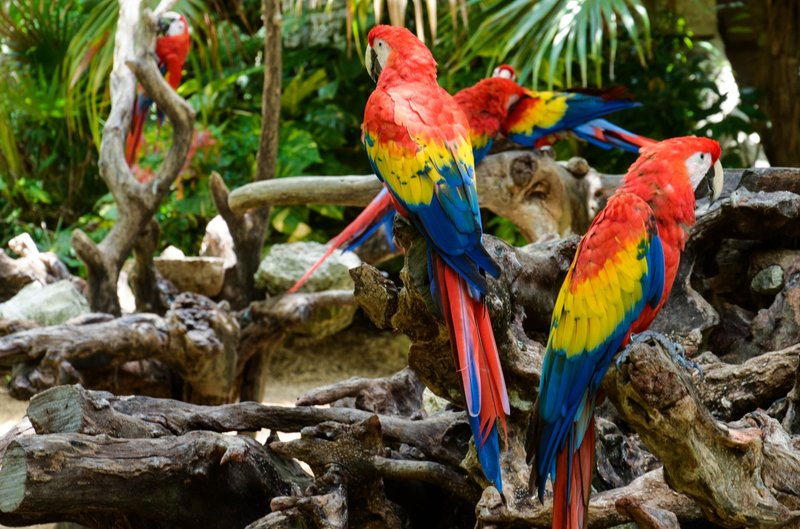
Along certain riverbanks in the western Amazon, exposed clay walls draw macaws and other parrots in the hundreds. Birds start arriving shortly after dawn, perch in nearby trees, drop down in small groups, and peck at the clay. Activity usually fades by mid-morning.
Why they do it is still studied. Sodium looks like the main reason: it is scarce in the diet of seed-eaters in inland rainforest, and the clay at the best-known licks is rich in it. A second idea is that the clay binds plant toxins in seeds, which would explain why birds eat more of it during certain parts of the year. Probably both play a role.
For a visitor, a lick is the most reliable way to see large numbers of macaws at close range. Lodges near famous sites, such as those in the Tambopata region of Peru, build hides across the river so you can watch without spooking the flock.
When and where to see birds in the Amazon
Time of year. The drier months, roughly June to November in much of the basin, are easiest. Water levels drop, trails and riverbanks open up, and birds concentrate around fruiting trees. The flooded season is good for river travel by boat, but the forest floor is under water and the ground birds are harder to find.
Time of day. Be on the trail or the river at first light. Activity peaks in the first two to three hours, goes quiet by midday, and picks up a little in late afternoon.
Where to look. Canopy towers and boat trips are your best tools. Towers put you at the level of the toucans and macaws, and boats let you scan the banks for hoatzins, hawks, screamers and sunbitterns without the noise of walking. For harpy eagles you need patience and a local guide who knows an active nest.
Which country. Peru’s Madre de Dios and Tambopata regions are famous for clay licks and high species counts. Brazil, Ecuador, Colombia and Bolivia all cover large areas of the basin. For the Guianan cock-of-the-rock, head to the Guiana Shield instead.
Conservation: what is happening to Amazon rainforest birds
Habitat loss through clearing, logging and fire is the obvious pressure. Harpy and crested eagles are Near Threatened because they need large areas of mature forest and breed so slowly. The hyacinth macaw is Vulnerable after decades of habitat conversion and capture for the pet trade.
The less obvious story is in the data on small birds. A study in Ecology Letters tracked the bird community in undisturbed rainforest north of Manaus over more than three decades and found that insect-eating birds foraging on or near the ground were disappearing even though the forest was not logged. The authors suggest a shifting baseline: the community that biologists measured in the 1980s may not be the one that existed before humans began altering the climate and surrounding landscape. The bird groups affected include antbirds and others that pick insects from leaf litter, the guild that the black-faced antthrush belongs to.
The takeaway for anyone interested in Amazon rainforest birds: protected, intact forest isn’t a guarantee on its own. The macaws and eagles are easy to love and to photograph, but the quiet species on the forest floor are the early-warning system.
If you go, hire a local guide, choose a lodge that employs people from nearby communities, and never feed or lure birds. Money spent that way is the clearest argument for keeping the standing forest worth more than the cleared one.