Papua New Guinea has roughly 245 recorded mammal species, and it’s one of the few places on Earth where all three mammal groups live side by side: egg-laying monotremes, pouched marsupials and placentals. There are no monkeys, no big cats and no native hoofed animals. What fills those gaps is stranger: tree-climbing kangaroos, spiny anteaters the size of a small dog, and rats that outweigh a house cat.
This guide sorts the mammals of Papua New Guinea by type, gives the species worth knowing in each group, and ends with a reference table, the critically endangered list and a few places you can see them.
Updated November 2026. Species counts and IUCN statuses change as assessments are revised, so check the IUCN Red List before citing a status.
TLDR
- About 245 mammal species are recorded in Papua New Guinea. Published counts range from 244 to 248 depending on how taxonomists split species.
- Rodents and bats make up more than half of the total. Marsupials dominate the large land mammals.
- Highlights: long-beaked echidnas, Goodfellow’s and Matschie’s tree kangaroos, spotted cuscuses, Bulmer’s fruit bat, dugongs.
- The most threatened: the Tenkile, the Telefomin cuscus, Bulmer’s fruit bat and the eastern long-beaked echidna, all listed as Critically Endangered.
- Wild sightings of the rare species are very hard. Zoos and Port Moresby’s nature park are the practical options.
Table of contents
- How many mammals live in Papua New Guinea?
- Echidnas
- Tree kangaroos
- Cuscuses, gliders, quolls and other marsupials
- Rodents and bats
- Marine mammals
- Introduced species
- Quick-reference table
- Critically endangered mammals
- Threats
- Where to see them
How many mammals live in Papua New Guinea?
The figure you’ll see most often is 244 to 248 species. Sources that quote “230 to 260” are padding the range for taxonomic uncertainty. New species are still being described from the mountains, and groups like bats and rodents get reshuffled whenever someone sequences their DNA.
Treat 245 as the working number. Rodents (around 70 species or more) and bats (around 90) account for most of it. Marsupials follow, with the monotremes down to a handful.
The reason for the diversity is geography. New Guinea is a tropical island with a spine of mountains rising above 4,000 meters, so a single day’s walk crosses lowland swamp, hill forest, cloud forest and alpine grassland. Each band of elevation has its own mammals, and many valleys are isolated enough that species exist in just one range.
Echidnas
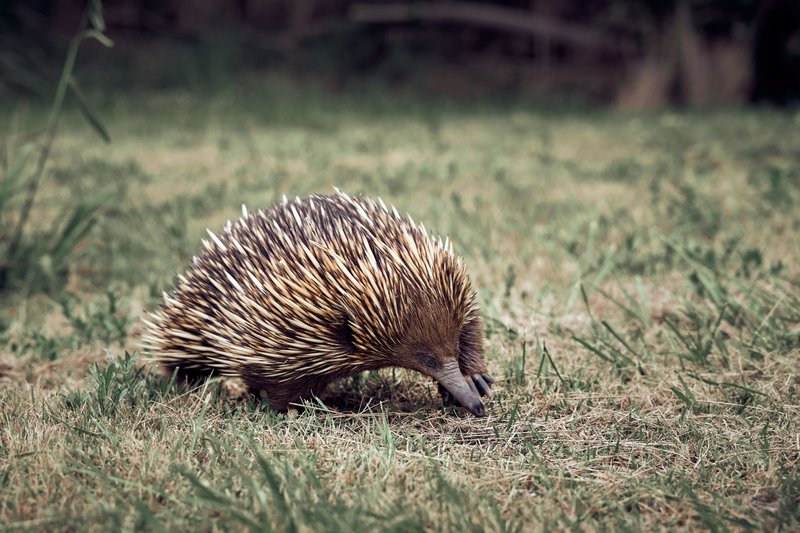
Papua New Guinea has two kinds of echidna, and they look nothing alike once you see them side by side.
The short-beaked echidna (Tachyglossus aculeatus) is the familiar one, also found in Australia. It lives in the southern savanna and lowland forests, and its status is Least Concern.
The eastern long-beaked echidna (Zaglossus bartoni) is the one that matters here. It can weigh up to around 10 kilograms, making it the largest of the egg-laying mammals. It lives in mountain forest and alpine grassland, eats earthworms, and catches them with a tongue lined with tiny spines. It is listed as Critically Endangered. Villagers hunt it for meat, and the forest it depends on keeps shrinking. A related species, the western long-beaked echidna, mostly occurs on the Indonesian side of the island.
Tree kangaroos
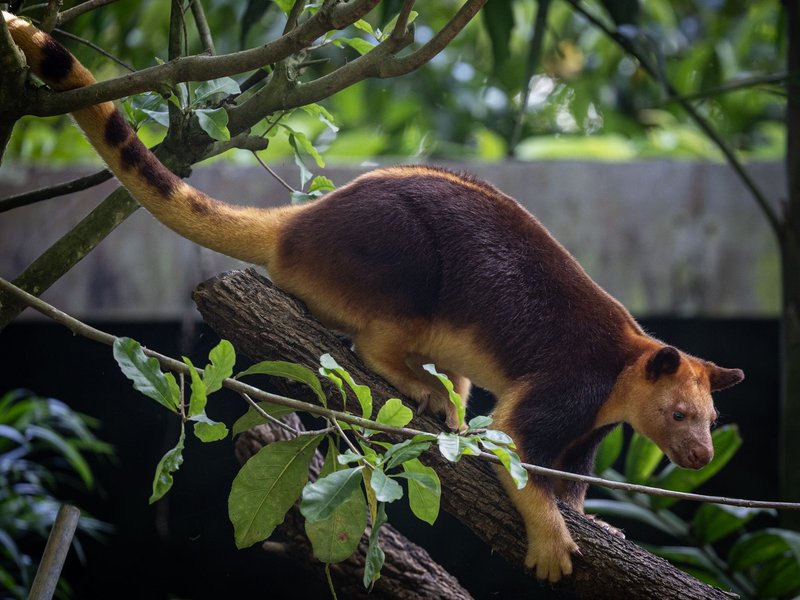
Tree kangaroos are the signature marsupials of New Guinea. Their ancestors were ground-dwelling kangaroos that went back up into the trees, and their bodies show it: shorter, stronger forelimbs, a long tail used for balance and a hind foot built for gripping branches. They can leap from heights of 15 meters or more and walk away.
- Goodfellow’s tree kangaroo (Dendrolagus goodfellowi): reddish-chestnut with a golden belly and pale-banded tail. It lives in the montane forests of the central ranges. Endangered.
- Matschie’s tree kangaroo (Dendrolagus matschiei): found only on the Huon Peninsula, with a dark back and bright golden-orange face and legs. Endangered. The Tree Kangaroo Conservation Program, run through Woodland Park Zoo, works with local landowners on the Huon Peninsula and helped set up the YUS Conservation Area, the first of its kind in the country.
- Tenkile, or Scott’s tree kangaroo (Dendrolagus scottae): restricted to the Torricelli Mountains in the north. Critically Endangered, and covered in more detail below.
- Doria’s tree kangaroo (Dendrolagus dorianus): the heaviest of the group, living at higher elevations. Vulnerable.
All of them are hunted, and all of them are shy. Even researchers working in tree kangaroo country go weeks without a sighting.
Cuscuses, gliders, quolls and other marsupials
The Papua New Guinea marsupials come in more shapes than most visitors expect.
Cuscuses are slow, heavy-bodied possums with prehensile tails and a diet of leaves and fruit. The spotted cuscus (Spilocuscus maculatus) is the one in photos: males carry white blotches on a gray coat, and both sexes have wide, orange-red eyes. It’s a lowland forest animal, active at night, and sits in the Least Concern category. Then there’s the Telefomin cuscus (Phalanger matanim), known from a handful of records around the Telefomin area and listed as Critically Endangered. Few people have seen one alive, which puts it among the rare animals of Papua New Guinea.
Gliders and possums fill the niches that squirrels and small primates fill elsewhere. Sugar gliders (Petaurus breviceps) live here too. The striped possum (Dactylopsila trivirgata) is the more unusual animal: it taps tree trunks to find insect larvae, then pulls them out with a thin elongated fourth finger, the same trick as the aye-aye in Madagascar. It also smells strongly, which discourages most predators. The pen-tailed possum (Distoechurus pennatus) has a tail with a feathery tip, like a tiny feather duster.
Quolls are the meat-eaters. The New Guinean quoll (Dasyurus albopunctatus) is a spotted, cat-sized hunter of insects, rodents and birds, mostly in the mountains. It’s the closest the island has to a small cat, with one catch: it’s a marsupial.
Others in this group include forest wallabies and dorcopsises, which graze the understory, and spiny bandicoots, which forage on the forest floor. The agile wallaby shows up in the southern savanna near the Australian border.
Rodents and bats
Rodents are the only native non-flying placentals on the island, and they’ve radiated into dozens of species. The most interesting are the giant woolly rats (Mallomys), which live in montane forest and can reach more than a kilogram in weight. In 2009 a BBC expedition to the crater of Mount Bosavi photographed a woolly rat about 82 centimeters long, nose to tail, that was new to science. It had never learned to fear humans, so the team could walk up to it. Water rats (Hydromys) swim in rivers and swamps, and the mosaic-tailed rats and a dozen similar groups fill most of the forest floor.
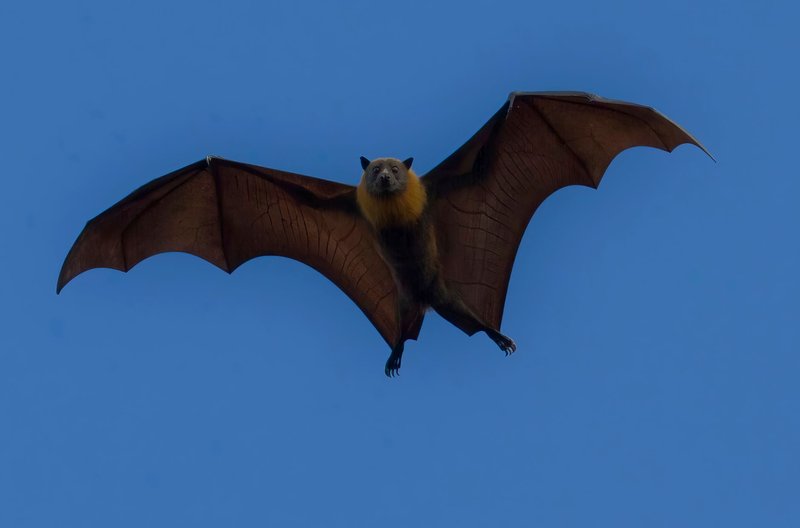
Bats are the other big group. Flying foxes such as the Bismarck flying fox have wingspans of around 1.5 meters, roost in large colonies and pollinate and disperse seeds across the lowlands. Small blossom bats feed on nectar. Insect-eating bats take almost everything else, including species that live in caves, which is where the most threatened bat on the island lives. That’s Bulmer’s fruit bat, described below.
Marine mammals
Papua New Guinea’s coast supports the dugong (Dugong dugon), which grazes on seagrass beds in the shallow waters of the south and the island groups. It is listed as Vulnerable. The Gulf of Papua and the Fly River delta also hold Australian snubfin dolphins (Orcaella heinsohni), rounded-headed coastal dolphins that are also listed as Vulnerable. Offshore, the Bismarck and Solomon Seas are used by whales and oceanic dolphins.
Introduced species
Pigs and dogs arrived with human settlers thousands of years ago, and the highland communities built whole social systems around pigs. Wild-living descendants of the dogs include the New Guinea highland wild dog, a close relative of the dingo. A population was confirmed again in 2016 in the highlands on the Indonesian side of the border after decades without clear records.
Rusa deer were introduced from Indonesia and now live in the southern grasslands. The black rat and the Pacific rat traveled in canoes and cargo, and both have spread into forest edges and gardens. Feral cats and cane toads (the latter not a mammal, but they feed on the same small prey) add pressure to small native species.
Quick-reference table
| Common name | Scientific name | Habitat | IUCN status |
|---|---|---|---|
| Eastern long-beaked echidna | Zaglossus bartoni | Montane forest, alpine grassland | Critically Endangered |
| Short-beaked echidna | Tachyglossus aculeatus | Savanna, lowland forest | Least Concern |
| Goodfellow’s tree kangaroo | Dendrolagus goodfellowi | Montane forest, central ranges | Endangered |
| Matschie’s tree kangaroo | Dendrolagus matschiei | Huon Peninsula montane forest | Endangered |
| Tenkile (Scott’s tree kangaroo) | Dendrolagus scottae | Torricelli Mountains | Critically Endangered |
| Doria’s tree kangaroo | Dendrolagus dorianus | High-elevation forest | Vulnerable |
| Spotted cuscus | Spilocuscus maculatus | Lowland rainforest | Least Concern |
| Telefomin cuscus | Phalanger matanim | Mid-elevation forest, Telefomin area | Critically Endangered |
| Striped possum | Dactylopsila trivirgata | Lowland and hill forest | Least Concern |
| Sugar glider | Petaurus breviceps | Forest and woodland | Least Concern |
| Bulmer’s fruit bat | Aproteles bulmerae | Limestone caves and montane forest | Critically Endangered |
| Dugong | Dugong dugon | Coastal seagrass beds | Vulnerable |
| Australian snubfin dolphin | Orcaella heinsohni | Coastal waters, river mouths | Vulnerable |
Critically endangered mammals
Three species stand out, partly because the numbers are so small.
Tenkile (Dendrolagus scottae). The Tenkile lives only in the Torricelli Mountains of Sandaun Province, and it was first described to science in the 1990s. The population is thought to be in the low hundreds at best. Local hunting and habitat loss did the damage. The Tenkile Conservation Alliance works with villagers to reduce hunting and run community breeding and protection programs.
Telefomin cuscus (Phalanger matanim). Described only in the mid-1990s, it’s known from a few specimens from the Telefomin area in the Star Mountains region. Nobody has produced a reliable population estimate, which is its own warning.
Bulmer’s fruit bat (Aproteles bulmerae). This species was first known from fossils in a cave, and for years scientists assumed it was extinct. Living bats were found later in a single cave in the Hindenburg Range. Estimates of the population run to a few hundred at most, and the entire species depends on one roost. A disturbance at that cave could wipe out a genus.
The eastern long-beaked echidna belongs on this list too, as covered above. For the wider picture, the complete list of endangered species in Papua New Guinea covers threatened animals across all groups.
Threats
Hunting is the main pressure on the large mammals. Tree kangaroos, echidnas, cuscuses and bats all go into village cooking pots, and tree kangaroos are easy targets for hunters with dogs. Where the population is already small, a few animals a year is enough.
Forest loss is the second driver. Commercial logging, conversion to oil palm and subsistence gardens push into lowland and mid-elevation forest, and road networks open remote valleys to hunters. Mining adds roads, pollution and local population surges around sites such as Porgera and Ok Tedi. Climate change is a longer-term risk for the high-altitude specialists, which have nowhere higher to go.
Where to see them
Seeing wild mammals here takes time and local guides, and for the rarest species the odds are close to zero. Realistic options:
- Port Moresby Nature Park. The country’s main zoo-style collection, with tree kangaroos, cuscuses, wallabies and cassowaries in one place.
- Varirata National Park, about an hour from Port Moresby. Walks here turn up wallabies and bats, with night walks adding possums and cuscuses.
- Highland lodges. Operations such as those in the Tari Valley and around Mount Hagen run guided forest walks. They’re marketed on birds-of-paradise, but guides know where mammals roost and feed.
- Outside Papua New Guinea. Zoos in North America and Europe keep Matschie’s and Goodfellow’s tree kangaroos in managed breeding programs. Woodland Park Zoo in Seattle is one of the most active supporters of the work in the wild.
- Conservation programs. Community-based groups like the Tenkile Conservation Alliance and the Tree Kangaroo Conservation Program take visits and volunteers, and your money does more good than a sighting would.
Go at night for cuscuses, possums and bats, and early morning for wallabies. Hire a local guide who knows the area. They’ll find in ten minutes what you’d miss in a day.