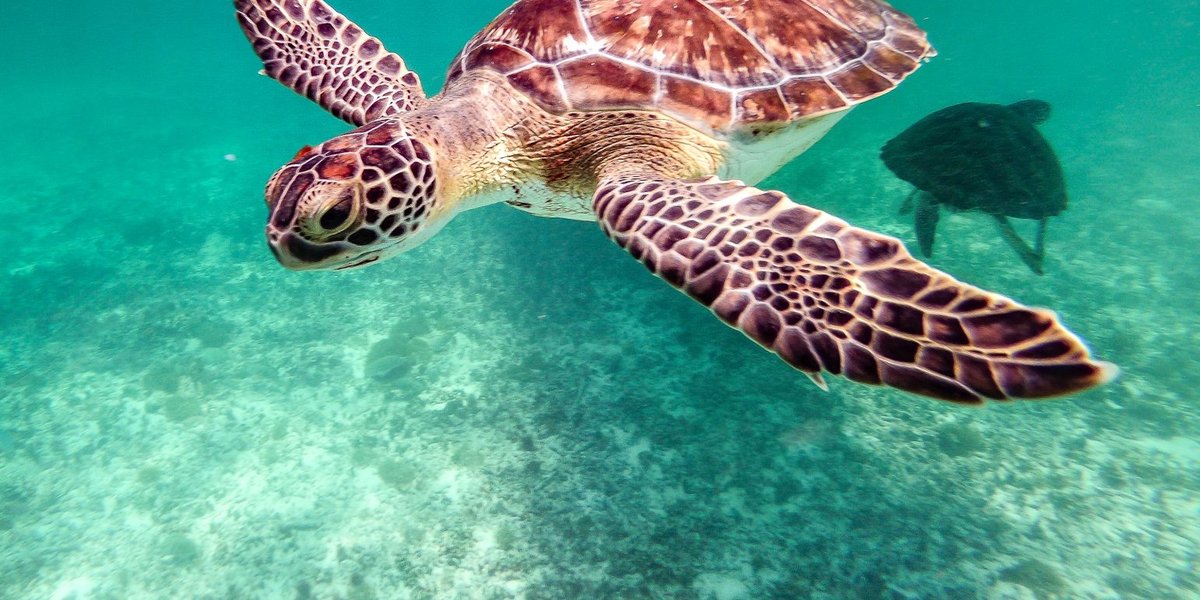
Sea turtles live in the ocean, have paddle-shaped flippers and can’t pull their heads into their shells. Freshwater turtles live in ponds, rivers and lakes, have webbed feet with claws, and most of them can tuck their head and legs inside.
That’s the short version of sea turtles vs freshwater turtles. The longer version explains why the two groups ended up so different, and it holds a few surprises: a sea turtle with no hard shell, a freshwater turtle that can weigh as much as a refrigerator, and lifespan numbers that nobody has pinned down.
Table of Contents
- Sea Turtles vs Freshwater Turtles: The Comparison Table
- Flippers vs Webbed Feet
- Shells: Streamlined vs Armored
- Salt Glands and the Saltwater Problem
- Size and Lifespan
- Diet
- Nesting and Hatchlings
- Conservation
- Turtle, Tortoise or Terrapin?
- Which One Is This? A Quick Checklist
- FAQ
Sea Turtles vs Freshwater Turtles: The Comparison Table
Every difference below has a species-level exception, and the table notes the big ones. “Sea turtle” covers seven species: green, loggerhead, leatherback, hawksbill, Kemp’s ridley, olive ridley and flatback. “Freshwater turtle” covers well over a hundred species, so the examples here are the ones you’re most likely to meet: red-eared slider, painted turtle and common snapping turtle.
| Sea turtles | Freshwater turtles | |
|---|---|---|
| Habitat | Open ocean, coastal waters, seagrass beds, reefs | Ponds, lakes, rivers, marshes, streams |
| Limbs | Long, paddle-like flippers; no distinct toes | Webbed feet with separate toes and claws |
| Shell shape | Flat, smooth, teardrop-shaped | Often higher and more domed, with a lot of variety |
| Head retraction | Cannot retract head or limbs | Most can retract at least partly; snappers only partly |
| Size | Roughly 70 lb (Kemp’s ridley) to 1,500+ lb (leatherback) | Roughly 0.5 lb (small musk and mud turtles) to 30+ lb (common snapper); alligator snappers can top 200 lb |
| Lifespan | Probably 50 to 80+ years; true maximum unknown | Varies from about 20 to 70+ years depending on species |
| Diet | Specialists: seagrass, jellyfish, sponges, crabs | Mostly omnivores: insects, fish, plants, carrion |
| Nesting | Females crawl onto ocean beaches; 80 to 120 eggs per clutch | Females nest near the water; clutches of roughly 4 to 40 eggs |
| Salt tolerance | Salt glands near the eyes remove excess salt | Most can’t live in salt water for long |
| Conservation | Six of seven species threatened or worse | Roughly half of all turtle species threatened, with habitat loss and the pet trade as leading causes |
Flippers vs Webbed Feet
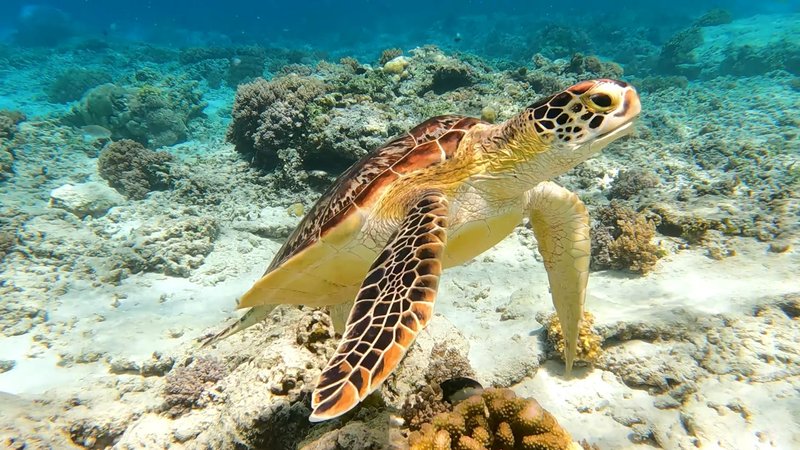
Sea turtle limbs are tools for flying through water. The front flippers are long and wing-shaped, and a green turtle powers itself with them in a figure-eight stroke, while the smaller rear flippers act as rudders. Leatherback front flippers can span more than the length of the animal’s body.
That design costs them on land. A sea turtle has no toes to grip with, so females drag themselves up the beach in a slow, labored shuffle, and males spend their entire lives in the water after hatching.
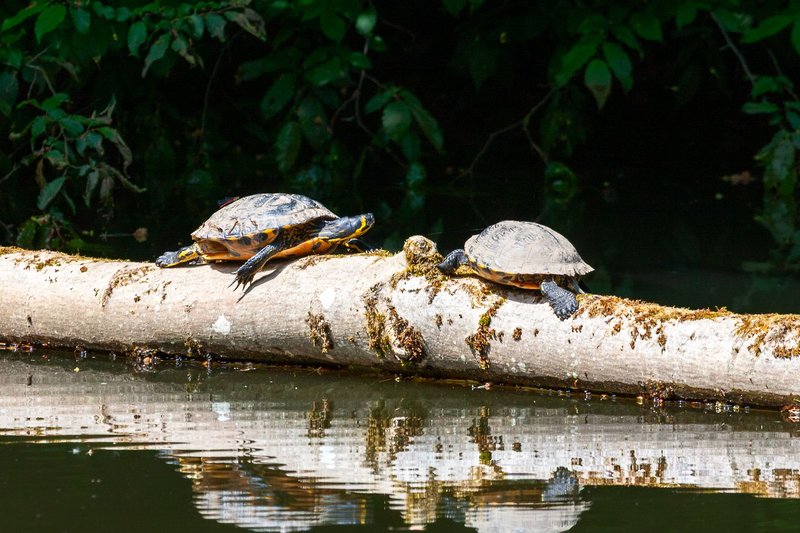
Freshwater turtles go the other way. Red-eared sliders and painted turtles have webbed toes that push water well enough for paddling, plus claws that let them climb out onto logs, dig nests and walk overland between ponds. A snapping turtle’s feet are barely webbed. It prefers to walk along the bottom of a pond rather than swim in open water.
Shells: Streamlined vs Armored
Both groups carry a shell made of a bony carapace on top and a plastron underneath, covered in keratin plates called scutes. The differences are in shape and function.
A sea turtle shell is flat and smooth, which reduces drag in open water. It’s also too small, relative to the body, to hide in. The head and flippers stay outside. Sea turtles don’t defend themselves by hiding. They rely on size, speed and, for hatchlings, sheer numbers.
Most freshwater turtles do the opposite. A higher shell leaves room for the head and limbs to withdraw, and many species, including painted turtles and sliders, pull everything in when threatened. Two caveats:
- Snapping turtles have a small plastron and can’t seal themselves in. They defend with a long neck and a bite.
- Side-necked turtles, found in the Southern Hemisphere, fold the neck sideways instead of pulling it straight back.
One exception goes the other way. The leatherback, the largest sea turtle, has no hard shell at all. Its back is a layer of oil-rich, leathery skin over a mosaic of small bones, with seven ridges running the length of the body. Like the other sea turtles, it can’t retract anything.
Salt Glands and the Saltwater Problem
Seawater is saltier than a turtle’s body fluids, so a turtle that lives in it has to get rid of salt. Sea turtles do it with specialized glands behind each eye that secrete a concentrated salty fluid. That’s why nesting females look like they’re crying. They’re not upset, they’re excreting salt.
Most freshwater turtles lack that equipment and can’t stay in the ocean for long. The best-known exception is the diamondback terrapin, which lives in brackish salt marshes along the US Atlantic and Gulf coasts and has its own salt-excreting glands.
Size and Lifespan
Size is where sea turtles pull ahead. Per NOAA Fisheries, leatherbacks can grow to six or seven feet long and roughly 2,000 pounds. Greens commonly reach 300 pounds or more, and even the smallest sea turtle, the Kemp’s ridley, is around 100 pounds.
Freshwater turtles are mostly smaller. A painted turtle fits in your hand at 5 to 7 inches. A red-eared slider typically reaches 8 to 12 inches. The big outliers are snappers: a common snapping turtle can pass 30 pounds, and the alligator snapping turtle, a freshwater species in the southeastern US, can weigh over 200.
Lifespan is where most articles contradict themselves, and the honest answer is that nobody knows for sure. Sea turtles are hard to track across decades, and they don’t breed until they’re adults of 20 years or more. Green turtles, for instance, take decades to reach breeding age. The commonly cited range of 50 to 80 years is an estimate. Claims of 100 years show up in popular sources without good documentation.
Freshwater turtles have better data, mostly from zoos and pet owners, and the numbers depend heavily on species:
- Red-eared slider: often 20 to 30 years in captivity, sometimes longer
- Painted turtle: 20 to 30 years in the wild, more in captivity
- Common snapping turtle: 30 or more years in the wild
- Blanding’s turtle: can pass 70 years
If you’re thinking about a pet, plan for decades, not years. A turtle bought as a 2-inch hatchling can outlive your first car, your second, and possibly your mortgage.
Diet
The diet gap follows the habitat gap. Sea turtles tend to specialize, because the ocean offers big, reliable food sources that reward specialization:
- Green turtles are the group’s grazers. Juveniles eat a mix of animals and plants, but adults feed mostly on seagrass and algae.
- Loggerheads have powerful jaws for crushing crabs, conchs and whelks.
- Leatherbacks eat jellyfish, and almost nothing else. That makes plastic bags a deadly look-alike.
- Hawksbills use narrow beaks to pick sponges out of reef crevices.
Freshwater turtles are generalists. Red-eared sliders, painted turtles and snappers all eat a mix of aquatic plants, insects, snails, small fish, tadpoles and carrion. Many start out more carnivorous as juveniles and eat more plant matter as adults. Ponds and rivers change with the seasons and the weather, and a turtle that eats whatever turns up does better there.
Nesting and Hatchlings
Both groups lay eggs on land, and in both the incubation temperature influences whether hatchlings are male or female. Warmer nests tend to produce more females. Beyond that, the two approaches differ.
Sea turtle females return to the region where they hatched, sometimes after migrating thousands of miles. Leatherbacks tagged in Indonesia have been tracked crossing the Pacific to feed off the US West Coast. A female digs a nest in the sand, lays roughly 80 to 120 eggs, covers them and leaves. She’ll repeat that several times in a season, then skip a few years before nesting again.
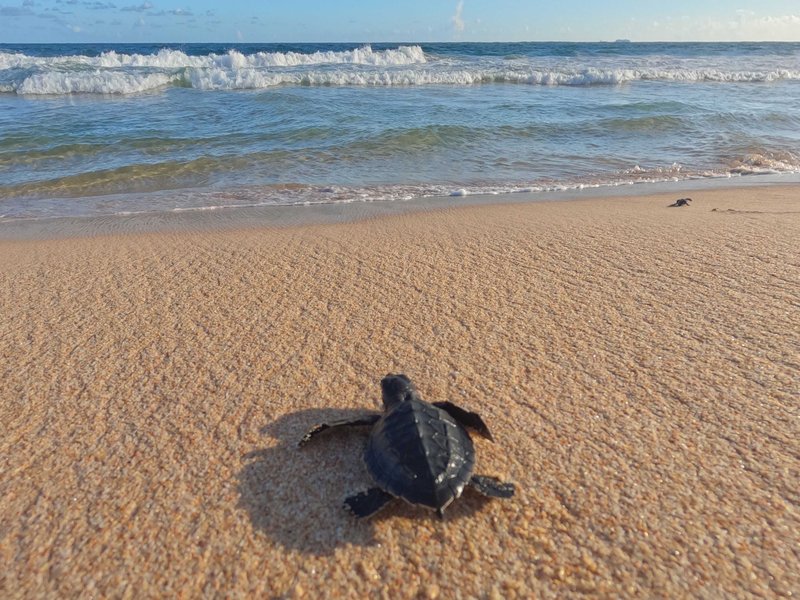
Hatchlings dig out together, mostly at night, and crawl to the sea. Then they vanish for years. Scientists call this the “lost years”: young sea turtles drift in ocean currents and floating seaweed, and researchers still have limited data on where they go.
Freshwater turtles nest on a smaller scale. A female sets out from the water, often just a short walk, digs a flask-shaped hole and lays a clutch that may range from about 4 eggs (some painted and musk turtles) to 40 or more (snapping turtles). Some species overwinter in the nest: painted turtle hatchlings can stay in the ground through winter and emerge in spring.
Conservation
Both groups are in trouble, for different reasons.
Six of the seven sea turtle species are listed as threatened by the IUCN, with hawksbills and Kemp’s ridleys classed as critically endangered. The main threats are fishing bycatch, plastic ingestion, coastal development that eats nesting beaches, and artificial lights that lure hatchlings inland instead of toward the sea.
Freshwater turtles are less visible, and arguably worse off in aggregate. Wetland drainage, road mortality (females crossing roads to nest), collection for the pet trade and harvesting for food have pushed many species down. Conservation groups estimate that roughly half of all turtle and tortoise species are threatened. The red-eared slider is an example of the pet trade backfiring: released pets have established invasive populations on several continents and are crowding out native turtles.
Turtle, Tortoise or Terrapin?
Search results for this topic drift into this question, so here’s the quick sort:
- Turtle: the broad group. Sea and freshwater turtles are both turtles.
- Tortoise: a land dweller with a high dome and stumpy, elephant-like legs. No webbing, no flippers.
- Terrapin: in the US, it usually means the diamondback terrapin of brackish marshes. In the UK, it often means a freshwater turtle.
Naming varies by country, so the habitat and the limbs are the more reliable guide.
Which One Is This? A Quick Checklist
Look at the animal and check these in order:
- Limbs. Flippers with no visible toes point to a sea turtle. Separate toes with claws point to a freshwater turtle or tortoise.
- Location. An ocean beach or reef is sea turtle territory. A pond, creek or garden is not.
- Shell height. A low, smooth teardrop leans sea turtle. A tall dome with stumpy legs is a tortoise.
- Head. If it can pull its head in, it isn’t a sea turtle.
- Shell surface. A ridged, leathery back with no plates is a leatherback.
FAQ
Can sea turtles retract into their shells?
No. Their heads and flippers always stay outside. Their shells are too streamlined to hide in, and that’s the trade-off for swimming efficiently.
Can freshwater turtles live in the ocean?
Most can’t. They lack the salt glands that sea turtles use to remove excess salt. The diamondback terrapin is the usual exception, and it stays in brackish water.
Which lives longer, a sea turtle or a freshwater turtle?
Sea turtles probably live longer on average, with estimates of 50 to 80 years or more, but species like Blanding’s turtle can match that. Exact figures for both groups vary by species, and no one has tracked a wild sea turtle for its entire life.
What do sea turtles eat compared to freshwater turtles?
Sea turtles tend to specialize in seagrass, jellyfish, sponges or crabs, depending on the species. Freshwater turtles mostly eat whatever they find, including plants, insects, snails, small fish and carrion.
Are sea turtles bigger than freshwater turtles?
Generally, yes. The smallest sea turtle is about 100 pounds, and the largest freshwater turtles are alligator snappers, which can exceed 200 pounds, but that’s rare. Most freshwater species weigh a few pounds at most.
Can I keep a sea turtle as a pet?
No. Sea turtles are protected by law in most countries, and they need an ocean. Freshwater species like sliders are the common pets, though they need large tanks, filtration and a long-term commitment.