Short answer: a baby goat needs colostrum in its first hours, at least 10% of its body weight within 24 hours. After that it drinks goat milk, a kid milk replacer or whole cow’s milk from a bottle. Never feed it calf or all-species milk replacer, which can cause abomasal bloat. Offer water in a pan from the first day, add hay and kid starter at about 1 week and wean at about 8 weeks or later, once it has reached 2.5 times its birth weight and eats solid feed well.
The chart below sorts common foods into safe staples, small amounts only and never feed. Search any food to see where it falls. Under the chart are the first-day steps, milk choices, bottle technique, a schedule by age and a printable cheat sheet.
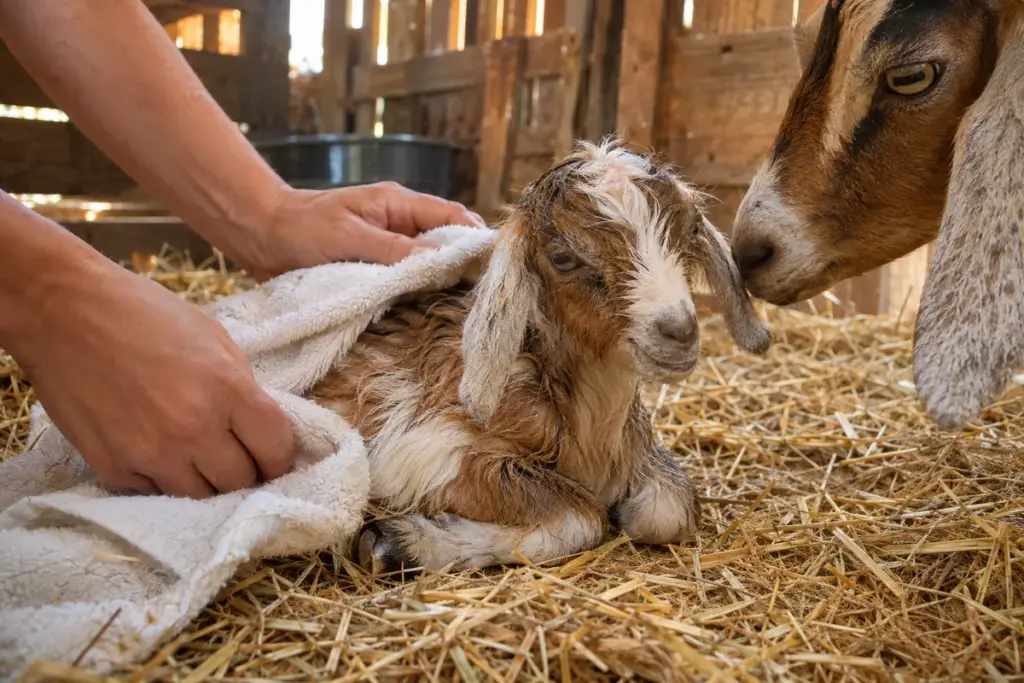
Weak, cold or orphaned newborn kid? Warm it first
Can a baby goat eat it?
Safe staples (11)
- Safe to feed. The first milk, carrying antibodies. At least 10% of body weight in the first 24 hours, starting as early as possible.Ages 0–3 days#
- Safe to feed. Backup when no clean doe colostrum exists. Buy a replacer with IgG. A product labeled supplement is not enough on its own.Ages 0–1 day#
- Safe to feed. Best choice after colostrum. Pasteurized is safest, because raw milk can pass CAE and Johne's disease to a kid.Ages 2 days–12 weeks#
- Safe to feed. A powder made for goat kids with milk protein, not soy. Weigh or measure it exactly as the bag says, the same way each time.Ages 2 days–12 weeks#
- Safe to feed. Extension sources accept whole, pasteurized cow's milk after colostrum. Goat milk or kid replacer come first. Add nothing to it.Ages 2 days–12 weeks#
- Safe to feed. Offer clean water in a shallow bucket or pan from the first day and keep it fresh. It does not replace milk.All ages#
- Safe to feed. Good, mold-free hay from about 1 week builds the rumen. Expect nibbling first and real eating later. Keep it off the floor.From 1 week#
- Safe to feed. Kids start nibbling around week 3. Introduce lush pasture slowly after a fill of dry hay, and check it for toxic plants.From 3 weeks#
- Safe to feed. Goats are natural browsers. Offer leaves only from plants you have identified as safe. Never toss in garden clippings.From 3 weeks#
- Safe to feed. A goat kid starter of about 18% protein, offered fresh daily from about 1 week. Intake of it tells you when to wean.Ages 1–12 weeks#
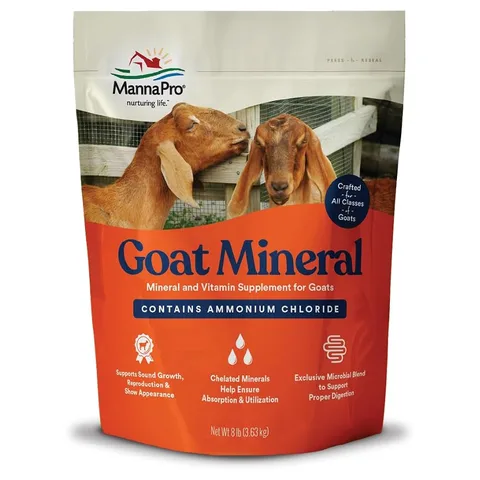
- Safe to feed. A loose mineral made for goats, kept dry. Sheep mineral is too low in copper for goats. Loose is preferred over blocks.From 2 weeks#
Small amounts only (9)
- Small amounts only. Not first choice. It is made richer for lambs. Use one only if the bag also lists kids, and follow the kid mixing line.Ages 2 days–12 weeks#
- Small amounts only. For a scouring kid, often given in place of milk for a few feeds, then milk is brought back. Do this with a vet's guidance.All ages#
- Small amounts only. Dairy programs feed it to growing kids. It is very high in calcium, and too much can cause bladder stones in males.From 2 weeks#
- Small amounts only. Measure it and change slowly over 2 to 3 weeks. Too much causes acidosis, enterotoxemia and bladder stones.From 12 weeks#
- Small amounts only. After weaning only, a few thin slices. Texas A&M vets allow a little fruit; apples in bulk are linked to rumen acidosis.From 12 weeks#
- Small amounts only. Not a kid food. After weaning, a small piece as an occasional treat. Texas A&M vets suggest only small amounts of fruit.From 12 weeks#
- Small amounts only. Not a kid food. After weaning, a few small pieces as a treat. Texas A&M vets suggest only small amounts of vegetables.From 12 weeks#
- Small amounts only. Not a kid food. After weaning, a leaf or two. Texas A&M vets say keep vegetable treats small and skip kale and broccoli.From 12 weeks#
- Small amounts only. After weaning only, one or two. Grapes in quantity have been linked to the same rumen acidosis as too much grain.From 12 weeks#
Never feed (12)
- Never feed. Maryland Extension says not to: the higher lactose may cause abomasal bloat. NC State warns of copper risk in cow replacer.
- Never feed. Young kids digest plant protein poorly. Replacer should be built on milk protein, and almond, oat or soy drinks are not milk.
- Never feed. Skip homemade mixes with corn syrup, honey, sugar or cream. Add-ins throw off milk solids and can cause severe gut upset.
- Never feed. Milk or colostrum from untested animals can pass CAE and Johne's disease. A few drops may be enough to pass CAE.
- Never feed. A hungry kid can gulp far too much water from a nipple. This causes water poisoning, often seen as bloody urine.
- Never feed. Not for a kid. Bread is linked to rumen acidosis, a sometimes fatal overload from fast-fermenting starch.
- Never feed. Spoiled hay or silage is a common route to listeriosis in goats, a fast and often fatal brain infection.
- Never feed. May carry urea or drugs not meant for goats, or the wrong minerals. Feed only products labeled for goats, at label rates.
- Never feed. Chocolate carries theobromine, and livestock have died on cocoa byproducts. Avocado leaves damage a goat's udder and heart.
- Never feed. A small amount of leaf can poison a goat, and azalea poisoning is often fatal. Mountain laurel is also toxic.
- Never feed. Highly toxic ornamentals. Yew can stop the heart. Keep kids out of reach of the plants and their clippings.
- Never feed. Wilted wild cherry and other stone-fruit leaves release cyanide. Storm-broken or cut branches can kill fast.
Sources
- Bottle Feeding Kids and Lambs (FS-1157) — University of Maryland Extension
- Nutrition of Newborn Kids: Colostrum and Bottle-Feeding — NC State Extension
- An Udder from Another Mother: Bottle Feeding Small Ruminants — Ohio State University Small Ruminant Team
- Dairy Goat Management: Seasonal Tips and Tricks — Ohio State University Small Ruminant Team and American Dairy Goat Association
- Husbandry of Dairy Animals, Goat: Replacement Management — Langston University and University of Vermont authors, via PubMed Central
- Raising Dairy Goat Kids (Publication 8160) — University of California Agriculture and Natural Resources
- Raising dairy goat buck kids — Ontario Ministry of Agriculture, Food and Agribusiness
- Artificial methods of rearing goats — New South Wales Department of Primary Industries
- Meat Goat Management (Publication 2781) — Mississippi State University Extension
- Lamb and kid care: The first 48 hours — Virginia Cooperative Extension
- Importance of Colostrum for Lambs and Kids (AS-657-W) — Purdue Extension
- 4-H Bucket or Bottle Lamb and Goat Project Guide — Oregon State University Extension
- Kid Milk Replacer Mixing and Feeding Directions — Premier1 Supplies (commercial)
- Birth to Weaning Management — Langston University
- Nutrition of Goats — Merck Veterinary Manual
- Normal Rectal Temperature Ranges — Merck Veterinary Manual
- Neonatal Hypothermia in Small Ruminants — Alabama Cooperative Extension System
- Neonatal Lamb Management: Intraperitoneal Injection of Dextrose — Ohio State University Small Ruminant Team (Alberta Lamb Producers factsheet)
- Floppy Kid Syndrome — LSU AgCenter
- Enterotoxemias in Animals — Merck Veterinary Manual
- Coccidiosis of Goats — Merck Veterinary Manual
- Bloat in Small Ruminants (FSA9625) — University of Arkansas Cooperative Extension
- Urinary Calculi in Male Goats and Sheep (FS-2021-0581) — University of Maryland Extension
- Urinary Tract Disease — Langston University
- Grain Overload in Goats — Oklahoma State University College of Veterinary Medicine
- Goat nutrition — New South Wales Government
- Poisonous plants — Langston University
- Poisonous Plants (4-H goat resources) — Cornell University College of Agriculture and Life Sciences
- Azalea Toxicity in Goats — LSU AgCenter
- Chocolate Toxicosis in Animals — Merck Veterinary Manual
- Nonprotein Nitrogen Toxicosis in Animals — Merck Veterinary Manual
- Ionophores Use in Animals — Merck Veterinary Manual
- Listeriosis in Sheep and Goats — Ohio State University Small Ruminant Team (Michigan State University Extension)
- Getting Started with Sheep and Goats: Nutrition and Feeding (EC 1652) — Oregon State University Extension
- Johne's Disease Q&A for Goat Owners — National Johne's Education Initiative, via North Dakota Department of Agriculture
- Johne's disease in sheep and goats — Ontario Ministry of Agriculture, Food and Agribusiness
- Floppy Kid Syndrome — Texas A&M Agricultural Experiment Station, hosted by Cornell University
- Chew on This: Goats as Pets — Texas A&M College of Veterinary Medicine and Biomedical Sciences
- 21 CFR 558.355, Monensin — Code of Federal Regulations, via Cornell Legal Information Institute
- Avocado (Persea spp) Toxicosis in Animals — Merck Veterinary Manual
The first 24 hours: colostrum comes first
Colostrum is the doe’s thick first milk. It carries antibodies a kid is born without, plus fat, energy and vitamin A. The gut absorbs those antibodies best in the first 6 hours and has largely stopped by about 24 hours.
1. Check that the kid is warm
Maryland Extension says not to feed a chilled kid. A goat’s normal rectal temperature is 101.3 to 103.5 °F. Dry a wet newborn, warm it and check again before you offer a bottle. A cold kid that is more than a few hours old and has not eaten needs a vet’s help, because it may need energy before it is warmed.
2. Weigh it and work out the amount
Plan on at least 10% of body weight across the first 24 hours. For an 8 lb kid that is about 13 oz, given in feeds of 2 to 4 oz. A 4 lb miniature kid needs half as much, so go by weight and not by the bottle size.
3. Feed within the first hour if you can
Give the first feed within an hour of birth and no later than 6 hours. A healthy kid nursing its mother does this on its own. Feel its belly: a fed kid’s belly is firm, not squishy or hard.
4. Choose the colostrum
- Its own mother’s colostrum is first choice, then colostrum from a healthy doe in the same herd.
- Frozen colostrum is the emergency stock. Thaw it in warm water, never in a microwave, and do not refreeze it. Purdue Extension keeps it up to 12 months.
- Ewe or cow colostrum are fallbacks. Purdue feeds about 30% more when using cow colostrum.
- Colostrum replacer with IgG listed on the label is the last choice. A product sold as a colostrum supplement does not contain enough antibodies to stand in for it.
Heat treating for CAE
Caprine arthritis and encephalitis (CAE) is an incurable virus that passes mainly through colostrum and milk. If you don’t know the doe’s CAE status, do not feed her colostrum or milk raw. CAE prevention programs heat colostrum to 133 to 135 °F and hold it there for 60 minutes in a water bath, then feed pasteurized milk or replacer. Hotter than about 135 °F, colostrum turns solid and loses antibody value.
That treatment does not reliably kill the Johne’s disease organism. For Johne’s, use colostrum only from does that test negative, never pool it, or use a replacer.
What to feed a baby goat after colostrum
From about day 2, a bottle kid moves to one of these. Pick one and stay with it, because a sudden switch can cause scours. If you have to change, blend the new milk in over a few days.
- Goat milk is the best choice. Pasteurize it unless the herd tests free of CAE and Johne’s: 145 °F for 30 minutes or 162 °F for 15 seconds.
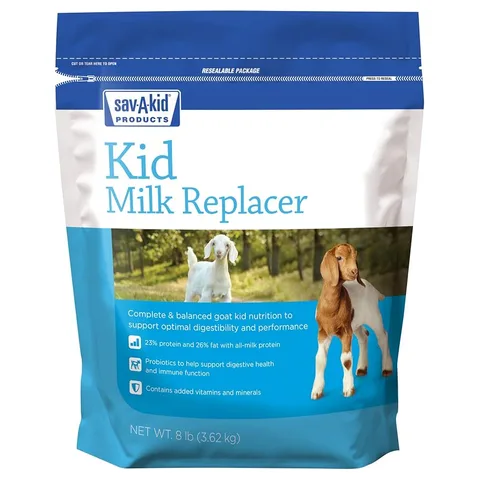
- Kid milk replacer made for goats with milk protein. Skip soy-based powders, which young kids digest poorly.
- Whole cow’s milk, pasteurized, with nothing added. University of Maryland and Mississippi State extension both allow it for kids after colostrum. Ohio State notes that it has less fat than young ruminants need, so watch weight gain.
- Lamb milk replacer only if the bag also gives directions for kids.
Maryland Extension says not to use calf or multi-species replacer, because the extra lactose may cause abomasal bloat. NC State also warns that cow milk replacer can carry too much copper. Do not stir syrup, honey, sugar or cream into any milk.
Mixing kid milk replacer
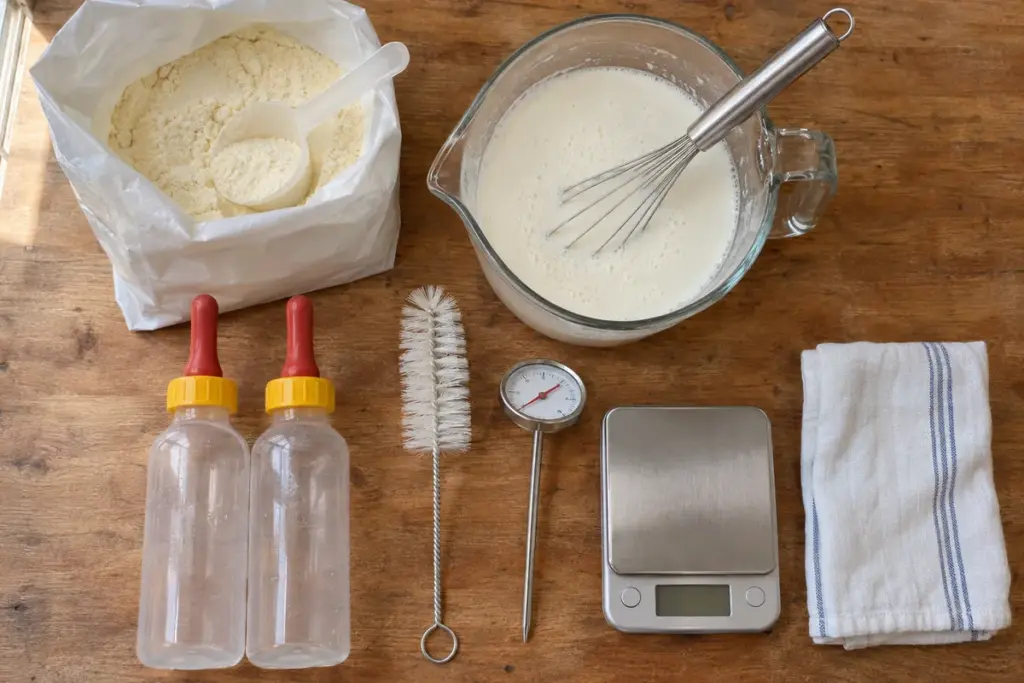
Follow the directions on your bag, since brands differ. Measure the powder with the maker’s cup or weigh it, mix until there are no clumps and check the water temperature the label gives. Water that is too cold leaves fat unmixed and water that is too hot damages the protein. Thin or lumpy replacer is linked to gorging and bloat. Throw out soured or stale milk.
How to bottle feed a baby goat
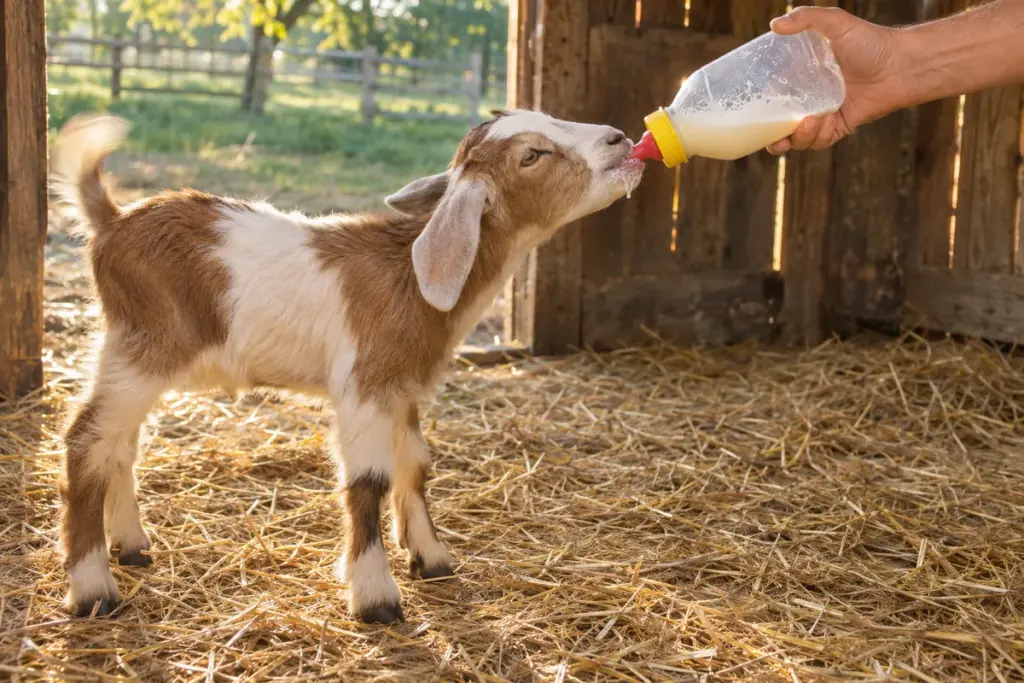
- Warm the milk to 102 to 105 °F by standing the bottle in hot water. Do not use a microwave.
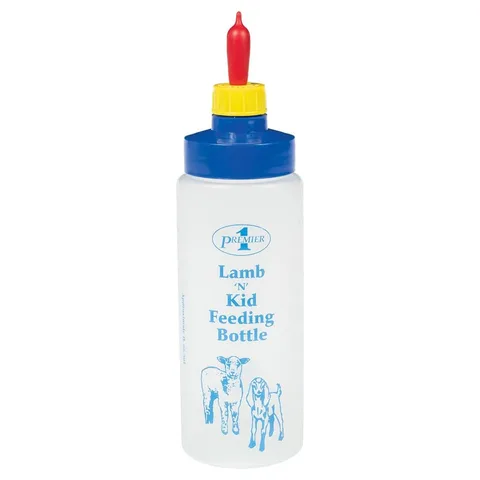
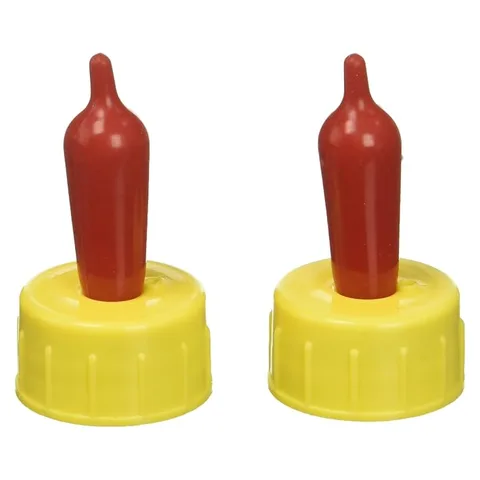
- Use a Pritchard teat or another soft kid teat. A Pritchard teat arrives sealed, so snip a very small opening or an X. Turned upside down, it should drip and never stream. Some newborns manage a baby bottle nipple better.
- Position the kid as if it were nursing its mother, with its head up and neck stretched forward. This closes a groove that sends milk past the unfinished rumen to the stomach that can digest it. A newborn can sit in your lap and an older kid can stand.
- Let it suck. Make sure the tongue wraps under the teat. Never squeeze the bottle or squirt milk into the mouth, because the kid can inhale it.
- Stop at the planned amount, even if it begs for more. Bottle kids act hungry even when they have had plenty.
- Wash everything. Rinse, scrub with hot soapy water, rinse, sanitize and air dry. Throw away damaged teats, which a kid can swallow.
A kid too weak to suck needs a feeding tube. Have a vet or an experienced goat keeper do it and show you how, since a misplaced tube puts milk in the lungs.
Bucket feeders for several kids
A lambar is a bucket fitted with several nipples. Start each kid on a bottle until it is strong, then move it over. Milk left out for free choice should be cold, because warm free-choice milk invites overeating and bloat. Take the nipples and tubes apart to clean them.
Baby goat feeding schedule by age
The amounts come from Oregon State’s 4-H bottle-feeding guide, with day-one figures from other extension sources. Some programs feed more, up to 15 to 20% of body weight a day. Do not go past 20%. The ounces suit a standard-size kid, so feed miniature breeds by percentage of body weight.
| Age | What it looks like | Food | Amount | How often | Notes |
|---|---|---|---|---|---|
| First 24 hours | Newborn; stands and hunts for a teat | Colostrum | At least 10% of body weight in total: about 13 oz for an 8 lb kid, in feeds of 2–4 oz | 4–6 feeds, the first within 1 hour if possible | No later than 6 hours for the first feed. Warm it in a water bath, never a microwave. A chilled kid is warmed before feeding. |
| 2–4 days | Learning the bottle; sleeps between feeds | Goat milk, kid replacer or whole cow's milk | 3–5 oz a feed, 12–24 oz a day. About 10–15% of body weight a day | 4–6 feeds a day | Change milk sources gradually. Leave it a little hungry rather than overfull. Water out in a pan. Miniature kids: go by percentage. |
| 5–14 days | Active and playful; starts mouthing hay and feed | Milk, plus a little kid starter and good hay from about 1 week | 4–6 oz a feed, 18–28 oz of milk a day. Never over 20% of body weight | 3–4 feeds a day (Ohio State keeps 6 for the first week) | Peak time for floppy kid syndrome (3–10 days): a suddenly weak, limp kid needs a vet. Do not force more milk into it. |
| 15–21 days | Nibbling hay, grass and starter; rumination starts | Milk, starter, hay, water, loose goat minerals | 6–8 oz a feed, 24–32 oz of milk a day | 3–4 feeds a day | Refresh starter daily. Coccidiosis risk starts now: pasty or watery stool means call the vet. |
| 3–8 weeks | Chewing cud; eats more solid feed each week | Milk, starter, hay, safe browse, water, minerals | 28–36 oz of milk a day, no more than 16 oz in one feed. Solids free choice | 3 feeds a day, never fewer than 2 before weaning | Ask your vet about CD&T shots for enterotoxemia and tetanus; bottle kids often start at 3–4 weeks and need boosters. |
| 8–12 weeks | Rumen working well; ready only when solids intake is high | Starter, hay, water and a shrinking milk ration | Wean at 2.5 times birth weight, eating about half a pound of starter a day plus hay (full-size breeds) | Drop to 1 bottle a day for 3–5 days, then stop | Do not wean on age alone. Hold off if the kid is small or sick, and avoid moving, disbudding or other stress that week. |
| 12 weeks and up | Eating like a small adult goat | Hay, pasture or browse, water, loose goat minerals; grain only as needed | Forage free choice. Grain for growing kids about 0.5–1% of body weight a day | Hay all day; split bigger grain rations into 3 or more meals | Males: keep grain low, calcium to phosphorus near 2:1, water always on hand. Straining to pee is an emergency. |
Weigh bottle kids regularly and write down weight, intake and stool. Steady gain tells you the amount is right better than the kid’s appetite does. For hay and grain amounts after weaning, use our goat feed calculator.
When can baby goats eat hay, grain and grass?
A kid is born with an undeveloped rumen. Solid food and the microbes that come with it build it up over the first weeks, so offer solids long before the kid depends on them.
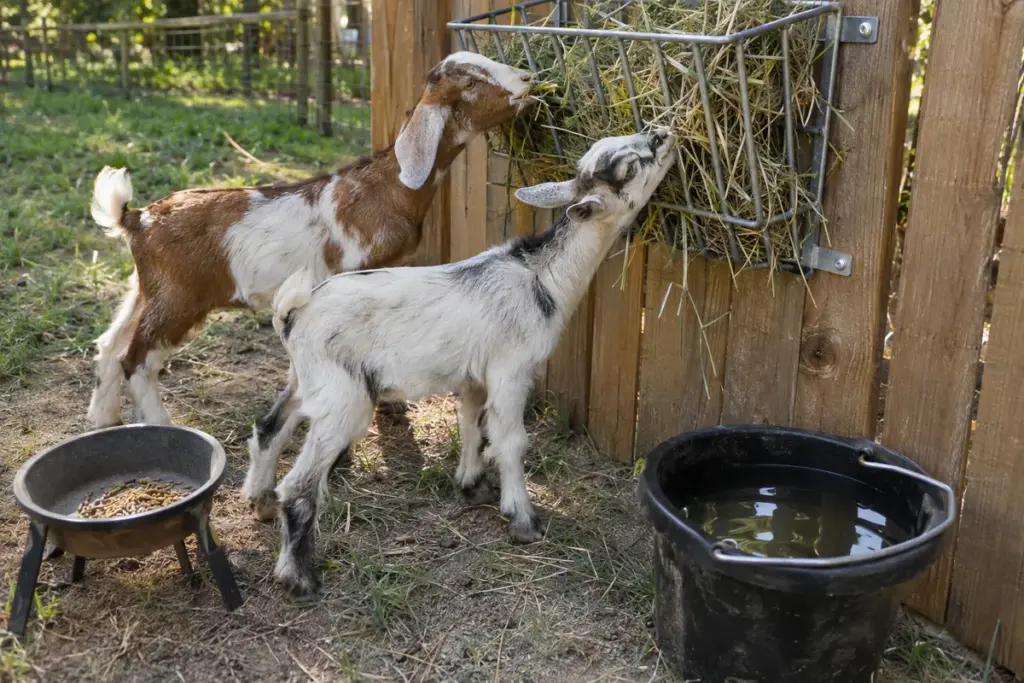
- Water: from the first day, in a shallow pan or bucket. Never by bottle.
- Hay: from about 1 week, clean and free of mold, in a rack off the floor.
- Kid starter: about 18% protein, from about 1 to 2 weeks, replaced fresh every day.
- Loose goat mineral: once it nibbles solids, around 2 weeks. Sheep mineral is too low in copper.
- Pasture and browse: from about 3 weeks. Introduce lush grass slowly, after a fill of dry hay.
Weaning
Wean at about 8 weeks or later, and only when the kid passes all three checks: it weighs at least 2.5 times its birth weight, eats about half a pound of starter a day (full-size breeds) and eats hay. Drop to one bottle a day for 3 to 5 days, then stop. Keep weaning week free of moving, disbudding and other stress. Published weaning ages run from 4 weeks to 3 months, which is why weight and intake matter more than the calendar.
Can baby goats eat fruit, vegetables or bread?
A kid on milk needs none of them. After weaning, a few thin apple slices, a small piece of banana, a few bits of carrot, a lettuce leaf or a grape or two are enough. Veterinarians at Texas A&M advise keeping fruit and vegetables small for pet goats and leaving out kale and broccoli. Skip bread, crackers and kitchen scraps: fast-fermenting starch can turn the rumen acidic.
Toxic plants and feeds to keep away
Goats browse almost anything within reach, and several common plants kill them. Remove or fence off:
- Rhododendron, azalea and mountain laurel
- Yew and oleander, including clippings
- Wilted wild cherry, peach and plum leaves
- Lily-of-the-valley, larkspur, delphinium, milkweed, nightshade, pokeweed and hemlock
The list is not complete, so identify a plant before you let a kid eat it. Keep kids out of cattle, horse and poultry feed too, which can carry urea, drugs or mineral levels not meant for goats.
Males: protect the urinary tract
Bucklings and wethers can form bladder stones that block urine flow. Keep grain low, water always available and the diet near 2 parts calcium to 1 part phosphorus. Go easy on alfalfa. Many goat feeds and minerals include ammonium chloride to lower the risk; ask your vet before adding more. A male that strains, cries or kicks at his belly and passes little or no urine is an emergency.
Signs something is wrong
- Sudden weakness and a floppy body at 3 to 10 days: possible floppy kid syndrome. Call a vet at once, stop forcing milk and follow their instructions.
- A swollen belly that sloshes, dullness or teeth grinding: possible abomasal bloat. This is an emergency.
- A tight, bulging left side: rumen bloat, which can kill quickly. Call a vet now.
- Loose or watery stool: a short spell can follow a milk change. If it persists, the kid needs a vet. From about 2 weeks, coccidiosis is a common cause.
- Staggering, convulsions, belly pain or sudden death in the group: possible enterotoxemia. Call a vet and ask about CD&T shots for the rest.
- Cough, fever above about 104 °F or heavy breathing: possible pneumonia, sometimes from inhaled milk.
- Circling or a drooping face: possible listeriosis, often from spoiled hay or silage. Treat it as urgent.
Printable baby goat feeding chart
The one-page cheat sheet has the safe, small amounts only and never food lists, the schedule by age and the newborn warning steps. Print it in color or black and white and keep it by the bottles.
Supplies for bottle feeding a baby goat
A bottle kid needs a milk source, a bottle and teats, a way to weigh it and, once it nibbles solids, goat mineral. Frozen colostrum from a tested herd is worth arranging before kidding season.

More about goats and kids’ care
Once your kid is weaned, the goat feed calculator works out daily hay, grain, water and minerals. Keeping sheep too? They need a separate mineral, covered in the sheep feed calculator. For a wild relative, read what Siberian ibexes eat, or browse farm animals from A to Z. For other young animals, see what to feed a baby deer and what to feed a baby duck.
Frequently asked questions
What do you feed a newborn baby goat?
Colostrum, at least 10% of body weight within the first 24 hours. Give the first feed within an hour of birth if possible and no later than 6 hours. Use the mother's colostrum, then a healthy herd mate's, then a colostrum replacer that lists IgG. Warm a chilled kid before feeding it.
Can baby goats drink cow's milk?
Yes. University extension sources allow whole, pasteurized cow's milk after the colostrum stage, with nothing added. Goat milk or a kid milk replacer come first. Cow's milk has less fat than young ruminants need, so check that the kid keeps gaining weight.
Can you give a baby goat calf milk replacer?
No. University of Maryland Extension advises against calf and multi-species replacers because the extra lactose may cause abomasal bloat. Use a replacer made for goat kids with milk protein.
How much milk does a baby goat need?
Oregon State's guide gives 12 to 24 oz a day at 1 to 4 days old, 18 to 28 oz at 5 to 14 days, 24 to 32 oz at 15 to 21 days and 28 to 36 oz from 3 weeks to weaning. Feed miniature breeds by weight instead, at about 10 to 15% of body weight a day. Never go over 20%.
How often do you bottle feed a baby goat?
Four to six times a day for the first few days, three to four times a day from 5 days to about 3 weeks, then two to three times a day. Keep at least two feeds a day until weaning starts.
What temperature should a baby goat's bottle be?
About 102 to 105 °F, close to the kid's body temperature. Warm the bottle in hot water, not a microwave. Milk left out free choice in a bucket feeder is the exception and should be cold.
Can baby goats drink water?
Yes, from the first day, from a shallow pan or bucket. Never give water by bottle. A hungry kid can gulp enough from a nipple to cause water poisoning.
When can baby goats eat hay and grain?
Offer clean hay from about 1 week and a kid starter of about 18% protein from about 1 to 2 weeks. A kid only nibbles at first. Real intake builds as the rumen develops over the following weeks.
When do you wean a baby goat?
At about 8 weeks or later, once the kid weighs at least 2.5 times its birth weight, eats hay and, for full-size breeds, about half a pound of starter a day. Cut to one bottle a day for 3 to 5 days, then stop.
Can baby goats eat bananas or apples?
Not while they are on milk. After weaning, a few thin apple slices or a small piece of banana make an occasional treat. Too much fruit or other rich food can upset the rumen.
Why is my baby goat suddenly weak and floppy?
A kid that was normal at birth and turns limp at 3 to 10 days old may have floppy kid syndrome. Take its temperature, do not force milk into it and call a vet immediately.
Can baby goats eat grass?
Yes. Kids start nibbling grass at about 3 weeks. Introduce lush pasture slowly, give dry hay first and check the area for rhododendron, azalea, yew, oleander and other poisonous plants.
Sources
- Bottle Feeding Kids and Lambs, University of Maryland Extension
- Nutrition of Newborn Kids, NC State Extension
- Bottle Feeding Small Ruminants, Ohio State University
- 4-H Bucket or Bottle Lamb and Goat Project Guide, Oregon State University Extension
- Importance of Colostrum for Lambs and Kids, Purdue Extension
- Goat: Replacement Management, Langston University and University of Vermont authors
- Nutrition of Goats, Merck Veterinary Manual
- Urinary Calculi in Male Goats and Sheep, University of Maryland Extension
- Poisonous Plants, Langston University
- Chew on This: Goats as Pets, Texas A&M College of Veterinary Medicine