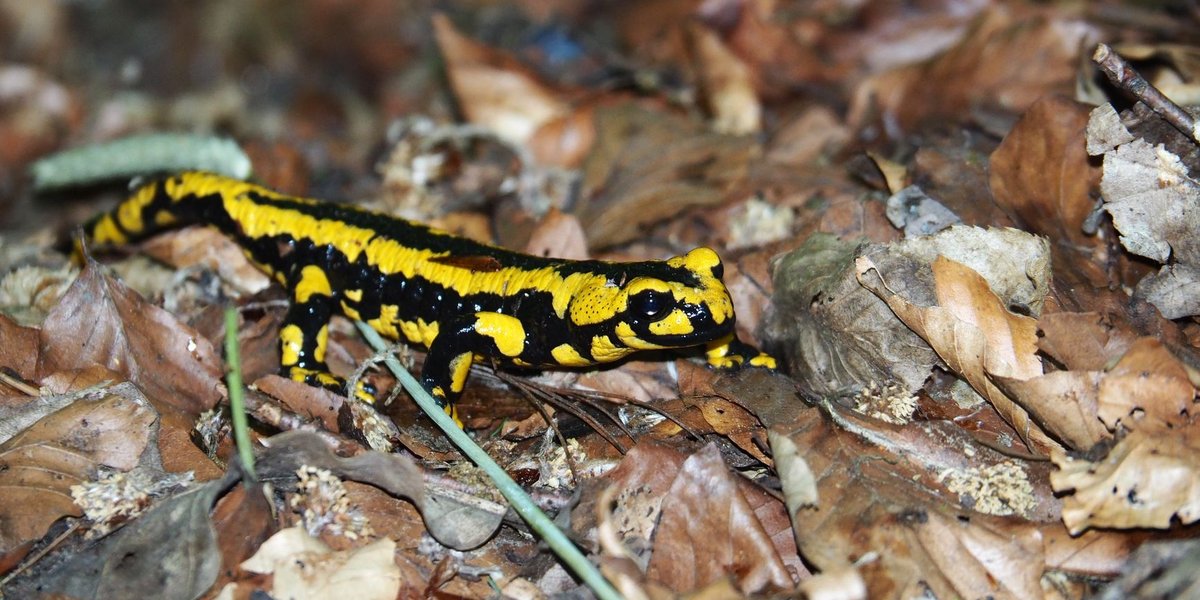
Luxembourg is small enough to drive across in an afternoon, but its patchwork of beech forest, river valleys, and leftover farm ponds holds thirteen native amphibian species. That’s a respectable count for a country the size of a mid-sized American county, and it includes everything from a fire-orange salamander that only comes out in the rain to a frog complex so genetically tangled that scientists needed DNA sequencing to sort out who’s who.
None of this diversity is guaranteed to last. Only about 10% of the “mares” — the shallow farm ponds that amphibians relied on for centuries — still exist in Luxembourg today, and one native species has already blinked out of the country entirely. Here’s every amphibian still holding on, what to look for, and where you’re most likely to find one.
Table of Contents
- Why Luxembourg’s Amphibians Are Disappearing
- Fire Salamander
- Alpine Newt
- Smooth Newt
- Palmate Newt
- Great Crested Newt
- Midwife Toad
- Yellow-Bellied Toad
- Common Toad
- Natterjack Toad
- Common Tree Frog
- Common Frog
- Pool Frog
- Edible Frog
- Where and When to Spot Them
TLDR
Thirteen species, one shared problem: vanishing ponds. The quick list —
- Fire Salamander — black with yellow blotches, forest streams
- Alpine Newt — bright orange belly, small woodland ponds
- Smooth Newt — Luxembourg’s most common newt, garden ponds included
- Palmate Newt — smallest newt, acidic pools and heathland
- Great Crested Newt — biggest newt, jagged crest, strictly protected
- Midwife Toad — the male carries the eggs, near-threatened
- Yellow-Bellied Toad — heart-shaped pupils, endangered
- Common Toad — the default toad, warty and unbothered
- Natterjack Toad — yellow racing stripe, loudest call in Europe, endangered
- Common Tree Frog — bright green, climbs, endangered
- Common Frog — brown, early breeder, still widespread
- Pool Frog — small, strictly protected under EU law
- Edible Frog — a hybrid, not a “real” species, everywhere anyway
Why Luxembourg’s Amphibians Are Disappearing
Walk the countryside in southern Luxembourg today and you’ll see tidy fields with straight edges. A century ago, those same fields were dotted with mares — small, stagnant ponds that farmers dug for livestock and that amphibians quietly colonized. Land consolidation drained or filled most of them. What survived got hit with fertilizer runoff, which chokes ponds with algae and strips the oxygen breeding amphibians need.
The result: only around 10% of the mares that existed in the 18th century are still there. One species, the common spadefoot toad, is now considered regionally extinct in Luxembourg — it hasn’t been reliably recorded in decades. Three of the thirteen species below are officially listed as endangered — patterns explored in our guide to endangered species in Luxembourg — and a fourth is near-threatened.
It’s not all decline, though. Between 1997 and 2001, a EU LIFE-funded conservation project coordinated by the Luxembourgish nature agency SICONA specifically targeted four struggling species — the European tree frog, great crested newt, yellow-bellied toad, and natterjack toad — with new breeding ponds and habitat restoration. Several of those populations are still hanging on today partly because of that work, and similar pond-digging efforts continue under Luxembourg’s national “Plan d’action mares.”
Fire Salamander
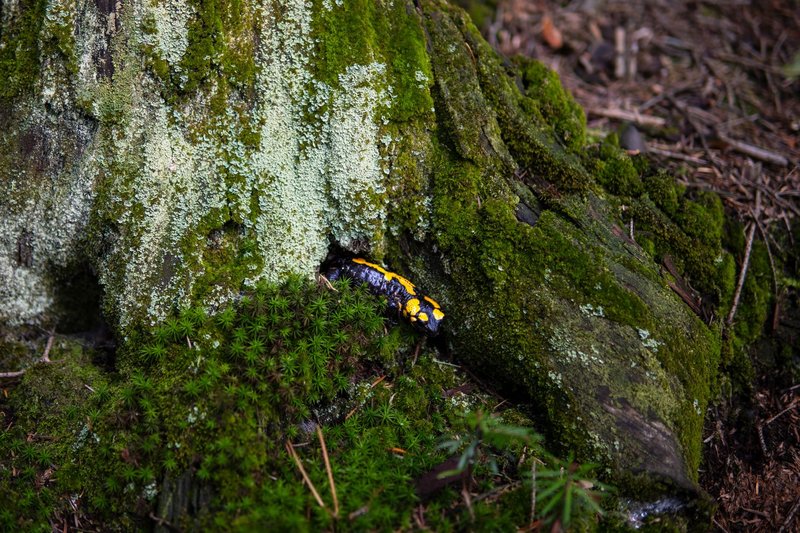
Black, glossy, and marked with irregular yellow or orange blotches that never repeat from one individual to the next — like a fingerprint. Adults run 15–20 cm and move with a slow, deliberate walk rather than a hop or a dart, which makes them easy to identify even for someone who’s never seen one before.
Fire salamanders are creatures of humid forest, sticking close to shaded streams and damp leaf litter in Luxembourg’s Ardennes and Éislek woodlands. They’re almost entirely nocturnal and surface most reliably during or right after rain — locals sometimes call them “rain salamanders” for exactly that reason. Unlike most amphibians here, they don’t lay eggs in ponds; females deposit live larvae directly into slow-moving forest streams.
Conservation status: not currently threatened, though forestry practices that remove streamside shade can hurt local populations.
Alpine Newt
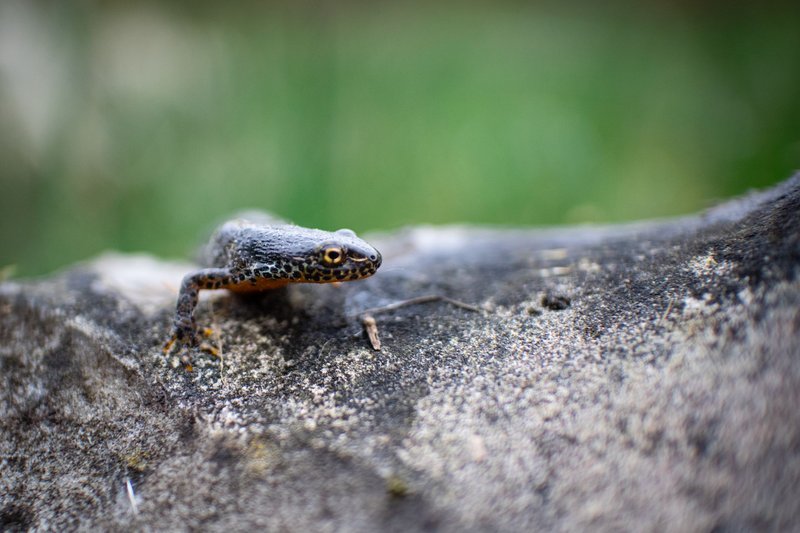
During breeding season, male alpine newts develop a smooth blue-grey back with black spots and a belly that goes bright orange to red — one of the more striking transformations in European wildlife. Outside the water, both sexes turn a duller grey-brown and are easy to mistake for a salamander at a glance.
They favor small, fishless ponds in wooded or semi-open areas, including garden ponds, which makes them one of the amphibians Luxembourg residents are most likely to encounter without even looking for them. Breeding runs from March through June, after which adults leave the water and spend the rest of the year on land under logs and stones.
Conservation status: stable and relatively widespread across Luxembourg.
Smooth Newt
The most frequently recorded newt in the country, and the one most likely to show up in a suburban rain barrel or ornamental pond. Males in breeding condition grow a wavy, unbroken crest running from head to tail and develop dark spots down an orange-tinted belly; females stay a plainer olive-brown year-round.
Smooth newts tolerate a wider range of pond conditions than most of their relatives — slightly murky water, some vegetation, occasional fish — which is a big part of why they’ve held on better than pickier species. They overwinter on land, often just meters from the pond where they bred.
Conservation status: least concern, the most secure of Luxembourg’s newts.
Palmate Newt
Luxembourg’s smallest newt, rarely topping 9 cm, and the trickiest to tell apart from the smooth newt. The reliable tell is the tail: breeding males grow a short filament thread at the very tip, and their hind feet develop dark webbing between the toes — hence “palmate.”
They prefer more acidic water than smooth or alpine newts, which puts them in shallow heathland pools and forest clearings rather than nutrient-rich farm ponds. That habitat preference makes them a useful indicator species; where palmate newts are breeding, water quality tends to be genuinely good.
Conservation status: stable, though tied to a narrower range of pond types than more generalist newts.
Great Crested Newt
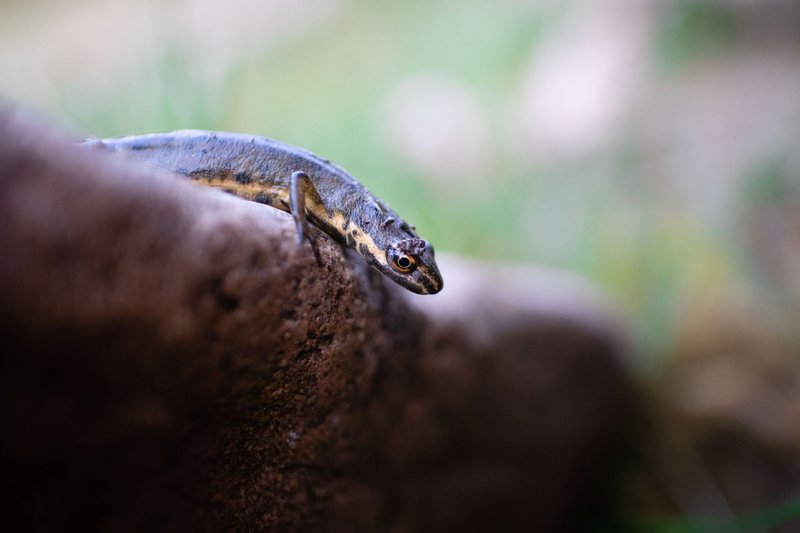
The giant of Luxembourg’s newt lineup, reaching up to 16 cm, with warty black skin and — on breeding males — a jagged, dinosaur-like crest running the length of the back. It’s the amphibian most likely to make someone do a double take at a pond edge.
Great crested newts need larger, deeper, fish-free ponds than their smaller relatives, and that specific requirement is exactly what’s disappeared alongside the mares. They’re protected under both Luxembourg law and the EU Habitats Directive, meaning any development near a known breeding pond triggers a legal review — one of the few amphibians here with that level of formal protection.
Conservation status: protected species; populations are patchy and dependent on active pond management.
Midwife Toad
The male midwife toad carries the fertilized eggs — literally wrapped around his hind legs in a gelatinous string — for three to eight weeks, releasing tadpoles into water only once they’re ready to hatch. It’s one of the more unusual parenting strategies in European wildlife, and it means you can sometimes spot an egg-carrying male on land, nowhere near a pond.
Compact and warty with vertical pupils, midwife toads favor rocky, well-drained sites: quarries, stone walls, and garden rockeries as much as natural habitat. Their call, a soft, repeated single “poop,” is often mistaken for an owl at a distance.
Conservation status: near-threatened in Luxembourg, with populations concentrated in the south.
Yellow-Bellied Toad
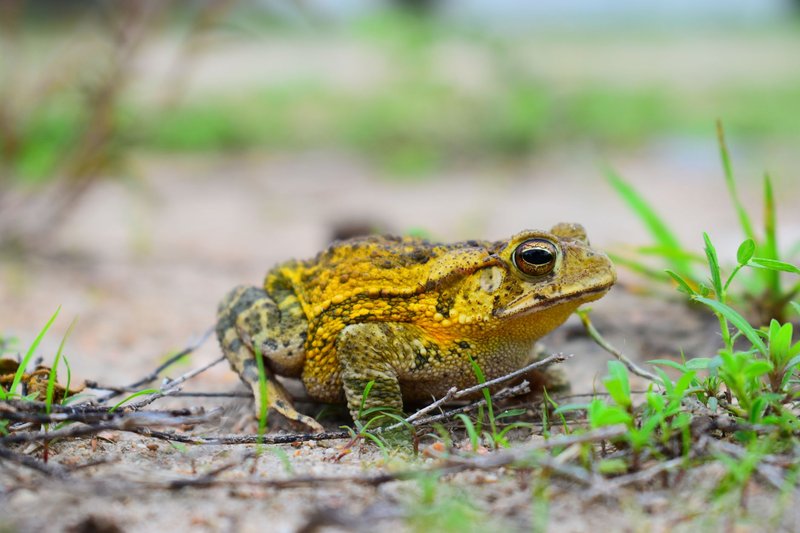
Small, flattened, and marked underneath with a bright yellow-and-black pattern unique to each individual — visible mainly when the toad flips itself over defensively, arching its back to flash the warning color at a predator. Its pupils are heart-shaped, a detail that’s oddly hard to unsee once you’ve noticed it.
Yellow-bellied toads breed in shallow, sun-warmed, often temporary puddles — wheel ruts, quarry pools, flooded ditches — rather than permanent ponds, which makes them vulnerable to exactly the kind of tidy land management that’s reshaped the Luxembourgish countryside. They were one of the four species targeted by the 1997–2001 LIFE conservation project.
Conservation status: endangered in Luxembourg, one of the species with the steepest documented decline.
Common Toad
Big, warty, and unhurried, with coppery eyes and skin that ranges from olive to brick-brown. It’s the toad most people picture when they hear the word, and for good reason — it’s the most widely distributed toad species across Europe.
Common toads migrate to breeding ponds in early spring, sometimes crossing considerable distances of open ground to reach the same pond generation after generation, which is why volunteer “toad patrols” that carry them across roads during migration nights are common practice in parts of Europe. Outside the breeding window they’re almost entirely terrestrial, hunting slugs and insects in gardens, hedgerows, and forest edges.
Conservation status: least concern, still common across Luxembourg.
Natterjack Toad
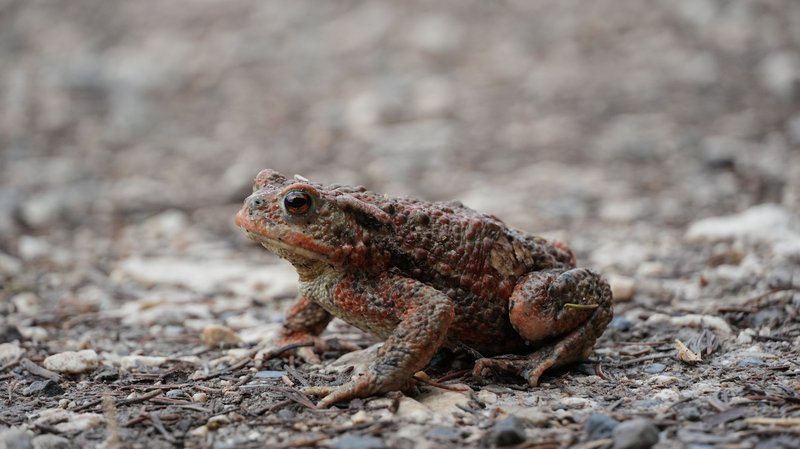
Identifiable at a glance by the thin yellow stripe running down its spine — no other Luxembourgish amphibian has one. Natterjacks also move differently from other toads: rather than hopping, they scurry on relatively long legs, closer to a run than a walk.
They need warm, shallow, sparsely vegetated pools, often on sandy or otherwise open ground, and their males produce one of the loudest calls of any European amphibian — audible over a kilometer away on a still spring night. That combination of specific habitat needs and a shrinking pool of open, undeveloped land has made them one of Luxembourg’s rarer amphibians.
Conservation status: endangered, another of the four species prioritized by the LIFE project.
Common Tree Frog
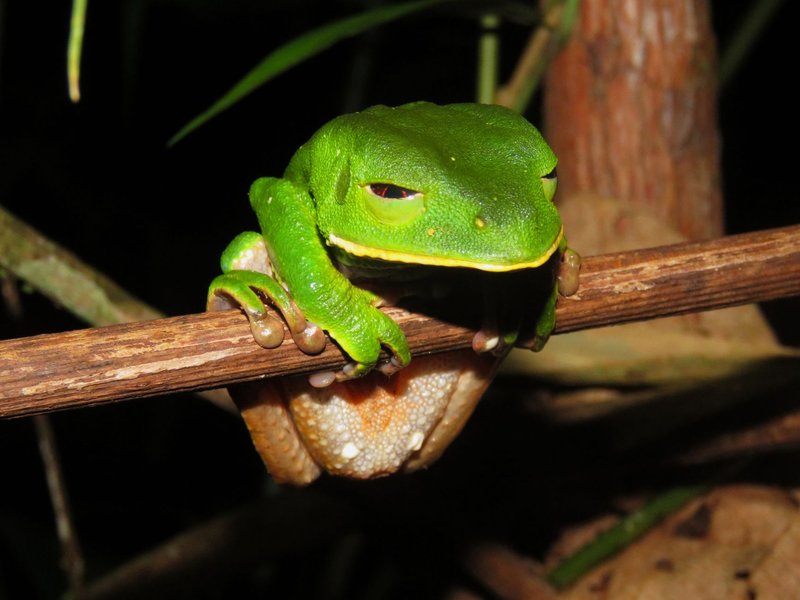
Small, bright green, and equipped with adhesive toe pads that let it climb reeds, shrubs, and low branches rather than staying pond-bound like most frogs. A dark stripe runs along each flank from eye to hip, which is the quickest way to separate it from a young common frog at a distance.
Males call from vegetation around breeding ponds on warm spring evenings in a loud, rasping chorus that can be heard well before the frogs themselves are visible. Luxembourg sits near the northern edge of this species’ European range, which is part of why populations here are thinner than in France or southern Germany.
Conservation status: endangered in Luxembourg, and was one of the four LIFE-project priority species.
Common Frog
Brown to olive with a dark “mask” patch behind each eye, the common frog is one of the first amphibians active each year — breeding can start in late February during a mild winter, well before most other species have stirred. Eggs are laid in large communal clumps rather than strings, often in the same shallow pond corner year after year.
It’s a habitat generalist, breeding in everything from woodland pools to garden ponds to roadside ditches, which has helped it stay widespread even as more specialized species have struggled.
Conservation status: least concern, one of the more secure species on this list.
Pool Frog
The smaller, quieter member of Luxembourg’s green water frog complex, typically under 7 cm, with a paler, more uniform green than its look-alike relatives and a shorter, less obviously pointed snout. Distinguishing it from the edible frog in the field is genuinely difficult — genomic research on Luxembourg’s water frogs has confirmed the two species breed in close contact across much of the country.
Pool frogs are listed under Annex IV of the EU Habitats Directive, giving them strict protection status that most of Luxembourg’s other water frogs don’t share. They favor smaller, well-vegetated ponds and are more sensitive to water quality decline than their hybrid neighbor.
Conservation status: strictly protected under EU law, though still found in scattered ponds nationwide.
Edible Frog
Not a species in the traditional sense — the edible frog is a naturally occurring hybrid between the pool frog and the marsh frog, a genetic combination stable enough to persist and breed across generations without settling into a “pure” lineage. Biologists write its name with a “kl.” (for klepton) to flag that unusual status: Pelophylax kl. esculentus.
It’s the water frog you’re most likely to actually see and hear in Luxembourg, calling from pond edges in a loud, motorbike-like chorus through late spring and summer. Because it depends on breeding alongside pool frogs to maintain its hybrid population, its future is tied directly to how well its rarer relative is doing.
Conservation status: not separately assessed as a species, but ecologically dependent on pool frog populations remaining healthy.
Where and When to Spot Them
Late March through May is peak season for almost everything on this list. Newts and common toads move first, often on the first mild, damp night after winter; tree frogs and water frogs follow in April and May once nights warm up, and their evening choruses are the easiest way to confirm a species is present without ever seeing it.
Luxembourg’s nature reserves are the most reliable starting points. Ponds managed by natur&ëmwelt and the Hëllef fir d’Natur foundation — including sites developed under the national mares restoration plan — were specifically dug or restored with amphibians in mind, and several still host descendants of the populations reinforced by the 1997–2001 LIFE project. The Dumontshaff Nature Reserve and other SICONA-managed sites in the south and west are good bets for yellow-bellied toad and natterjack toad, both of which favor the open, sun-warmed pools those reserves maintain. For fire salamanders, skip the ponds entirely and head to shaded forest streams in the Éislek after rain — daylight sightings are rare, but a wet evening walk along a wooded stream in April or May is close to a guarantee.
Bring a flashlight with a red filter if you’re heading out after dark. It lets you spot eyeshine and movement without dazzling the animals or disrupting their behavior — good practice for watching any nocturnal wildlife, not just amphibians.