Congaree National Park has 21 snake species, and only three of them are venomous: the timber rattlesnake, the copperhead and the cottonmouth. Bites are rare. Snakes here want nothing to do with you, and the real problem for most visitors is not getting bitten but misidentifying a harmless water snake as a cottonmouth and spending a paddle in a panic.
This guide fixes that. It covers what lives in the park, how to tell the dangerous three from their lookalikes, where each tends to turn up, and what to do if the worst happens.
Contents
- The short version
- The three venomous snakes
- Cottonmouth or harmless water snake?
- Harmless snakes you’ll actually see
- When snakes are active
- Snakes on the trails and the water
- If you are bitten
The short version
TLDR
- 21 snake species live in Congaree. 3 are venomous: timber rattlesnake, copperhead, cottonmouth (water moccasin).
- Most of what you’ll see is harmless: water snakes, black racers, rat snakes, garter snakes.
- Snakes are most active from spring through early fall, and the park posts warnings when “snake season” begins.
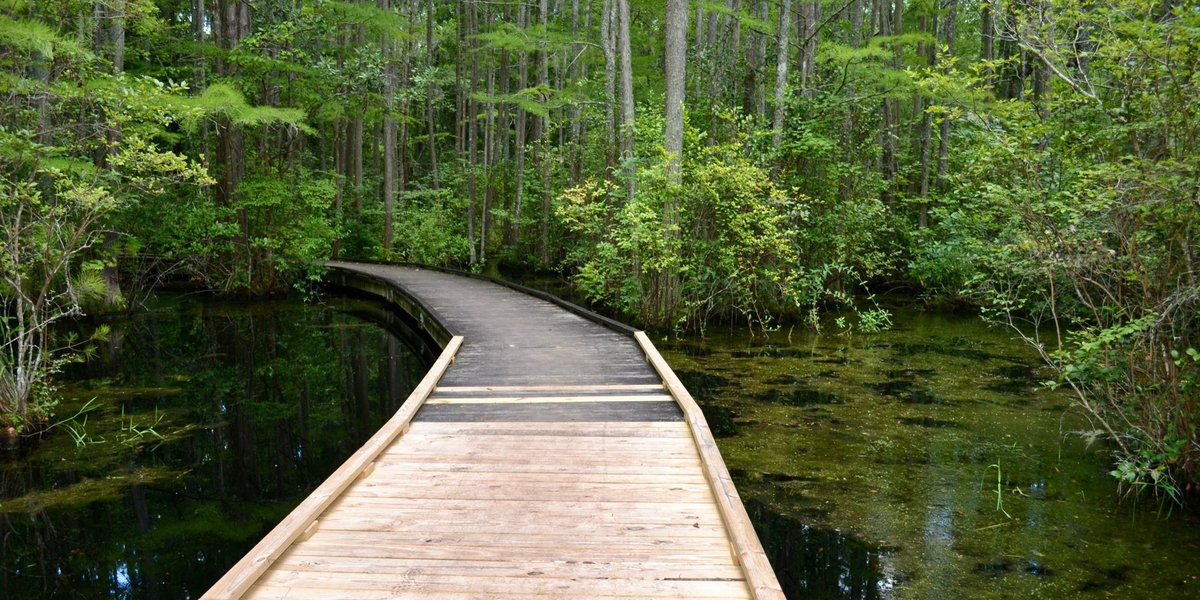
- The 2.6-mile Boardwalk Loop is raised off the forest floor, which makes it the lowest-risk way to see the swamp.
- Stay at least 6 feet back, watch where you put hands and feet, and wear long pants and closed boots off the boardwalk.
- If bitten: stay calm, keep the limb still, call 911. No tourniquet, no cutting, no sucking.
The three venomous snakes
The National Park Service protects this 26,000-acre floodplain forest as the largest intact stretch of old-growth bottomland hardwood forest in the southeastern United States. A forest that wet and that full of rodents, frogs and fish is good snake habitat. Here are the three you need to know by sight.
Timber rattlesnake
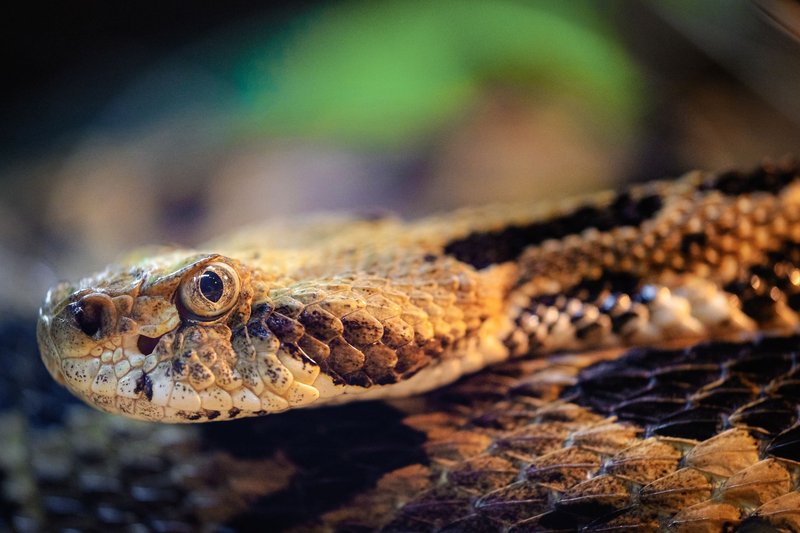
The big one. Adults commonly run 3 to 5 feet and are heavy-bodied. In the Southeast’s coastal plain, the local form is often called a canebrake rattlesnake: pinkish-tan to gray, with dark chevron-shaped bands, a rusty stripe down the middle of the back and a solid black tail ending in the rattle.
Timber rattlers prefer drier ground, so look for them on the slightly higher ridges and around fallen logs rather than in open water. They lean on camouflage. Many bites on hikers happen because someone stepped over a log without looking at what was behind it. They also don’t always rattle, so don’t count on a warning.
Copperhead
Copperheads are the smallest of the three, usually 2 to 3 feet. The pattern is the giveaway: hourglass-shaped bands, narrow across the back and wide on the sides, on a pale tan or pinkish body. The head has a coppery tint.
They live in leaf litter, where that pattern disappears completely. They sit still and trust their camouflage, which is exactly why people step close to them. A copperhead bite is painful but rarely life-threatening in healthy adults. Treat it as an emergency anyway.
Cottonmouth (water moccasin)
The cottonmouth is the only venomous water snake in North America, and in a swamp park it’s the one that gets all the attention. Adults are thick-bodied and usually 2 to 4 feet long. Color ranges from olive-brown to nearly black, and older snakes lose most of their pattern. Juveniles are brighter, with bold bands and a yellowish tail tip.
When threatened, a cottonmouth may hold its ground, coil and gape to show the pale white lining of its mouth that gives it the name. That’s a bluff in most cases. Back away and it will usually go on with its day.
Cottonmouth or harmless water snake?
This is the identification problem that matters most in Congaree, because the park has several harmless water snakes that look vaguely similar from a canoe. Here is how to separate them.
| Feature | Cottonmouth (venomous) | Harmless water snakes |
|---|---|---|
| Body | Thick, heavy for its length | Slimmer, often longer-looking |
| Head | Blocky, distinct from the neck, with a dark band through the eye | Narrower, closer to the width of the neck |
| Swimming | Floats high, body and tail riding on the surface | Swims with head up and most of the body submerged |
| When disturbed | Stands its ground, may gape and show a white mouth | Flees toward the water or dives |
| Pupils | Vertical slits | Round |
Do not use pupils as your field test. You’d have to be dangerously close. Use body shape and swimming behavior instead. A thick-bodied snake floating like a pool toy is a cottonmouth. A thin snake with only its head showing, cutting a V through the water, is almost certainly a harmless one.
The one you’re most likely to meet is the red-bellied water snake, a plain brown to reddish snake with an orange-red belly. It’s often mistaken for a moccasin because it’s big and hangs out in the same swampy places. It bites if grabbed, but it is not venomous.
If you can’t tell, treat it as a cottonmouth, keep your distance and move on.
Harmless snakes you’ll actually see
Most snakes in Congaree pose no danger. Learning a few of them turns anxiety into a game of spotting.
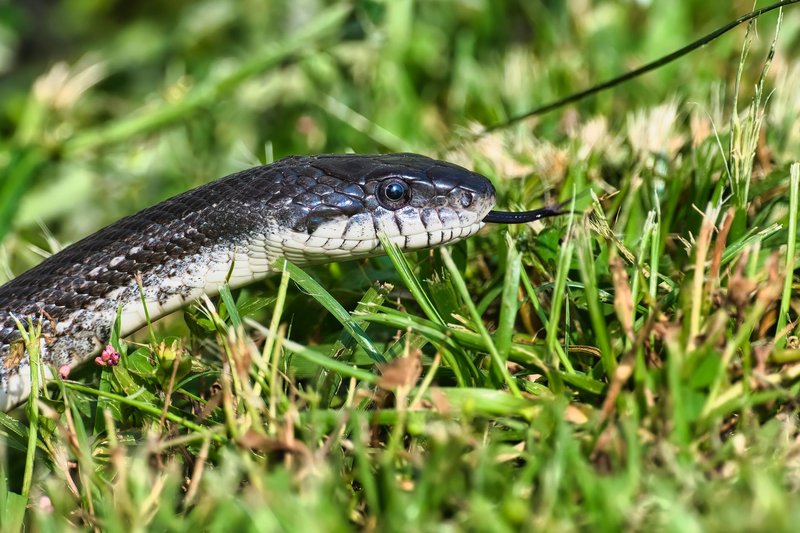
- Black rat snake. Large (often 4 to 6 feet), glossy black with a pale chin. It climbs trees and sometimes drapes over low branches. It eats rodents and is good for the forest.
- Black racer. Slender, matte-to-glossy black, with a white chin. It’s fast and alert, and tends to disappear before you see more than a tail.
- Rough green snake. Bright, leaf-green and thin. Look for it in shrubs and branches along the water’s edge, where it hunts insects and spiders.
- Eastern kingsnake. Black with white or yellow chain-link bands. It eats other snakes, including venomous ones.
- Mud snake. Glossy black above, with red bars wrapping onto the belly. It’s secretive, aquatic, and has a pointed tail tip that people wrongly call a stinger. It’s harmless.
- Eastern hognose. Stout and upturned at the snout. When scared, it flattens its neck like a cobra, hisses, and then rolls over and plays dead.
- Garter and ribbon snakes. Slim, striped and quick, usually near water.
The other species in the park’s list of 21 are mostly small, secretive and rarely seen by people: ground-dwelling snakes under logs and bark that you’d only meet if you were flipping debris.
When snakes are active
Snakes are cold-blooded, so temperature runs their calendar. The pattern in the Congaree Valley goes roughly like this:
- December to February. Mostly inactive and sheltering. Snakes can still appear on a warm, sunny winter afternoon, especially basking spots such as sun-warmed logs or boardwalk edges.
- March and April. Emerging. This is when the park issues its “snake season” warnings, as reported by FOX Carolina. Snakes are sluggish in the mornings and bask to warm up.
- May to September. Peak activity. Heat pushes snakes to be most active at dawn, dusk and after dark, and to hide in shade at midday. Mosquitoes will be a bigger daily problem than snakes, but snakes are around.
- October and November. Still active on warm days, then winding down toward shelter as nights get cold.
Congaree also floods, sometimes dramatically. When water rises, snakes and other animals move to whatever dry ground is left, which can concentrate them near high spots and trails. If the park posts flood warnings, that’s a good reason to postpone off-boardwalk hiking.
Snakes on the trails and the water
Boardwalk Loop
The 2.6-mile Boardwalk Loop is elevated above the forest floor, so you’re walking above the leaf litter where copperheads hide. Snakes do occasionally cross or bask on it, especially on warm evenings. Watch the planks ahead of you, don’t lean over the rails to touch anything, and give any snake you meet a wide berth rather than stepping around it.
Weston Lake Loop and backcountry trails
Once you leave the boardwalk, you’re walking on soil and leaf litter. This is where long pants and closed, sturdy boots earn their place. Look before stepping over logs, don’t put hands on ledges or into hollows you can’t see, and stay on the trail. Weston Lake edges can have cottonmouths basking in warm weather.
Paddling Cedar Creek
Paddling Cedar Creek is one of the best ways to see the park, and the snake risk is real but manageable. The main hazard is overhanging branches. Snakes bask on limbs above the water, and a canoe passing underneath can bump them off into the boat or the water. A few rules:
- Scan overhead branches before you drift under them.
- Don’t grab branches or logs to pull yourself along.
- Don’t beach the boat on snaggy banks without checking first.
- If a snake lands in the boat, stop paddling, stay still and let it find its own way out. Most will leave on their own.
If you are bitten
Venomous bites in the park are uncommon, and deaths from snakebites in the United States average only a handful per year. But a bite is still a medical emergency.
- Move away from the snake. Don’t try to catch or kill it. Note what it looked like if you can do so safely, or take a photo from a distance.
- Call 911. Cell service in the park can be patchy, so check coverage at the visitor center before you head out and tell someone your route.
- Keep the bitten limb still and at about heart level. Stay calm and avoid walking if you can.
- Remove rings, watches and tight clothing near the bite before swelling starts.
- Do not apply a tourniquet, cut the wound, suck out venom, apply ice, or drink alcohol.
For non-emergency questions after a possible bite, Poison Control (1-800-222-1222 in the US) can advise, but any bite you suspect is venomous should be seen at a hospital.
Snakes in Congaree are part of what makes the place feel alive. Learn the three that matter, keep your eyes on the ground and the branches, and most people leave with nothing worse than mosquito bites and a good story. The park’s own reptile page is worth checking before you go for any updates.