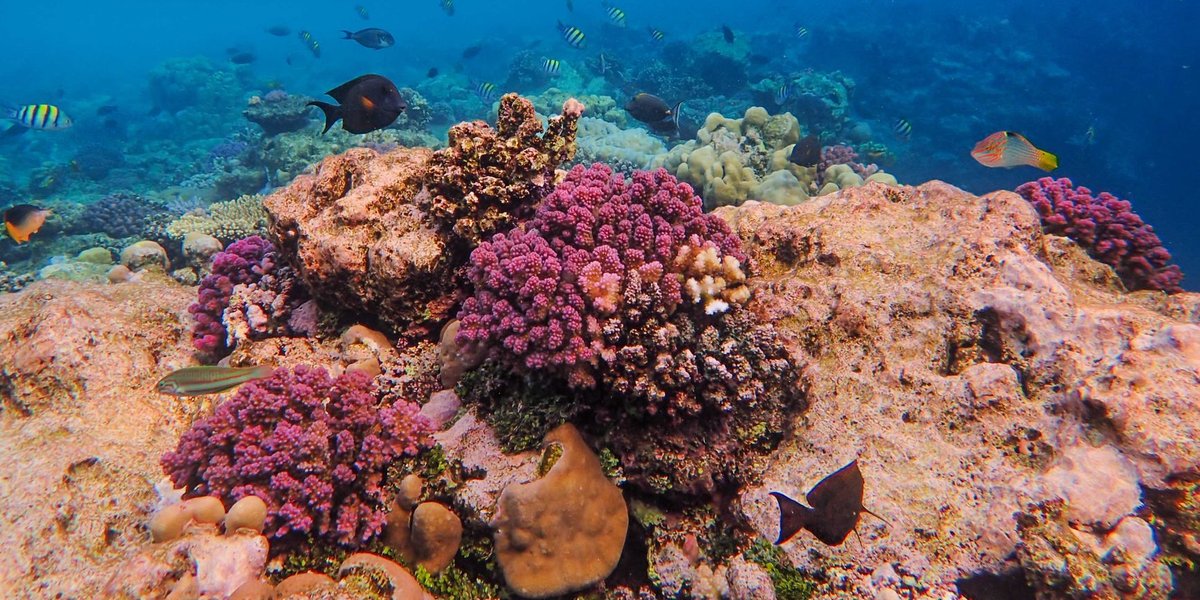
Pull the sea cucumbers off a patch of reef and watch what happens to the coral nearby. Researchers at Georgia Tech did exactly that in French Polynesia and at Palmyra Atoll, and the results were not subtle: coral tissue death jumped by roughly 370%, and whole-colony death rates rose by around 1,500% compared to patches where sea cucumbers stayed put. That single Nature Communications study reframes what a “scavenger” actually does on a reef. These aren’t just the animals that mop up leftovers. They’re part of what keeps coral alive in the first place.
Coral reef scavengers are the crabs, worms, fish, and echinoderms that eat dead organic matter, waste, and carrion on a reef instead of hunting live prey. That’s a different category from an aquarium “clean-up crew” — a curated group of species hobbyists buy to manage algae and detritus in a tank, which overlaps with wild scavengers but isn’t the same thing. This piece is about the wild version: who they are, what they eat, and why a reef missing its scavengers is a reef in trouble.
Table of Contents
- Crustacean Scavengers
- Sea Cucumbers: The Reef’s Sediment Filter
- Opportunistic Fish Scavengers
- The Small Stuff: Isopods, Amphipods, and Polychaetes
- Why Scavengers Matter More Than People Think
- Wild Scavengers vs. Aquarium Clean-Up Crews
Crustacean Scavengers
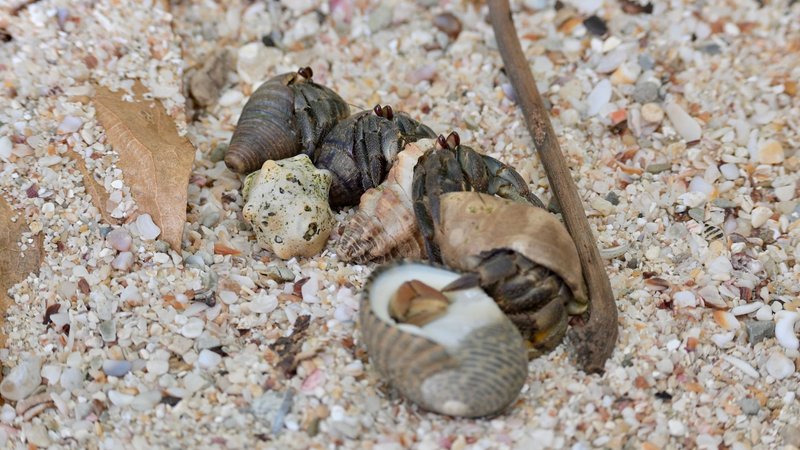
Hermit crabs are the reef’s most visible scavengers, and they’re built for the job — no fixed shell means no fixed territory, so they wander the reef flat picking through whatever the current delivers. Reef hermit crabs are detritivores first: they work through decaying algae, leftover fish scraps, and organic film on rock and sand, and they’re just as happy stripping a dead fish as they are grazing filamentous algae off a coral skeleton. A hermit crab doesn’t discriminate between a fresh meal and last week’s, which is exactly what makes it useful — it removes decaying material before it becomes a bacterial problem.
Anemone crabs work a narrower patch. They live inside a single host anemone, feeding on the anemone’s leftover prey scraps and mucus along with whatever detritus drifts through their tentacles. It’s a tight, specific relationship — the crab gets shelter and food, the anemone gets its tentacles kept clean of debris.
Spiny lobsters scavenge on a bigger scale, mostly at night. They emerge from reef crevices after dark and range across the sand flats and rubble zones, eating mollusks, dead fish, and carrion alongside live prey like snails and urchins. Their scavenging isn’t incidental — carrion is a reliable, low-effort calorie source compared to hunting, and lobsters take advantage of it whenever it’s available.
Sea Cucumbers: The Reef’s Sediment Filter
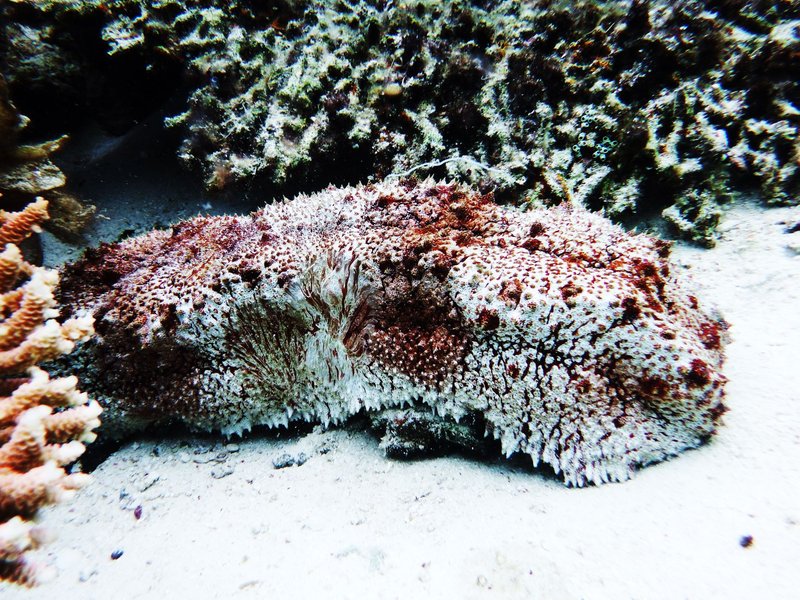
Sea cucumbers don’t look like they’re doing much. They sit on sand and rubble, and they eat their way through it — sediment goes in one end, stripped of organic material and bacteria, and comes out the other as clean, processed sand. A single sea cucumber can move a significant volume of substrate this way over its lifetime, which is why the field is sometimes called “bioturbation”: they physically rework the seafloor while feeding.
That grazing turns out to matter for reasons beyond tidy sand. Marine biologists Cody Clements and Mark Hay, working across sites in Moorea, French Polynesia, and Palmyra Atoll, ran a set of field experiments: they removed sea cucumbers from some sand patches, left them in place on others, and tracked coral health in both. Corals near sea cucumbers stayed markedly healthier. When the researchers pulled the animals out, disease and death in nearby Acropora pulchra coral spiked — tissue mortality up about 370%, colony mortality up around 1,500%. The mechanism seems to be straightforward: sea cucumbers consume the bacteria living in reef sediment, including pathogens that cause coral disease, before those pathogens can build up and spread to coral in contact with the seafloor.
This matters because sea cucumbers are also one of the most heavily overharvested animals on any reef. Tropical species are targeted for the dried “bêche-de-mer” trade across Asia, and populations have collapsed in region after region — surveys in the Red Sea found the number of species present dropped from 13 to 7 between the early 2000s and 2016, and remote Australian reef systems have logged population declines of more than half in under five years. Sea cucumbers grow slowly, live for decades, and reproduce infrequently, so once a reef’s population is fished out, it doesn’t bounce back on its own. Losing the janitor doesn’t just mean a messier seafloor. It means a reef with measurably less resistance to disease.
Opportunistic Fish Scavengers
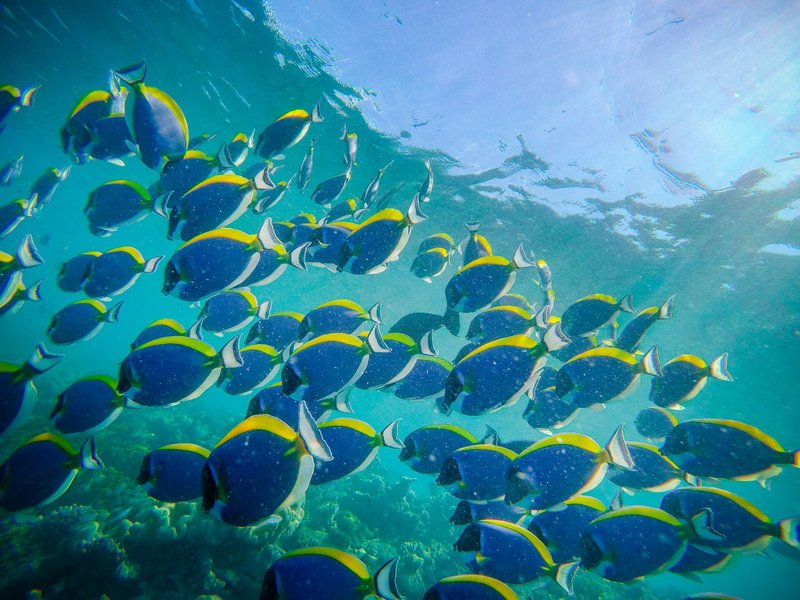
Most reef fish people think of as “scavengers” — moray eels, certain groupers — are really opportunistic predators that will also take carrion when it’s easy. But some of the more interesting scavenging on a reef comes from fish nobody expects: herbivores.
Researchers working in the Mexican Caribbean documented a group of ocean surgeonfish (Acanthurus chirurgus) — a species that spends most of its life grazing algae off rock and coral rubble — feeding directly on a tuna head. That’s not a one-off. Stomach-content studies on the same species have turned up crustacean fragments, soft coral tissue, and fish scales and eggs mixed in with the expected algae. Herbivorous fish run a demanding metabolism relative to what algae provides, and during growth periods their protein needs spike; when animal tissue becomes available, cheaply and without a fight, plenty of nominally herbivorous species will take it. Researchers also note that fish-feeding by divers and snorkelers — bait used to draw in marine life for photos — has likely made this kind of facultative scavenging more common than it used to be, simply by putting more free protein in the water.
The upshot: on a coral reef, the line between herbivore and scavenger is a lot blurrier than field guides suggest.
The Small Stuff: Isopods, Amphipods, and Polychaetes
The smallest scavengers do the most volume. Isopods, amphipods, and scavenging polychaete worms find and strip carcasses that bigger animals miss entirely — a dead fish, a dying giant clam, a crab that didn’t survive its last molt. These invertebrates converge in numbers researchers describe as “rapid scavenging,” clearing soft tissue from a carcass fast enough that studies of reef mortality sometimes struggle to find evidence a death even happened, because the evidence gets eaten within hours.
Amphipods in particular are generalists — some graze algae, some filter feed, and many switch to scavenging carrion whenever it turns up, functioning as opportunistic recyclers in whatever role the reef needs at the moment. Polychaete worms play a similar dual role: several reef species are predators or filter feeders most of the time but scavenge readily when carrion is available. None of these animals are charismatic. All of them are doing constant, unglamorous nutrient cycling that keeps organic matter moving through the reef food web instead of piling up.
Why Scavengers Matter More Than People Think
Coral reefs are nutrient-poor environments — famously, thriving reefs sit in some of the clearest, least nutrient-rich water in the ocean, which is part of why coral has such a tightly wound relationship with the algae living inside its tissue. In a system with almost no nutrient slack, scavengers are the recycling infrastructure. They take dead material — a fish carcass, decaying algae, sediment loaded with organic waste — and convert it back into a form other reef organisms can use, instead of letting it rot in place and feed bacterial blooms.
The sea cucumber research is the clearest evidence that this recycling function has a direct, measurable effect on coral survival, not just a vague “ecosystem services” effect. But the same logic runs through every scavenger on this list: hermit crabs and isopods strip decaying tissue before it becomes a bacterial hotspot, spiny lobsters and surgeonfish redirect carrion into the food web instead of letting it foul the water column. Remove enough of them, and a reef doesn’t just look messier. It gets sicker.
Wild Scavengers vs. Aquarium Clean-Up Crews
If your search led you here from an aquarium forum, it’s worth being clear about the difference. A “clean-up crew” is a hobbyist term for a curated set of species — usually hermit crabs, certain snails, and sometimes small shrimp — stocked deliberately in a home reef tank to manage algae and leftover food in a closed system with no natural nutrient cycle. It’s a useful concept, but it’s a small, artificial subset of what’s actually scavenging on a wild reef.
Wild reef scavengers include species no aquarium could support — spiny lobsters that range across open sand flats at night, sea cucumbers processing tons of sediment over a lifetime, facultative fish scavengers switching diets on the fly, and an entire invisible layer of isopods, amphipods, and worms doing carrion cleanup at a scale no tank replicates. The aquarium version borrows the concept. The reef version is what actually keeps a wild ecosystem functioning.
Next time you’re snorkeling over a reef flat and spot a hermit crab dragging its shell across the rubble, or a sea cucumber sitting motionless on the sand, you’re not looking at background scenery. You’re looking at the reef’s maintenance crew, doing the unglamorous work that keeps the coral around it alive.